Once you have the chain rule, you can differentiate any function that is built out of standard pieces, however tangled it looks. So we start there. Then we collect the derivatives of the inverse trigonometric, exponential and logarithmic functions, and learn three techniques for awkward cases: implicit, logarithmic and parametric differentiation.
The chain rule#
If y = f ( u ) y = f(u) y = f ( u ) u = g ( x ) u = g(x) u = g ( x ) d y d x = d y d u ⋅ d u d x \displaystyle \frac{dy}{dx} = \frac{dy}{du}\cdot\frac{du}{dx} d x d y = d u d y ⋅ d x d u
Example 1. d d x sin ( 3 x 2 + 1 ) = 6 x cos ( 3 x 2 + 1 ) \displaystyle \tfrac{d}{dx}\sin(3x^2 + 1) = 6x\cos(3x^2 + 1) d x d sin ( 3 x 2 + 1 ) = 6 x cos ( 3 x 2 + 1 ) d d x ( 2 x − 5 ) 7 = 14 ( 2 x − 5 ) 6 \displaystyle \tfrac{d}{dx}(2x - 5)^7 = 14(2x - 5)^6 d x d ( 2 x − 5 ) 7 = 14 ( 2 x − 5 ) 6 d d x cos x = − sin x 2 cos x \displaystyle \tfrac{d}{dx}\sqrt{\cos x} = -\tfrac{\sin x}{2\sqrt{\cos x}} d x d cos x = − 2 c o s x s i n x
Standard derivatives to know by heart#
Example 2. d d x e sin x = cos x e sin x \displaystyle \tfrac{d}{dx}e^{\sin x} = \cos x\, e^{\sin x} d x d e s i n x = cos x e s i n x d d x log ( x 2 + 4 ) = 2 x x 2 + 4 \displaystyle \tfrac{d}{dx}\log(x^2 + 4) = \tfrac{2x}{x^2 + 4} d x d log ( x 2 + 4 ) = x 2 + 4 2 x d d x tan − 1 ( 3 x ) = 3 1 + 9 x 2 \displaystyle \tfrac{d}{dx}\tan^{-1}(3x) = \tfrac{3}{1 + 9x^2} d x d tan − 1 ( 3 x ) = 1 + 9 x 2 3
Example 3. y = sin − 1 2 x 1 + x 2 \displaystyle y = \sin^{-1}\frac{2x}{1 + x^2} y = sin − 1 1 + x 2 2 x ∣ x ∣ < 1 \lvert x \rvert < 1 ∣ x ∣ < 1 x = tan θ x = \tan\theta x = tan θ y = 2 θ = 2 tan − 1 x y = 2\theta = 2\tan^{-1}x y = 2 θ = 2 tan − 1 x d y d x = 2 1 + x 2 \displaystyle \tfrac{dy}{dx} = \tfrac{2}{1 + x^2} d x d y = 1 + x 2 2
Implicit differentiation#
Sometimes the two variables are tangled up and one cannot be pulled out on its own. No problem: differentiate both sides with respect to x x x y y y x x x
Example 4. x 2 + x y + y 2 = 7 x^2 + xy + y^2 = 7 x 2 + x y + y 2 = 7 2 x + y + x y ′ + 2 y y ′ = 0 2x + y + x y' + 2y y' = 0 2 x + y + x y ′ + 2 y y ′ = 0 y ′ = − 2 x + y x + 2 y \displaystyle y' = -\frac{2x + y}{x + 2y} y ′ = − x + 2 y 2 x + y
Logarithmic differentiation#
When you face long products and quotients, or a variable raised to a variable power, take log \log log
Example 5. y = x x y = x^x y = x x log y = x log x \log y = x\log x log y = x log x y ′ y = log x + 1 \displaystyle \tfrac{y'}{y} = \log x + 1 y y ′ = log x + 1 y ′ = x x ( 1 + log x ) y' = x^x(1 + \log x) y ′ = x x ( 1 + log x )
Example 6. y = ( x + 1 ) 2 x − 2 ( x + 4 ) 3 \displaystyle y = \frac{(x + 1)^2\sqrt{x - 2}}{(x + 4)^3} y = ( x + 4 ) 3 ( x + 1 ) 2 x − 2 y ′ y = 2 x + 1 + 1 2 ( x − 2 ) − 3 x + 4 \displaystyle \tfrac{y'}{y} = \tfrac{2}{x + 1} + \tfrac{1}{2(x - 2)} - \tfrac{3}{x + 4} y y ′ = x + 1 2 + 2 ( x − 2 ) 1 − x + 4 3
When both coordinates are given in terms of a parameter, x = f ( t ) x = f(t) x = f ( t ) y = g ( t ) y = g(t) y = g ( t ) d y d x = d y / d t d x / d t \displaystyle \frac{dy}{dx} = \frac{dy/dt}{dx/dt} d x d y = d x / d t d y / d t
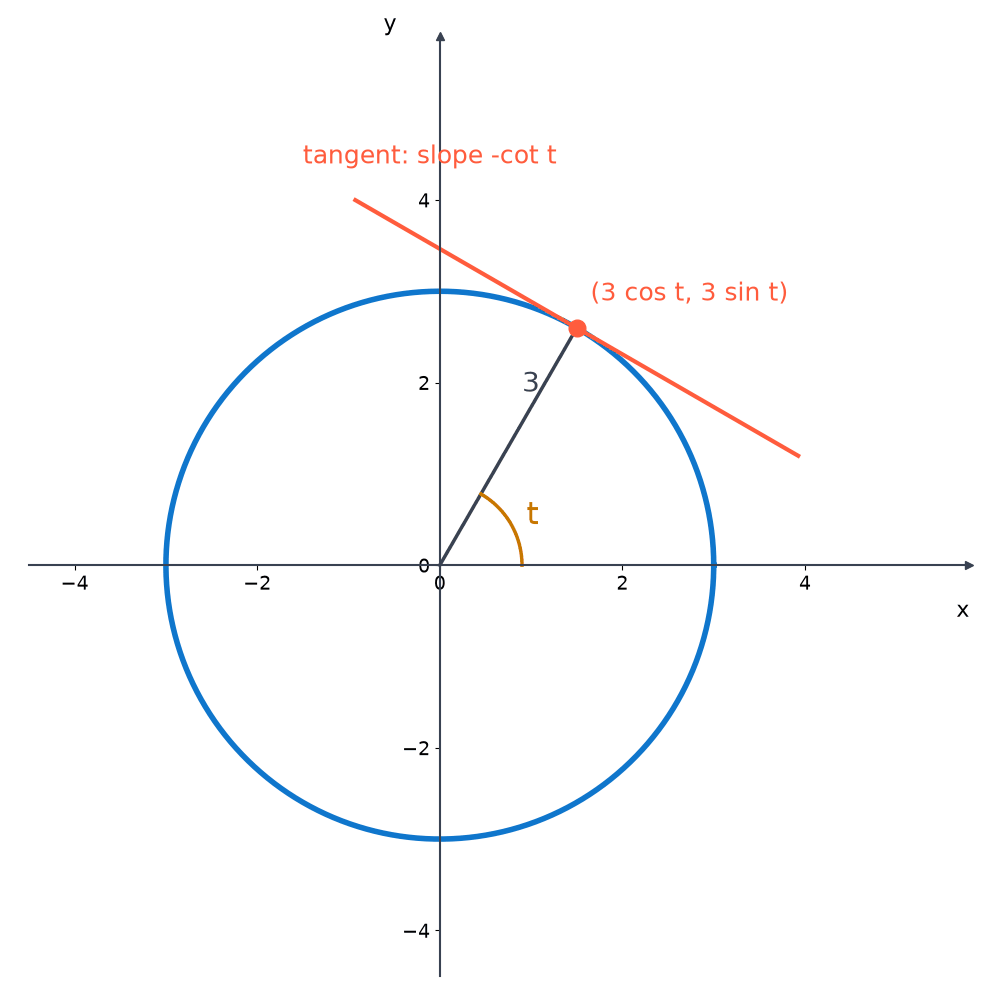
Example 7. x = 3 cos t x = 3\cos t x = 3 cos t y = 3 sin t y = 3\sin t y = 3 sin t d y d x = 3 cos t − 3 sin t = − cot t \displaystyle \tfrac{dy}{dx} = \tfrac{3\cos t}{-3\sin t} = -\cot t d x d y = − 3 s i n t 3 c o s t = − cot t
x = 3 cos t, y = 3 sin t traces a circle of radius 3; the tangent at parameter t has slope -cot t. Example 8. x = a t 2 x = at^2 x = a t 2 y = 2 a t y = 2at y = 2 a t d y d x = 2 a 2 a t = 1 t \displaystyle \tfrac{dy}{dx} = \tfrac{2a}{2at} = \tfrac{1}{t} d x d y = 2 a t 2 a = t 1
The second derivative d 2 y d x 2 \displaystyle \tfrac{d^2y}{dx^2} d x 2 d 2 y d y d x \displaystyle \tfrac{dy}{dx} d x d y y = A sin 2 x + B cos 2 x y = A\sin 2x + B\cos 2x y = A sin 2 x + B cos 2 x y ′ ′ = − 4 y y'' = -4y y ′′ = − 4 y y ′ ′ + 4 y = 0 y'' + 4y = 0 y ′′ + 4 y = 0
Try these yourself#
Differentiate: cos ( 5 x − 2 ) \cos(5x - 2) cos ( 5 x − 2 ) ( 3 x 2 − x + 1 ) 4 (3x^2 - x + 1)^4 ( 3 x 2 − x + 1 ) 4 sin 3 x \sin^3 x sin 3 x 1 + e 2 x \sqrt{1 + e^{2x}} 1 + e 2 x
Differentiate: e x 2 e^{x^2} e x 2 log ( sin x ) \log(\sin x) log ( sin x ) x 2 e x x^2 e^x x 2 e x log x x \displaystyle \frac{\log x}{x} x log x
Differentiate: sin − 1 ( 2 x ) \sin^{-1}(2x) sin − 1 ( 2 x ) tan − 1 ( e x ) \tan^{-1}(e^x) tan − 1 ( e x ) cos − 1 1 − x 2 1 + x 2 \displaystyle \cos^{-1}\frac{1 - x^2}{1 + x^2} cos − 1 1 + x 2 1 − x 2 0 < x < 1 0 < x < 1 0 < x < 1
Find d y d x \displaystyle \tfrac{dy}{dx} d x d y x 3 + y 3 = 6 x y x^3 + y^3 = 6xy x 3 + y 3 = 6 x y sin ( x y ) + y = x \sin(xy) + y = x sin ( x y ) + y = x
Find d y d x \displaystyle \tfrac{dy}{dx} d x d y y = ( sin x ) x y = (\sin x)^x y = ( sin x ) x y = x sin x y = x^{\sin x} y = x s i n x y = 2 x + x 2 y = 2^x + x^2 y = 2 x + x 2
Find d y d x \displaystyle \tfrac{dy}{dx} d x d y x = t 2 + 1 x = t^2 + 1 x = t 2 + 1 y = t 3 − t y = t^3 - t y = t 3 − t x = a ( θ − sin θ ) x = a(\theta - \sin\theta) x = a ( θ − sin θ ) y = a ( 1 − cos θ ) y = a(1 - \cos\theta) y = a ( 1 − cos θ )
Find d 2 y d x 2 \displaystyle \tfrac{d^2y}{dx^2} d x 2 d 2 y y = x 3 log x y = x^3 \log x y = x 3 log x y = e 3 x cos x y = e^{3x}\cos x y = e 3 x cos x
If y = e 2 x + e − 2 x y = e^{2x} + e^{-2x} y = e 2 x + e − 2 x y ′ ′ = 4 y y'' = 4y y ′′ = 4 y
If y = tan − 1 x y = \tan^{-1}x y = tan − 1 x ( 1 + x 2 ) y ′ ′ + 2 x y ′ = 0 (1 + x^2)y'' + 2xy' = 0 ( 1 + x 2 ) y ′′ + 2 x y ′ = 0
If e y ( x + 1 ) = 1 e^y(x + 1) = 1 e y ( x + 1 ) = 1 y ′ ′ = ( y ′ ) 2 y'' = (y')^2 y ′′ = ( y ′ ) 2
Answers to check against#
Show answers
− 5 sin ( 5 x − 2 ) -5\sin(5x - 2) − 5 sin ( 5 x − 2 ) 4 ( 3 x 2 − x + 1 ) 3 ( 6 x − 1 ) 4(3x^2 - x + 1)^3(6x - 1) 4 ( 3 x 2 − x + 1 ) 3 ( 6 x − 1 ) 3 sin 2 x cos x 3\sin^2 x\cos x 3 sin 2 x cos x e 2 x 1 + e 2 x \displaystyle \tfrac{e^{2x}}{\sqrt{1 + e^{2x}}} 1 + e 2 x e 2 x 2 x e x 2 2xe^{x^2} 2 x e x 2 cot x \cot x cot x e x ( x 2 + 2 x ) e^x(x^2 + 2x) e x ( x 2 + 2 x ) 1 − log x x 2 \displaystyle \tfrac{1 - \log x}{x^2} x 2 1 − l o g x 2 1 − 4 x 2 \displaystyle \tfrac{2}{\sqrt{1 - 4x^2}} 1 − 4 x 2 2 e x 1 + e 2 x \displaystyle \tfrac{e^x}{1 + e^{2x}} 1 + e 2 x e x x = tan θ x = \tan\theta x = tan θ 2 tan − 1 x 2\tan^{-1}x 2 tan − 1 x 2 1 + x 2 \displaystyle \tfrac{2}{1 + x^2} 1 + x 2 2 2 y − x 2 y 2 − 2 x \displaystyle \tfrac{2y - x^2}{y^2 - 2x} y 2 − 2 x 2 y − x 2 1 − y cos ( x y ) 1 + x cos ( x y ) \displaystyle \tfrac{1 - y\cos(xy)}{1 + x\cos(xy)} 1 + x c o s ( x y ) 1 − y c o s ( x y ) ( sin x ) x ( log sin x + x cot x ) (\sin x)^x(\log\sin x + x\cot x) ( sin x ) x ( log sin x + x cot x ) x sin x ( cos x log x + sin x x ) \displaystyle x^{\sin x}\left(\cos x\log x + \tfrac{\sin x}{x}\right) x s i n x ( cos x log x + x s i n x ) 2 x log 2 + 2 x 2^x\log 2 + 2x 2 x log 2 + 2 x 3 t 2 − 1 2 t \displaystyle \tfrac{3t^2 - 1}{2t} 2 t 3 t 2 − 1 sin θ 1 − cos θ = cot θ 2 \displaystyle \tfrac{\sin\theta}{1 - \cos\theta} = \cot\tfrac{\theta}{2} 1 − c o s θ s i n θ = cot 2 θ 6 x log x + 5 x 6x\log x + 5x 6 x log x + 5 x e 3 x ( 8 cos x − 6 sin x ) e^{3x}(8\cos x - 6\sin x) e 3 x ( 8 cos x − 6 sin x ) y ′ ′ = 4 e 2 x + 4 e − 2 x y'' = 4e^{2x} + 4e^{-2x} y ′′ = 4 e 2 x + 4 e − 2 x y ′ = 1 1 + x 2 \displaystyle y' = \tfrac{1}{1 + x^2} y ′ = 1 + x 2 1 y ′ ′ = − 2 x ( 1 + x 2 ) 2 \displaystyle y'' = -\tfrac{2x}{(1 + x^2)^2} y ′′ = − ( 1 + x 2 ) 2 2 x y = − log ( x + 1 ) y = -\log(x + 1) y = − log ( x + 1 ) y ′ = − 1 x + 1 \displaystyle y' = -\tfrac{1}{x + 1} y ′ = − x + 1 1 y ′ ′ = 1 ( x + 1 ) 2 \displaystyle y'' = \tfrac{1}{(x + 1)^2} y ′′ = ( x + 1 ) 2 1