Before you start#
Twelve questions from across the chapter. For continuity questions, always check three things side by side: the left limit, the right limit and the value. For derivatives, say to yourself which rule you are using before you start writing. It stops a lot of careless slips.
The questions#
Find k k k f ( x ) = { k x 2 , x ≤ 2 3 , x > 2 f(x) = \begin{cases} kx^2, & x \le 2 \\ 3, & x > 2 \end{cases} f ( x ) = { k x 2 , 3 , x ≤ 2 x > 2 2 2 2
Discuss the continuity of f ( x ) = ∣ x ∣ − ∣ x + 1 ∣ f(x) = \lvert x \rvert - \lvert x + 1 \rvert f ( x ) = ∣ x ∣ − ∣ x + 1 ∣
Find the points of discontinuity of f ( x ) = x 2 + 1 x 2 − 5 x + 6 \displaystyle f(x) = \frac{x^2 + 1}{x^2 - 5x + 6} f ( x ) = x 2 − 5 x + 6 x 2 + 1
Differentiate sin ( cos ( x 2 ) ) \sin(\cos(x^2)) sin ( cos ( x 2 ))
Differentiate sec − 1 1 2 x 2 − 1 \displaystyle \sec^{-1}\frac{1}{2x^2 - 1} sec − 1 2 x 2 − 1 1 0 < x < 1 2 \displaystyle 0 < x < \tfrac{1}{\sqrt{2}} 0 < x < 2 1
Find d y d x \displaystyle \tfrac{dy}{dx} d x d y y x = x y y^x = x^y y x = x y
Find d y d x \displaystyle \tfrac{dy}{dx} d x d y x = cos θ + θ sin θ x = \cos\theta + \theta\sin\theta x = cos θ + θ sin θ y = sin θ − θ cos θ y = \sin\theta - \theta\cos\theta y = sin θ − θ cos θ
Differentiate ( log x ) cos x (\log x)^{\cos x} ( log x ) c o s x
If y = 3 cos ( log x ) + 4 sin ( log x ) y = 3\cos(\log x) + 4\sin(\log x) y = 3 cos ( log x ) + 4 sin ( log x ) x 2 y ′ ′ + x y ′ + y = 0 x^2 y'' + x y' + y = 0 x 2 y ′′ + x y ′ + y = 0
If 1 − x 2 + 1 − y 2 = a ( x − y ) \sqrt{1 - x^2} + \sqrt{1 - y^2} = a(x - y) 1 − x 2 + 1 − y 2 = a ( x − y ) d y d x = 1 − y 2 1 − x 2 \displaystyle \tfrac{dy}{dx} = \sqrt{\tfrac{1 - y^2}{1 - x^2}} d x d y = 1 − x 2 1 − y 2 x = sin A x = \sin A x = sin A y = sin B y = \sin B y = sin B
Differentiate x x 2 − 3 + ( x − 3 ) x 2 x^{x^2 - 3} + (x - 3)^{x^2} x x 2 − 3 + ( x − 3 ) x 2 x > 3 x > 3 x > 3
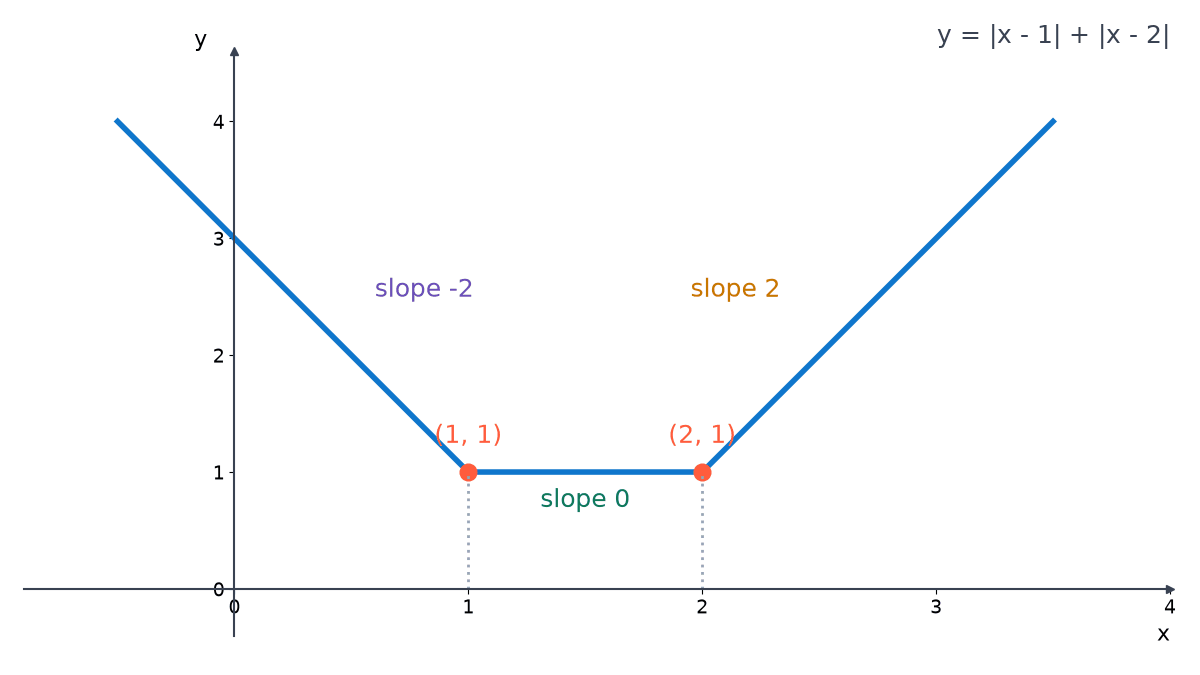
Show that f ( x ) = ∣ x − 1 ∣ + ∣ x − 2 ∣ f(x) = \lvert x - 1 \rvert + \lvert x - 2 \rvert f ( x ) = ∣ x − 1 ∣ + ∣ x − 2 ∣ 1 1 1 2 2 2
Answers to check against#
Show answers
4 k = 3 4k = 3 4 k = 3 k = 3 4 \displaystyle k = \tfrac{3}{4} k = 4 3 It is continuous everywhere, being the difference of two continuous functions.
x = 2 x = 2 x = 2 x = 3 x = 3 x = 3 − 2 x sin ( x 2 ) cos ( cos ( x 2 ) ) -2x\sin(x^2)\cos(\cos(x^2)) − 2 x sin ( x 2 ) cos ( cos ( x 2 )) Put x = cos θ x = \cos\theta x = cos θ 1 cos 2 θ \displaystyle \tfrac{1}{\cos 2\theta} c o s 2 θ 1 y = 2 θ = 2 cos − 1 x y = 2\theta = 2\cos^{-1}x y = 2 θ = 2 cos − 1 x y ′ = − 2 1 − x 2 \displaystyle y' = -\tfrac{2}{\sqrt{1 - x^2}} y ′ = − 1 − x 2 2
x log y = y log x x\log y = y\log x x log y = y log x y ′ = y x − log y x y − log x \displaystyle y' = \frac{\frac{y}{x} - \log y}{\frac{x}{y} - \log x} y ′ = y x − log x x y − log y d x d θ = θ cos θ \displaystyle \tfrac{dx}{d\theta} = \theta\cos\theta d θ d x = θ cos θ d y d θ = θ sin θ \displaystyle \tfrac{dy}{d\theta} = \theta\sin\theta d θ d y = θ sin θ tan θ \tan\theta tan θ ( log x ) cos x ( cos x x log x − sin x log ( log x ) ) \displaystyle (\log x)^{\cos x}\left(\tfrac{\cos x}{x\log x} - \sin x\log(\log x)\right) ( log x ) c o s x ( x l o g x c o s x − sin x log ( log x ) ) x y ′ = − 3 sin ( log x ) + 4 cos ( log x ) xy' = -3\sin(\log x) + 4\cos(\log x) x y ′ = − 3 sin ( log x ) + 4 cos ( log x ) x y ′ ′ + y ′ = − y x \displaystyle xy'' + y' = -\tfrac{y}{x} x y ′′ + y ′ = − x y cos A + cos B = a ( sin A − sin B ) \cos A + \cos B = a(\sin A - \sin B) cos A + cos B = a ( sin A − sin B ) cot A − B 2 = a \displaystyle \cot\tfrac{A - B}{2} = a cot 2 A − B = a A − B A - B A − B sin − 1 x − sin − 1 y = c \sin^{-1}x - \sin^{-1}y = c sin − 1 x − sin − 1 y = c x x 2 − 3 ( x 2 − 3 x + 2 x log x ) + ( x − 3 ) x 2 ( x 2 x − 3 + 2 x log ( x − 3 ) ) \displaystyle x^{x^2 - 3}\left(\tfrac{x^2 - 3}{x} + 2x\log x\right) + (x - 3)^{x^2}\left(\tfrac{x^2}{x - 3} + 2x\log(x - 3)\right) x x 2 − 3 ( x x 2 − 3 + 2 x log x ) + ( x − 3 ) x 2 ( x − 3 x 2 + 2 x log ( x − 3 ) ) It is a sum of continuous functions. At 1 1 1 − 2 -2 − 2 0 0 0 2 2 2 0 0 0 2 2 2
Question 12: the graph is unbroken, with corners at x = 1 and x = 2.