Why three numbers?
Suppose a fly is buzzing around your classroom and you want to say exactly where it is. Two numbers are not enough. You need three: how far it is from two of the walls, and how high it is above the floor. That is all three-dimensional geometry really asks of you. We will set up axes in space, give names to the eight octants, stretch the distance formula into three dimensions, and end with practice on the chapter.
Axes, planes and octants
Draw three mutually perpendicular lines , , through the origin ; these are the coordinate axes. Taken two at a time, they give three coordinate planes: the -plane (), the -plane () and the -plane (), and these planes cut space into eight octants.
A point has coordinates , which are simply its signed perpendicular distances from the -, - and -planes. So a point on the -axis looks like , and a point on the -plane looks like .
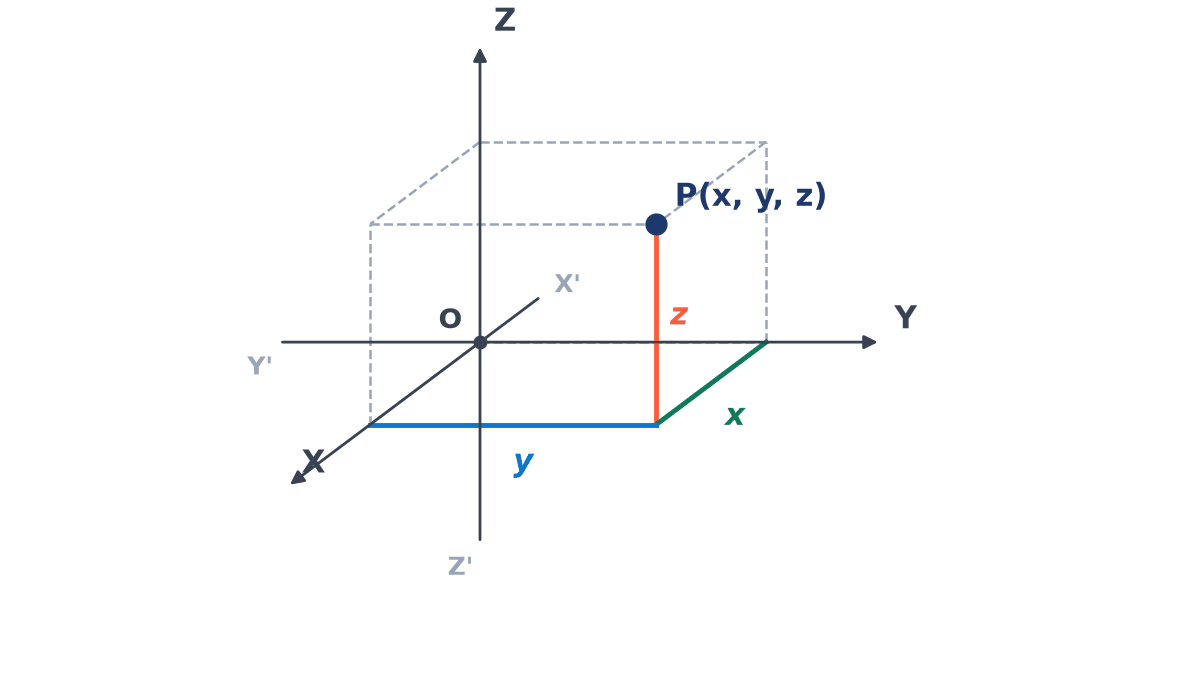
| Octant | I | II | III | IV | V | VI | VII | VIII |
|---|---|---|---|---|---|---|---|---|
Example 1. is in octant IV, is in VII, and lies in the -plane.
Distance between two points
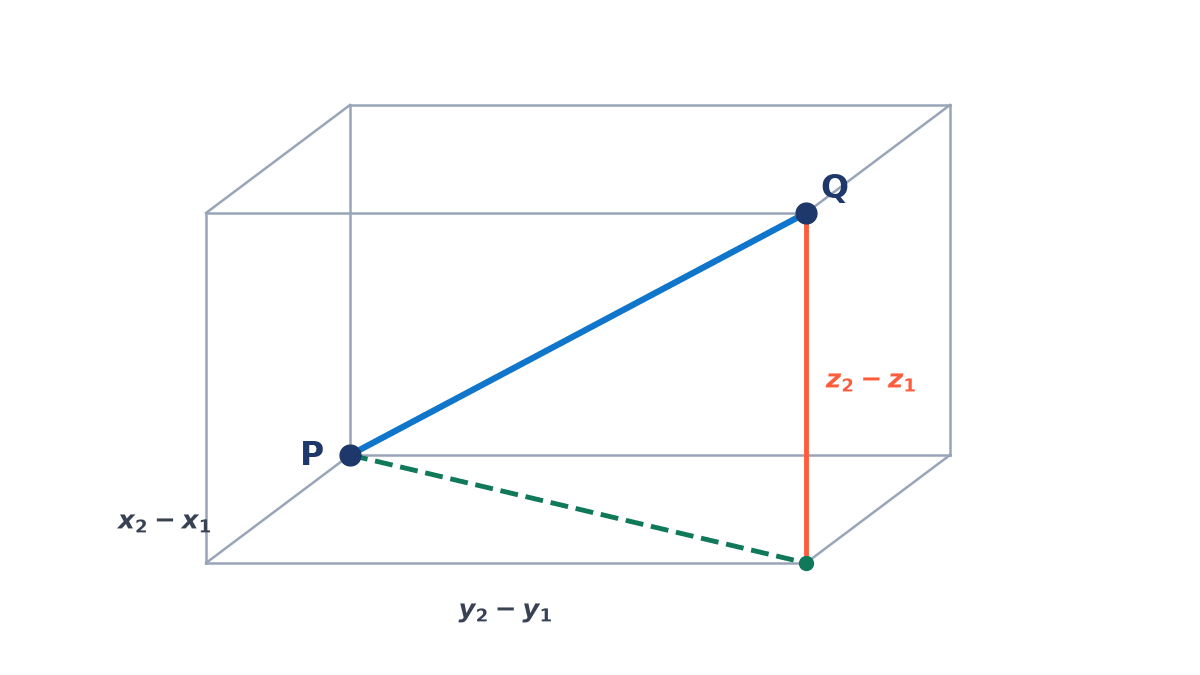
This is nothing more than Pythagoras used twice: once across the floor, and once going straight up. From the origin it becomes .
Example 2. , : .
Example 3. , , : , , . Two sides are equal, and since , the triangle is right-angled isosceles.
Example 4. , , : , , and . The points must lie on one line, so they are collinear.
Example 5. Which points are equidistant from and ? Setting the distances equal, gives . That is a plane, the perpendicular bisector of .
Example 6. The set of points whose distances from and add to is .
Try these yourself
- Name the octant of each point: ; ; ; .
- What are the coordinates of a point on the -axis? In the -plane?
- Find the distance between and ; between and .
- Show that , and are collinear.
- Show that , and form an equilateral triangle.
- Show that , , and form a parallelogram.
- Find the point on the -axis equidistant from and .
- Find the equation of the set of points equidistant from and .
- Find the locus of points whose distance from the origin is .
- A box sits in the first octant with one corner at the origin and edges , and along the axes. What is the length of the longest rod you can fit inside?
Answers to check against
Show answers
- II; VIII; III; V.
- ; .
- ; .
- The distances are , , , and the two smaller ones add up to the largest.
- Each side is .
- Every side is , so opposite sides are equal; it is in fact a rhombus, and the diagonals bisect each other at .
- gives , : .
- .
- It is the sphere .
- .