In the last lesson we got rid of negative signs by taking absolute values. There is a neater way: square the deviations. Average those squares and you have the variance; take its square root and you have the standard deviation, the measure of spread you will meet most often. We will compute both for raw data, frequency tables and grouped data, learn a short-cut that keeps the arithmetic small, use the coefficient of variation to decide which of two series is more consistent, and finish with mixed practice.
When the data come with frequencies, σ2=N1∑fi(xi−xˉ)2=N1∑fixi2−xˉ2.
The short-cut (step-deviation) method. Choose a convenient A and let yi=hxi−A with class width h. Then xˉ=A+hyˉ and σx=hσy. Two facts make this work. Shifting every value by the same constant leaves σ unchanged, and multiplying every value by k multiplies σ by ∣k∣.
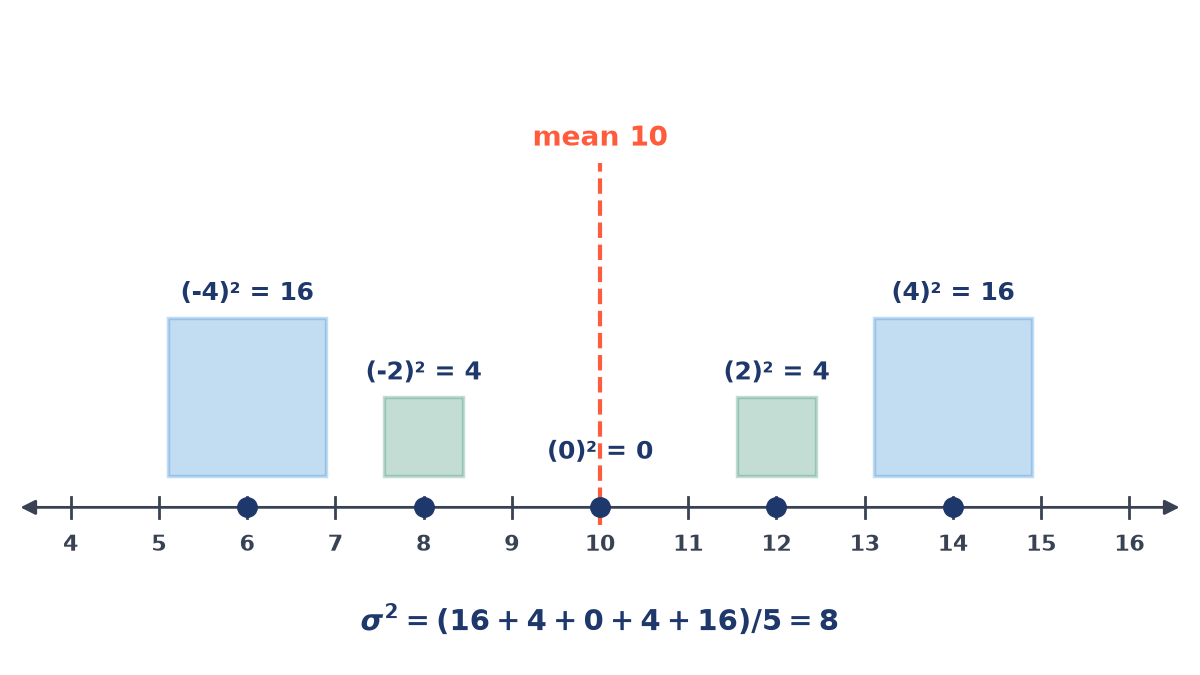
Example 1. Data 6,8,10,12,14: xˉ=10, the squared deviations are 16,4,0,4,16, and so σ2=8, σ=22.
Example 1: the squared deviations average to a variance of 8
Example 2. Take the first 10 natural numbers. Here xˉ=5.5, 101∑x2=38.5, σ2=38.5−30.25=8.25. In general, for 1,…,n you get σ2=12n2−1.
Example 3.
Class
0–10
10–20
20–30
30–40
40–50
f
4
6
10
6
4
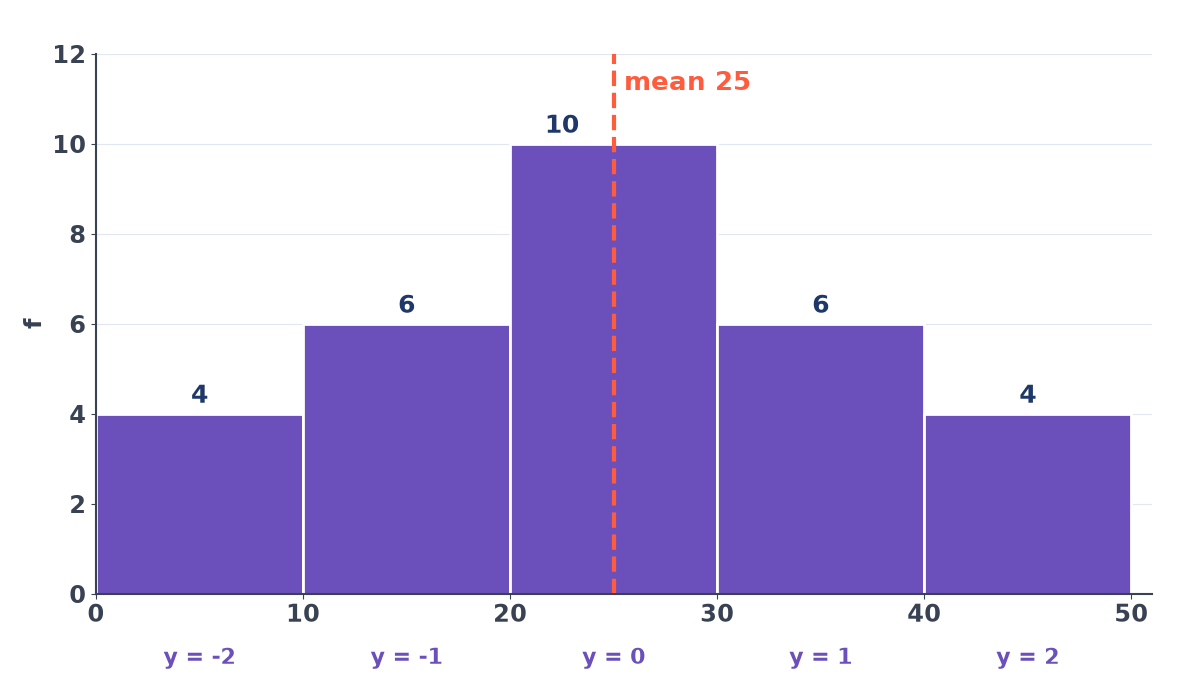
The midpoints run 5–45. Taking A=25 and h=10 gives y=−2,−1,0,1,2. N=30, ∑fy=0, ∑fy2=16+6+0+6+16=44. xˉ=25, σy2=3044, σx=101522≈12.11.
Example 3: the grouped data, symmetric about the mean 25
The coefficient of variationCV=xˉσ×100 measures spread relative to the size of the values. Whichever series has the smaller CV is the more consistent one.
Example 4. Two batsmen: A averages 48 runs with σ=12; B averages 40 with σ=8. Their CVs are A 25% and B 20%. So B is the more consistent batsman, even though A scores more.
Example 5. Five observations have mean 6 and variance 8; three of them are 2,6,8. The other two, a and b, satisfy a+b=30−16=14 and a2+b2=5(8+36)−(4+36+64)=116, so ab=2196−116=40: a,b=4,10.
Correcting a mistake. Suppose a wrong value w was recorded in place of the right value r in data of size n. Do not start again from scratch. Instead, correct ∑x=∑x−w+r and correct ∑x2=∑x2−w2+r2, and then recompute.
Find the variance of the first n even natural numbers.
Find the mean and standard deviation:
xi
4
8
11
17
20
24
32
fi
3
5
9
5
4
3
1
Find the mean and standard deviation by the short-cut method:
Class
30–40
40–50
50–60
60–70
70–80
80–90
90–100
f
3
7
12
15
8
3
2
Two plants' daily output: plant P mean 63, σ=9; plant Q mean 54, σ=7.2. Which is more consistent?
The mean and standard deviation of 25 observations are 12 and 3. One observation was recorded as 9 instead of 14. Find the correct mean and standard deviation.
If each observation is multiplied by 3 and then increased by 5, how do the mean and standard deviation change?
The mean and variance of 7 observations are 8 and 16. Five of them are 2,4,10,12,14. Find the other two.
Show that the variance of a set of equal numbers is 0, and conversely.
Compute the mean deviation about the mean and the standard deviation of 3,5,7,9,11. Which is larger?