Life is full of limits
Your pocket money is a budget. The road has a speed limit. An exam has a pass mark. In real life, conditions are far more often "at most" or "at least" than "exactly equal". That is what inequalities describe. The good news is that solving a linear inequality is almost the same as solving an equation. There is just one rule that is different, and we will keep a close eye on it. We will also learn to show the answers on a number line.
The rules
An inequality keeps its direction when you add or subtract the same number on both sides, and when you multiply or divide both sides by a positive number. Here is the one that trips people up: multiplying or dividing by a negative number reverses the sign. For example, gives . Check it with a number if you doubt it; the rule is not arbitrary.
Solving
Example 1. Solve . Collecting terms, , so . The answer also depends on which numbers are allowed. For the solution is ; for it is .
Example 2. Solve . Clear the fractions by multiplying by : . Then , and flipping the sign as we multiply through by minus one, . The solution is .
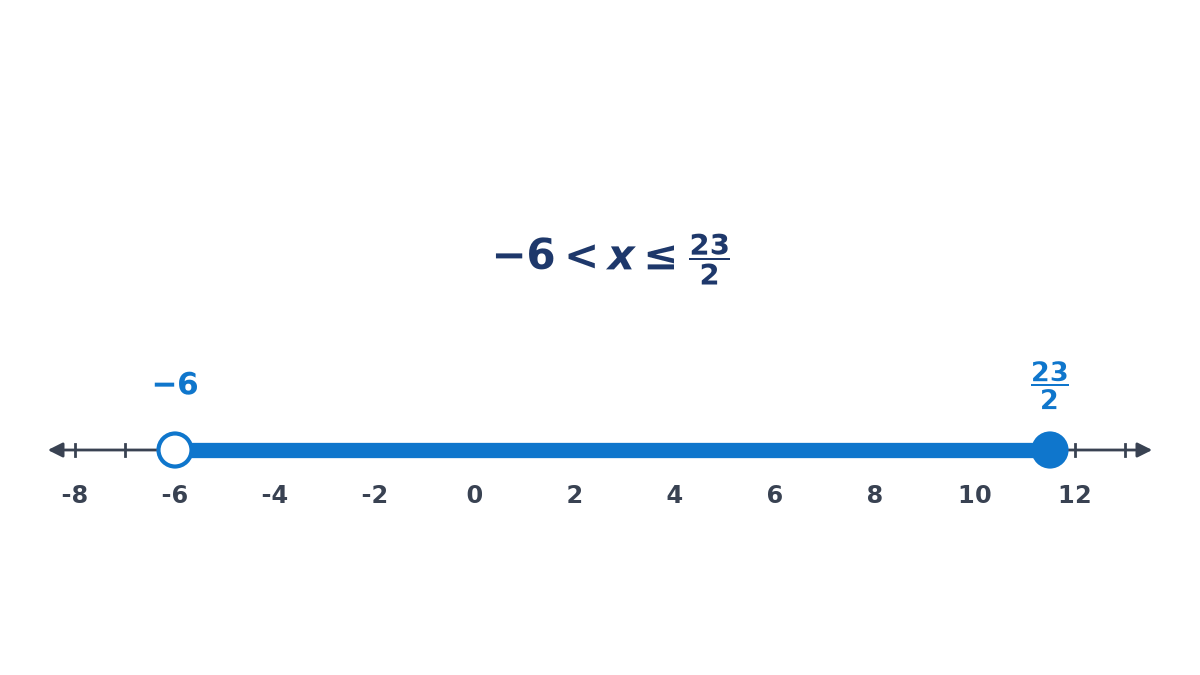
Example 3. A double inequality is handled on all three parts at once. Take . Multiply by : . Subtract : . Now divide by , remembering to reverse both signs: . The solution is .
Example 4. Sometimes the variable disappears altogether. Then look at what is left. reduces to , which is false, so there is no solution. reduces to , which is always true, so every real works.
On the number line
A picture makes the answer clear at a glance. Put an open circle at an endpoint that is left out ( or ), a filled circle at one that is included ( or ), and shade the solution. When there are two inequalities in one variable to satisfy together, solve each one and keep only the part where the two shadings overlap.
Example 5. From and we get and . Together, that is .
![Three number lines from 0 to 7: the first shades x greater than 2 with an open circle at 2, the second shades x at most 4 with a filled dot at 4, the third shows their overlap (2, 4].](/storage/courses/lessons/lesson-331-system-x-greater-2-and-x-at-most-4.png)
Word problems
Example 6. A student has marks of and in two tests, and needs an average of at least over three. The three marks must total at least three times that, so we need , which gives .
Example 7. Two consecutive odd natural numbers are each greater than , and their sum is less than . If the smaller one is the unknown, then and give with odd, so the pairs are .
Example 8. A solution in a laboratory must be kept between C and C. Using on both ends, the range is degrees Fahrenheit.
Practice questions
- Solve for : ; ; .
- Solve for : .
- Solve and draw: .
- Solve the system: and .
- Solve: .
- A student scored , and . What must the fourth score be for an average of at least ?
- Find all pairs of consecutive multiples of , both greater than , whose sum is less than .
- In a triangle, one side is twice the shortest and the third side is cm longer than the shortest. The perimeter is at most cm. Find the greatest possible length of the shortest side.
- How many litres of water must be added to L of a salt solution so that the result is between and salt?
- Explain why means , and solve .
Answers
Show answers
- ; ; multiply by : , i.e. , .
- : .
- : .
- and : .
- Multiply by : ; ; .
- : .
- . The smaller one must satisfy and .
- : cm.
- Salt L; : L.
- is the distance from , so it is less than three exactly on that stretch. Then gives .