From a point to a region
An equation like a straight line is satisfied by points on a line. An inequality in two variables, such as , is satisfied by a whole region of the plane: everything on one side of a line. Such regions are how we picture real limits, like a fixed budget, as you will see in an example. We will graph such inequalities, use a test point to decide which side to shade, and find the region common to a system of inequalities. A mixed practice set on the whole chapter rounds things off.
One inequality in two variables
The line cuts the plane into two half-planes. Every point on one side satisfies , and every point on the other side satisfies . There is no mixing.
Method. First draw the line. Make it dashed for or , since the line itself is not included, and solid for or , since it is. Then test any point not on the line; is usually easiest. If it satisfies the inequality, shade its side. If not, shade the other side. Because of the no-mixing fact above, one test point is enough.
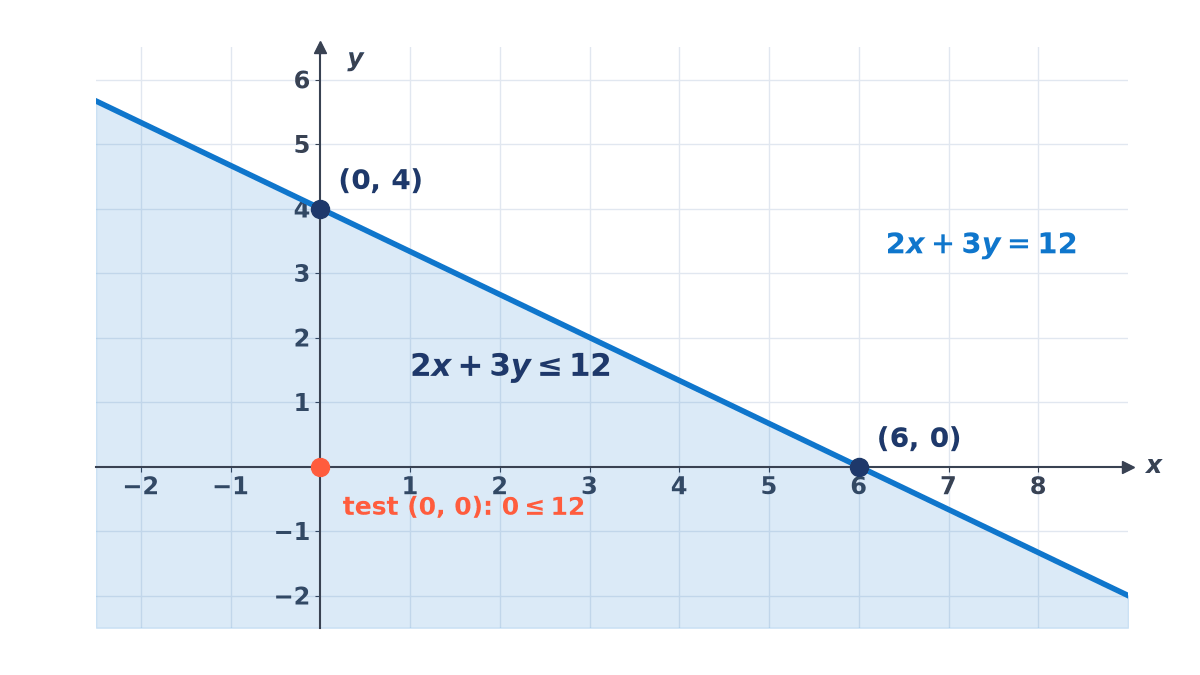
Example 1. For , draw a solid line through and . Testing gives , which is true, so shade the side containing the origin.
Example 2. For , the line through and is dashed. Testing gives , true, so shade above the line.
Example 3. Some lines are parallel to an axis. For , draw a solid vertical line and shade to its right. For , draw a dashed horizontal line and shade below it.
Example 4. A shopkeeper can spend at most ₹ on pens at ₹ each and notebooks at ₹ each. So , with and because you cannot buy a negative number of anything. The region is a triangle in the first quadrant with vertices .
Systems
With several inequalities, the solution is the region that every one of them shades. A practical tip: shade each one lightly, or better, mark the side each one rules out, so the common region stands out clearly at the end.
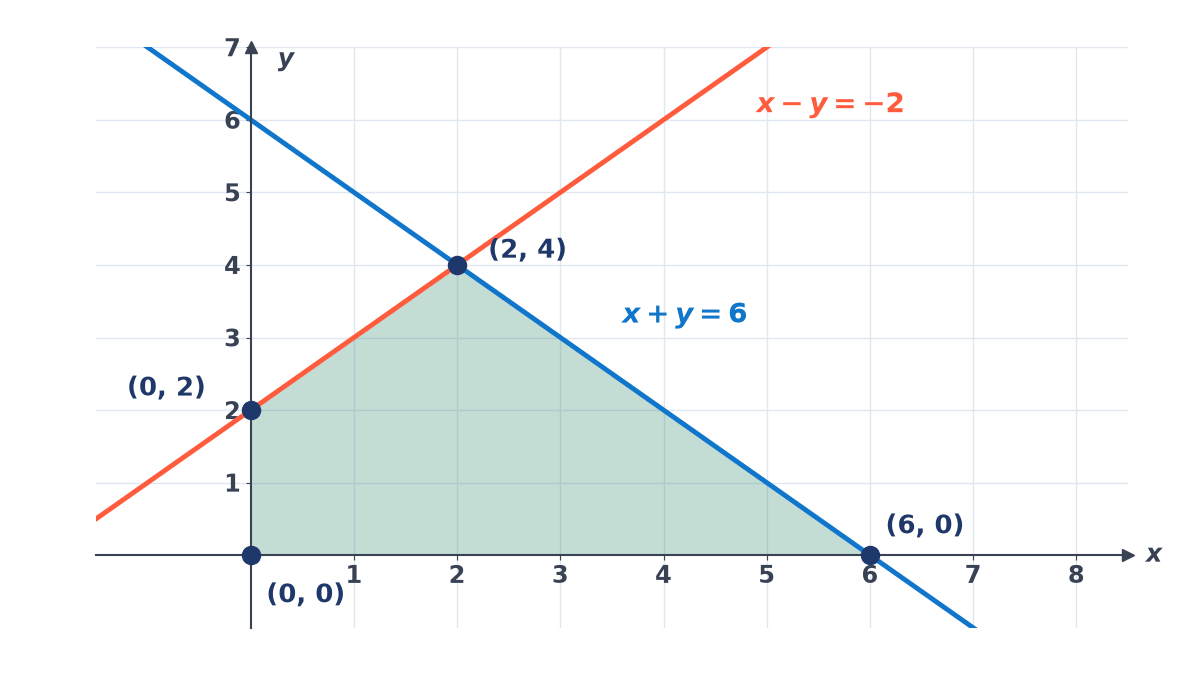
Example 5. Take , , , . The lines and meet at , and the region is the quadrilateral with vertices .
Example 6. A system can also have no solution. For and the two lines are parallel, and the half-planes point away from each other, so they never meet.
Mixed practice
- Solve for real : .
- Solve: .
- Solve the system , .
- Graph: ; ; .
- Graph the system , , , and list its corner points.
- Graph the system , , , .
- Show that and have no common solution.
- A company makes chairs ( h of labour each) and tables ( h each), with at most labour hours. Write the inequality and graph it for .
- IQ . For -year-olds the IQ ranges over . Find the range of mental age .
- Find all real satisfying both and .
Answers
Show answers
- Multiply by : ; ; .
- : .
- and , : .
- Solid line through , shade away from origin; dashed through , shade towards origin; solid , shade below.
- Corners .
- Unbounded region; lines meet and at , but cuts it: corners , and , where meets the -axis, extending upward.
- The second says , contradicting .
- : triangle with vertices .
- : .
- and : .