Gaps in a crowded line
The rationals are dense, and yet, strangely, they still leave gaps. The diagonal of a square of side one is a length that no fraction can name. We will prove this, and then draw such a length on the number line. After a short visit to , we turn to decimals. Which rationals give terminating decimals? Why do the rest repeat? How do you turn a repeating decimal back into a fraction? And how does the decimal of an irrational number look different from both?
A length with no fraction
A square of side has a diagonal with , by the Baudhāyana–Pythagoras theorem. So . Baudhāyana met lengths like this around 800 BCE while laying out altars, and the Greeks came across them a few centuries later.
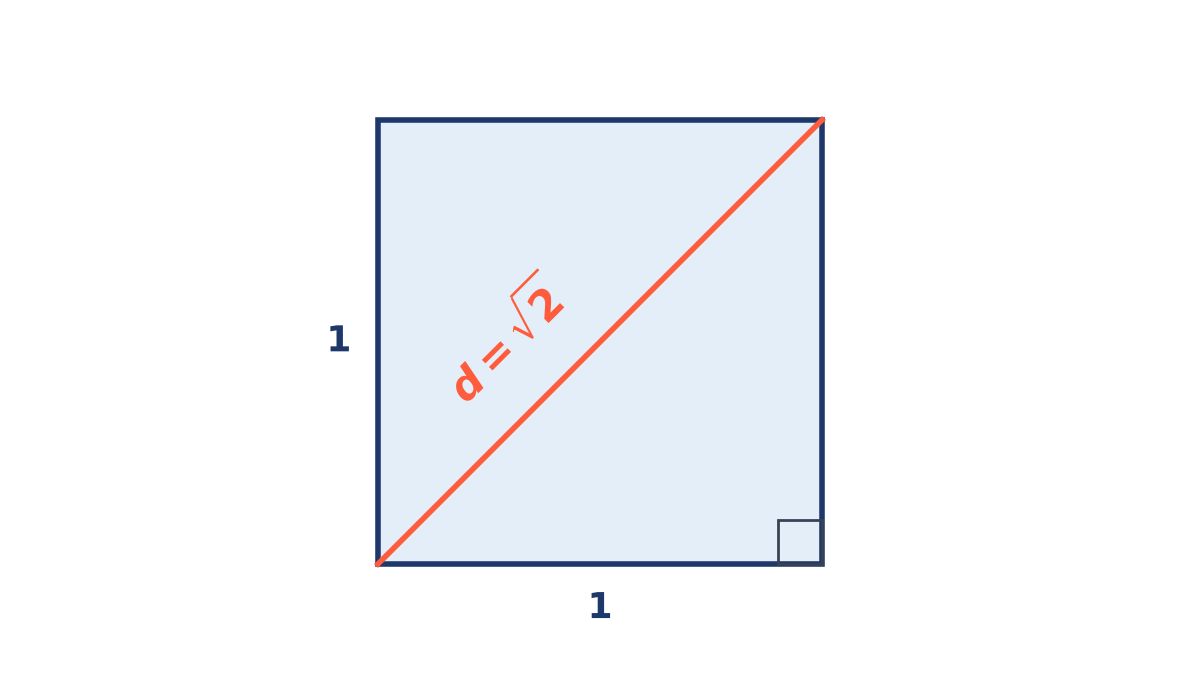
Numbers on the line that are not ratios of integers are called irrational. is one of them. The proof uses contradiction, a lovely method: you assume the opposite, and then watch it fall apart.
Claim. is not rational.
Suppose it is. Then in lowest terms, which means and have no common factor.
Squaring both sides, , so .
That makes even. Since an odd number squared is always odd, itself must be even, say .
Put this back in: , so . Now is even, so is even too.
But look what has happened. and are both even, so both are divisible by . That goes against "no common factor". Our assumption must have been false, and so is irrational.
The same argument with in place of shows that is irrational. The same is true of , , and indeed for any that is not a perfect square.
Drawing on the number line
You can actually draw this number. Mark at and at . At , draw a perpendicular and mark on it so that . Then . Put the compass point at , open it to , and swing an arc down to the line. It lands exactly at .
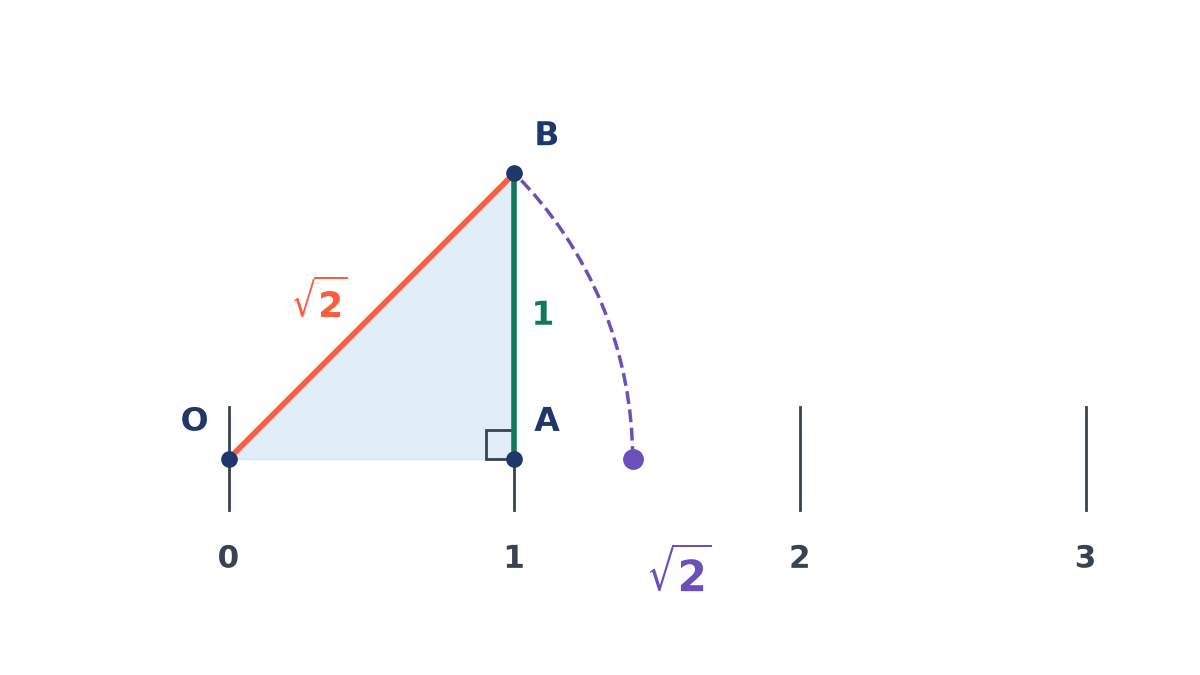
Now repeat from that point with another unit perpendicular, and you get . Keep going for , then , and so on. The result is a beautiful spiral of right triangles that gives you every .

The ratio of a circle's circumference to its diameter is . Āryabhaṭa gave , and he was careful to call it an approximation, not the exact value. He was right to be careful. is irrational (Lambert proved this in 1761), so no fraction is exact. In the fourteenth century, Mādhava of Saṅgamagrāma found an exact expression that uses infinitely many terms.
The more terms you add, the closer you get, and the value you are closing in on is .
Real numbers
Put the rationals and irrationals together and they fill the whole line, with no gaps left. This complete set is called the real numbers, .
Decimals of rational numbers
When you divide by , one of just two things can happen.
It terminates. . Here the remainder reaches and the division stops.
It repeats. . Here the remainder never reaches . But there are only possible nonzero remainders, so sooner or later one of them must come back, and from then on the digits go round in a cycle.
Here is the nice part: you can predict which will happen without dividing at all. Write in lowest terms and factorise . If has no prime factors other than and , the decimal terminates, because the denominator can be scaled up to a power of . For example, . Any other prime in makes it repeat. Take . Here , and that factor of three makes it repeat: .
From repeating decimal back to fraction
Pure repeating decimals, where the block starts right after the point, are the easier kind. Call the number , multiply by where is the length of the block, and subtract.
Example 1. . . Subtract: , .
Example 2. . . , .
Mixed decimals have some digits before the block starts. First shift the non-repeating digits past the point, then shift one full block more, and subtract.
Example 3. . There is one non-repeating digit, so . The block has one digit, so . Subtracting, , .
Example 4. . ; . Subtract: , .
Example 5. Here is one that surprises everybody: why is ? Let . Then , so and . Not approximately, but exactly. In fact every terminating decimal has a twin ending in repeating nines, such as .
A cyclic curiosity
. Try multiplying the block by . You get , , , and . They are the same six digits every time, just rotated. Repeating blocks like this are called cyclic numbers.
Decimals of irrational numbers
These neither terminate nor repeat, as in and . Be careful, though: a decimal can follow a pattern and still be irrational, as long as the pattern never settles into a fixed block. In the runs of zeros keep getting longer, so no block ever repeats.
Practice
- Without dividing, say which terminate: , , , . Then find the decimals.
- Write as fractions in lowest terms: (a) ; (b) ; (c) ; (d) .
- Classify as rational or irrational: (a) ; (b) ; (c) ; (d) ; (e) ; (f) .
- Prove that is irrational, following the steps used for . (Use: if is a multiple of , so is .)
- Describe how to mark on the number line using a right triangle with legs and .
- Find the decimal expansions of and . What do you notice about the repeating blocks?
- Is equal to ? Explain in one sentence.
Answers
Show answers
- : terminates, . has a : repeats, . : terminates, . has a : repeats, .
- (a) . (b) . (c) , , : . (d) , , : .
- (a) Rational, . (b) Irrational ( is not a perfect square). (c) Rational, . (d) Irrational: the runs of s grow, so no block repeats. (e) Rational. (f) Irrational.
- Suppose in lowest terms. Then , so and hence is a multiple of : . Then , , so is a multiple of . Both share the factor : contradiction.
- From mark on the line; at raise a perpendicular of length ; the hypotenuse from is ; swing it down to the line with a compass.
- ; . Both blocks have six digits; the second is not a rotation of the first, so 's block is not cyclic in the way 's is, though is a rotation of the first block.
- No: is rational and repeats, while is irrational; they agree only to two decimal places.