How to use this set
Here are fourteen questions from across the chapter. Use unless a question tells you otherwise. In every area question, write down which formula you are using and why the figure is allowed to use it. This matters most with Brahmagupta: say why the quadrilateral is cyclic before you reach for his formula.
Section A, Perimeter and arcs
- A circular pond has circumference m. Find its diameter.
- Find the arc length and the perimeter of a sector of radius cm and angle .
- A running track has straights of m and semicircular ends of inner radius m. Lanes are m wide. Measuring along the inner edge of each lane, how much longer is one lap in the second lane than in the first?
- A shape is made of a square of side cm with a semicircle cut away from one side and an identical semicircle attached to the opposite side. Find its perimeter.
- Two circles of radius cm each pass through the other's centre. Find the perimeter of their combined outline (using ).
Section B, Areas
- A parallelogram has base cm and height cm. Find its area.
- A triangle has sides , , . Find its area.
- A triangle has sides cm and cm and perimeter cm. Find its area.
- The sides of a triangular garden are in the ratio and its perimeter is m. Find its area.
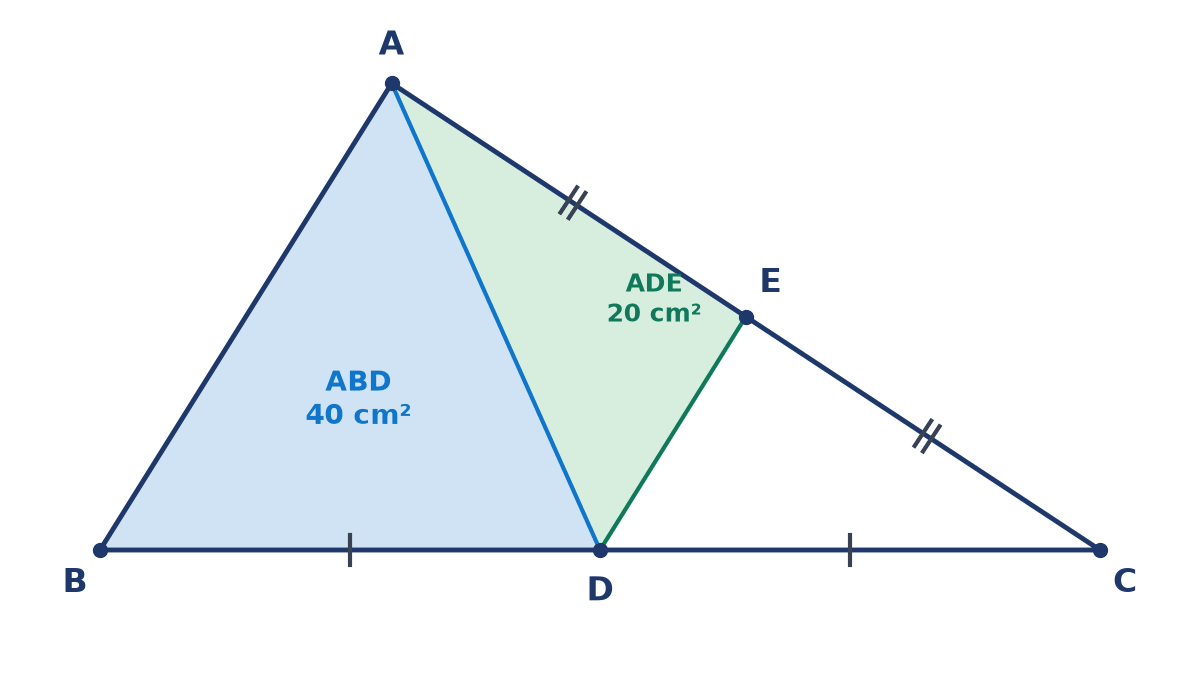
- In triangle , is the midpoint of and is the midpoint of . If the area of is cm², find the areas of , and .
- A trapezium has parallel sides cm and cm and equal non-parallel sides of cm each. Find its area.
- A cyclic quadrilateral has sides . Find its area.
Section C, Reasoning
- A rectangle is cm by cm. Find the side of the square of equal area, and check it with the identity .
- Explain in your own words why Heron's formula can be read as a special case of Brahmagupta's.
Answers
Show answers
- , m.
- Arc cm. Perimeter cm.
- The straights are equal. The curves make a full circle of radius in lane one and in lane two: difference m.
- Two straight sides cm plus two semicircles of radius , together one circumference cm. Total cm.
- Each circle contributes of its circumference: cm.
- cm².
- : right-angled, area .
- Third side ; : cm².
- Sides ; : m².
- (median ). ( is a median of triangle , which has area ). ( is a median of triangle ; that triangle has area since is a median of ).
- Height: the overhang on each side is , so . Area cm². (Brahmagupta with : ✓, since an isosceles trapezium is cyclic.)
- : .
- Area , side . ✓.
- Setting one side turns a cyclic quadrilateral into a triangle (two vertices coincide) and turns into , with the same .