How to use this set
These fourteen questions cover the whole chapter. For every one, draw a figure, mark the centre, and mark the equal radii before you do anything else. You will find that most circle arguments are really an isosceles triangle in disguise. In the proofs, name the theorem you are using at each step.
Section A, Chords
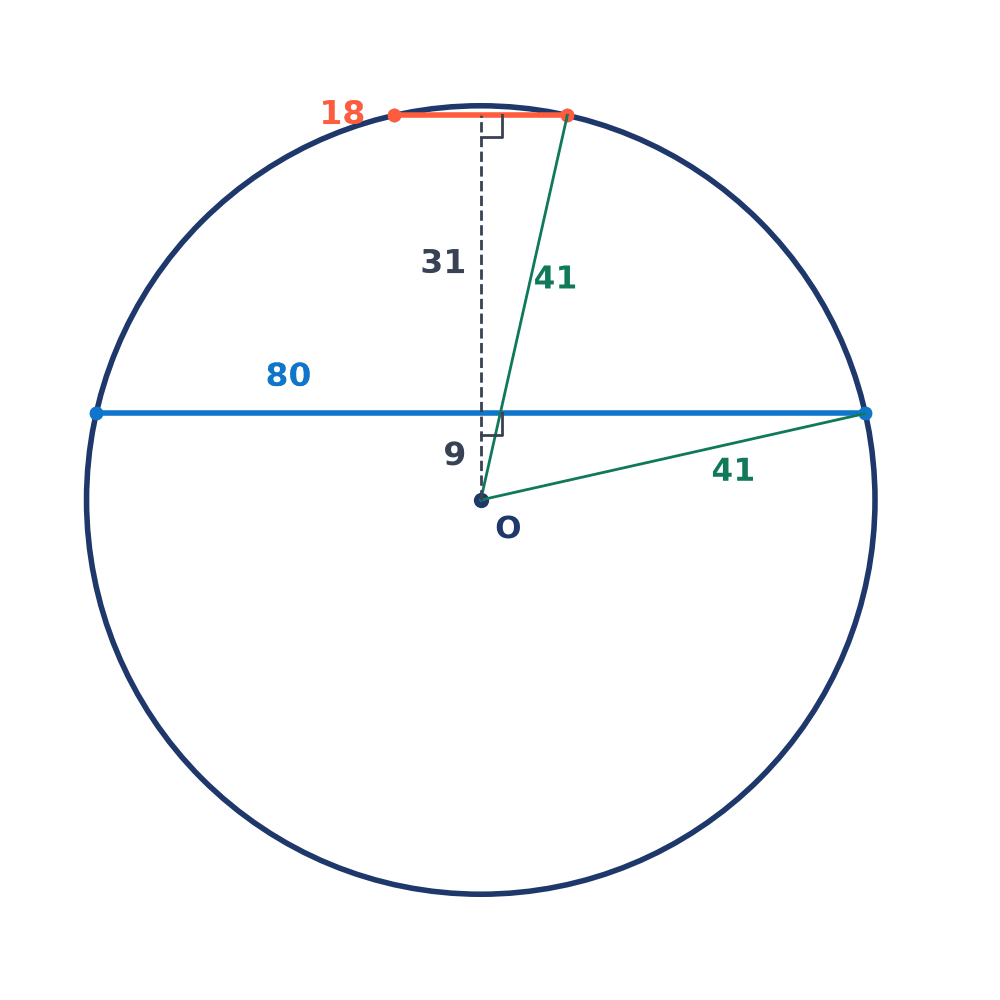
- A chord is cm from the centre of a circle of radius cm. Find its length.
- A circle has diameter cm. A chord of length cm is drawn. How far is it from the centre?
- A chord of length cm is cm from the centre. Find the radius.
- Two parallel chords of lengths cm and cm are on the same side of the centre and cm apart. Find the radius. (Set the distances as and with the longer chord nearer.)
- Which is nearer the centre in a circle of radius : a chord of length or one of length ? Find both distances.
- Think about all the chords of a circle of radius that have length . What figure do their midpoints make?
Section B, Angles
- An arc subtends at the centre. What does it subtend at a point on the remaining circle?
- is a diameter and is on the circle with . Find .
- Points lie on a circle in order. and . Find and .
- Cyclic has . Find both.
- In cyclic , side is extended to and . Find .
Section C, Proofs and constructions
- Prove that the perpendicular bisector of a chord passes through the centre.
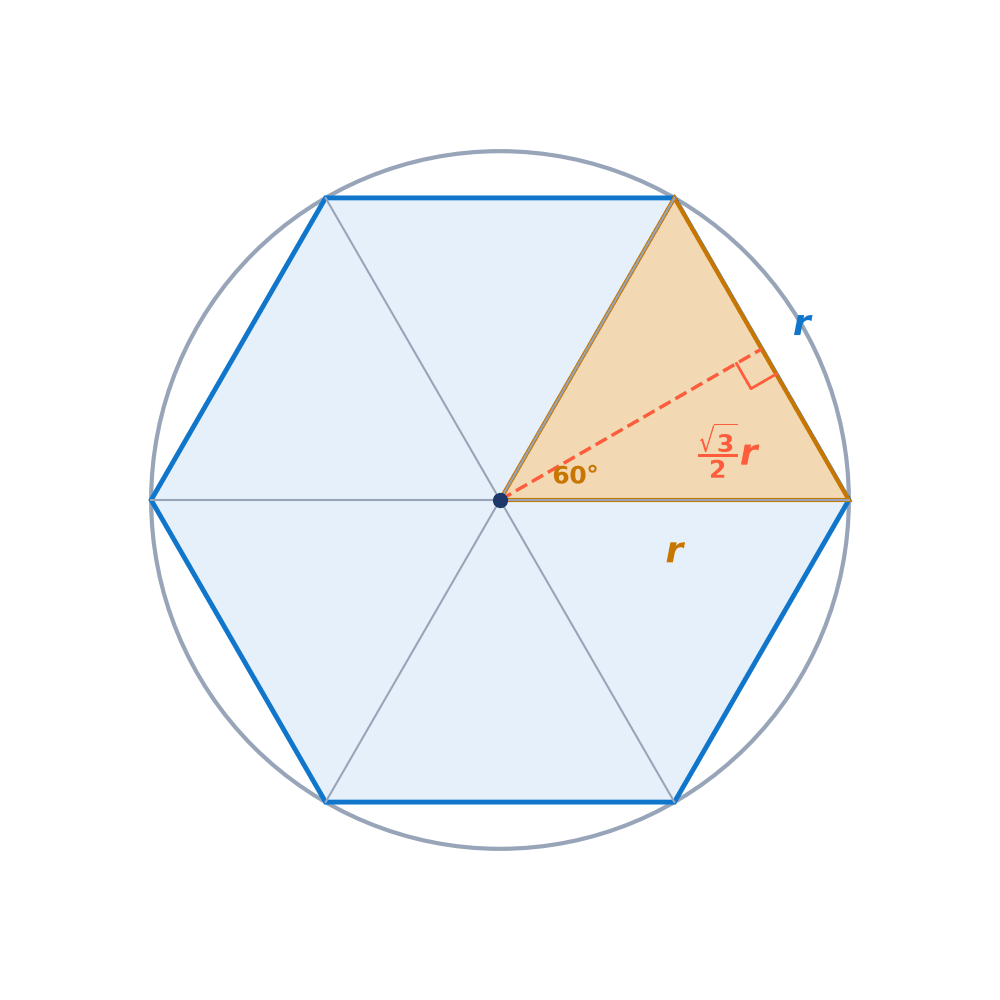
- A regular hexagon is inscribed in a circle of radius . Find the side of the hexagon and its distance from the centre.
- Draw a circle in which a chord of length cm lies cm from the centre. Start by finding the radius.
Answers
Show answers
- cm.
- cm.
- cm.
- , so , , . cm.
- Distances and . The longer chord (length ) is nearer.
- Every such chord is at the same distance from the centre, and that distance is measured to the midpoint. So the midpoints lie on a circle concentric with the original, of radius .
- .
- , .
- (same segment, arc ). (same segment, arc ).
- and : , , .
- The exterior angle at equals the interior opposite angle: .
- Let be the midpoint of chord and the centre. , so is equidistant from and and therefore lies on the perpendicular bisector of , the locus of all such points. (Alternatively: because the line from the centre to the midpoint of a chord is perpendicular to it, so is the perpendicular bisector.)
- Joining the centre to the six vertices makes six triangles with apex angle and two sides : equilateral, so the side is . The distance from the centre to a side is the height of such a triangle, .
- Half-chord , distance : radius cm. Draw the circle of radius , mark a point cm from the centre, and draw the chord through it perpendicular to the radius; its length will be cm.