One triangle does most of the work
Draw a chord, then draw the two radii to its ends. You have made an isosceles triangle, and almost everything about chords follows from that triangle and from congruence. We will prove the results in pairs: equal chords and equal central angles, the line from the centre to the midpoint and the perpendicular, and equal chords and equal distances. We finish with one inequality: the longer chord is nearer the centre.
The basic triangle
For a chord of a circle with centre , the triangle has , because both are radii. So it is isosceles with base , and . If two such triangles stand on chords of equal length, all three sides match, so they are congruent by SSS.
Equal chords, equal angles
Theorem. Equal chords subtend equal angles at the centre.
Proof. Let the chords be . In triangles and , we have and (radii), and (given). By SSS congruence, .
Converse. Chords that subtend equal angles at the centre are equal.
Proof. Here , with and . By SAS congruence, .
A picture to hold on to: tie a thread across a bicycle wheel. As the wheel turns, the thread becomes a new chord of the same length, making the same angle at the axle.
The centre and the midpoint of a chord
Theorem. The line from the centre to the midpoint of a chord is perpendicular to the chord.
Proof. Let be the midpoint of . In triangles and , , , and is common. By SSS, . These two angles also add up to , since they sit on a straight line, so each must be .
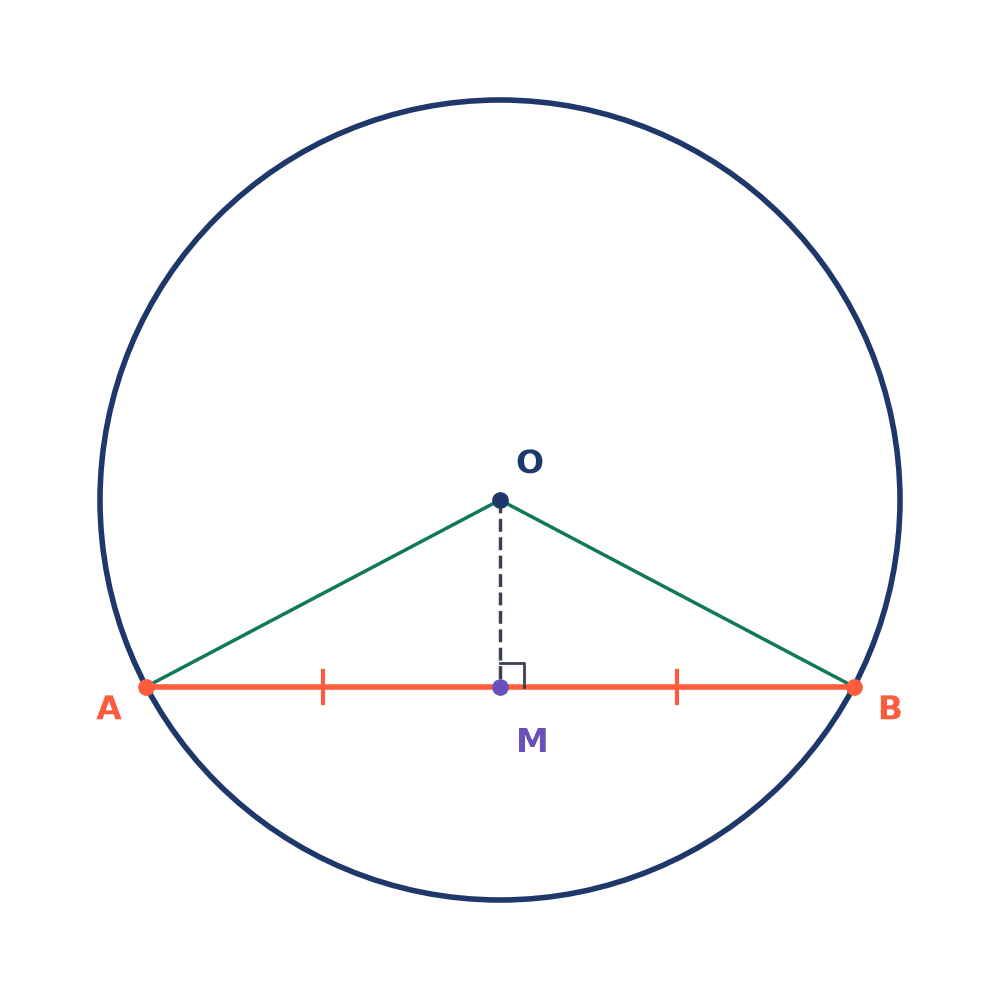
Converse. The perpendicular from the centre to a chord bisects it.
Proof. Call the foot of the perpendicular , so . Triangles and are right-angled, with equal hypotenuses and the common side . So RHS congruence gives .
This leads to a very handy fact: the perpendicular bisector of any chord passes through the centre. The reason is simple. The centre is equidistant from and , and the perpendicular bisector is exactly the locus of such points.
Length of a chord from its distance
Now we can put numbers to all this. Let a chord be at perpendicular distance from the centre of a circle of radius . The perpendicular meets the chord at its midpoint , and the right triangle gives . So
Example 1. With radius cm and distance cm, the chord is cm.

Example 2. A chord of length cm is cm from the centre. Half the chord is fifteen, so the radius is cm.
Example 3. A circle has diameter cm. How far from the centre is a chord of length cm? Using the radius and half the chord, the distance is cm.
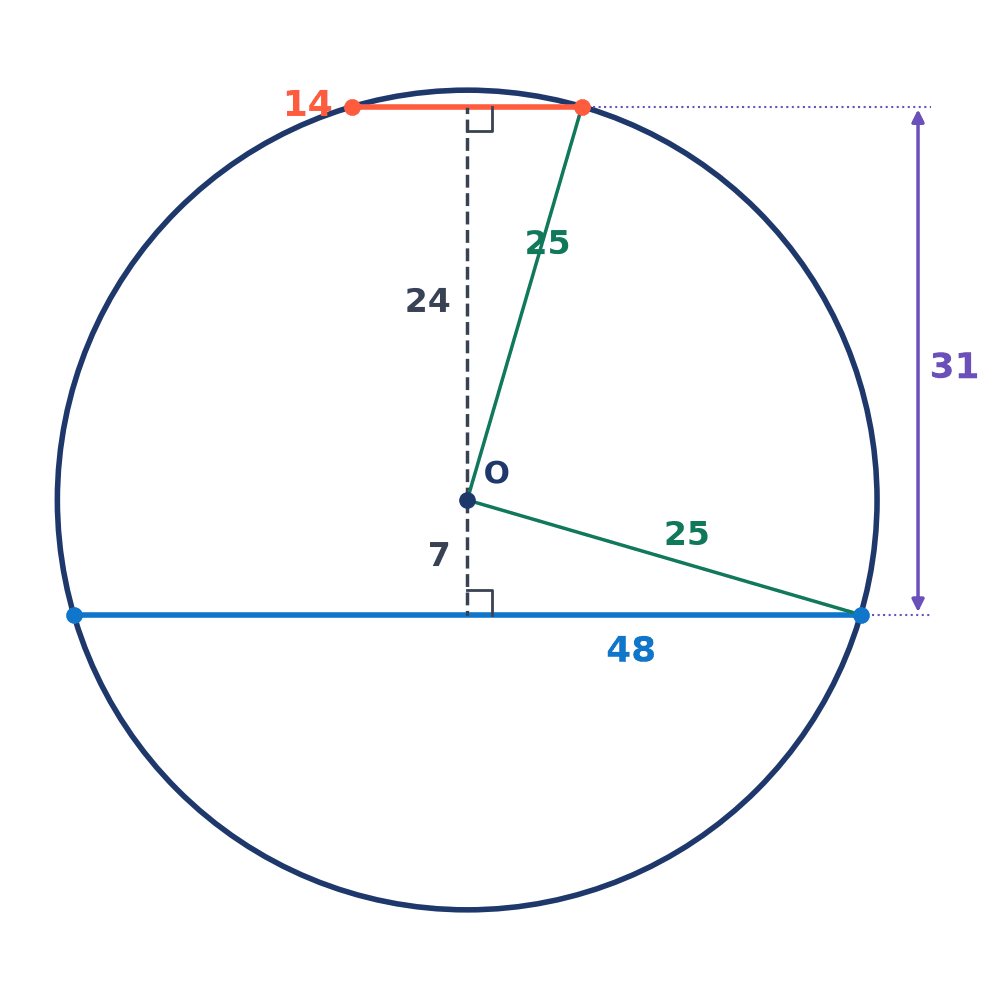
Example 4. Two parallel chords of lengths cm and cm lie on opposite sides of the centre of a circle of radius cm. How far apart are they?
Their distances from the centre are and . They are on opposite sides, so the gap is cm. (Had they been on the same side, it would be cm. Always read which side!)
Equal chords, equal distances
Theorem. Equal chords are equidistant from the centre.
Proof. Take chords , with perpendiculars and from the centre. By the converse above, and are midpoints, so . Triangles and are right-angled with and , so RHS gives .
You can also see it from the formula: both distances equal , and the chords are equal.
Converse. Chords equidistant from the centre are equal.
Proof. Now and , so RHS gives , and therefore .
The longer chord is nearer
Theorem. Of two unequal chords, the longer is closer to the centre.
Proof. Take chords with midpoints and . The right triangles give . Since , we get , so and .
Picture it moving. Push a chord away from the centre and it gets shorter, until at distance it has shrunk to a single point. Pull it in and it gets longer, until at distance it becomes a diameter, the longest chord of all.
Example 5. In a circle of radius , chord is cm from the centre and chord is cm from it. Which is longer, and by how much?
We get and . So is longer by cm. Notice something, though: cutting the distance by more than half did not simply double the chord.

Example 6. An isosceles triangle with is inscribed in a circle. Show that the altitude from passes through the centre.
The altitude from the top vertex of an isosceles triangle bisects the base and is perpendicular to it. In other words, it is the perpendicular bisector of the chord , and we know that line passes through the centre.
Practice
- Find the chord length: (a) radius cm, distance cm; (b) radius cm, distance cm.
- A chord of length cm is cm from the centre. Find the radius.
- A chord of length cm is drawn in a circle of diameter cm. Find its distance from the centre.
- Two parallel chords of lengths cm and cm lie on the same side of the centre of a circle of radius cm. Find the distance between them.
- Two parallel chords of lengths cm and cm are on opposite sides of the centre and cm apart. Find the radius. (Let the distances be and .)
- Chord is cm from the centre and chord is cm from it. Is twice ? Test with radius .
- Chords and of a circle are equal. Show that the centre lies on the bisector of .
- Two chords of equal length cross at a point inside the circle. Show that divides them into corresponding equal parts.
Answers
Show answers
- (a) cm. (b) cm.
- cm.
- cm.
- Distances and ; same side, so cm apart.
- , so , , . cm.
- , . No, chord length is not proportional to distance.
- Equal chords are equidistant from the centre, so the perpendiculars from to and are equal. A point equidistant from the two arms of an angle lies on its bisector.
- Equal chords are equidistant from the centre, so for their midpoints . Right triangles and share the hypotenuse , so . Then the parts and match, since (half of equal chords).