Where we are headed
Every whole number bigger than is either prime or can be broken down into primes. You probably did this with factor trees in your junior classes. Here we ask how far that idea really goes, and we meet the one word that does the heavy lifting: uniquely.
By the end you should be able to write any composite number as a product of prime powers, and explain why nobody else's factorisation of that number can ever disagree with yours.
Building numbers out of primes
Start from the primes and multiply. Take , , and , use each as often as you like:
Every product you form this way is a positive integer. The more interesting question runs the other way: if you start from a number, can you always get back to primes?
Try it with . Keep pulling out the smallest prime that divides what is left:
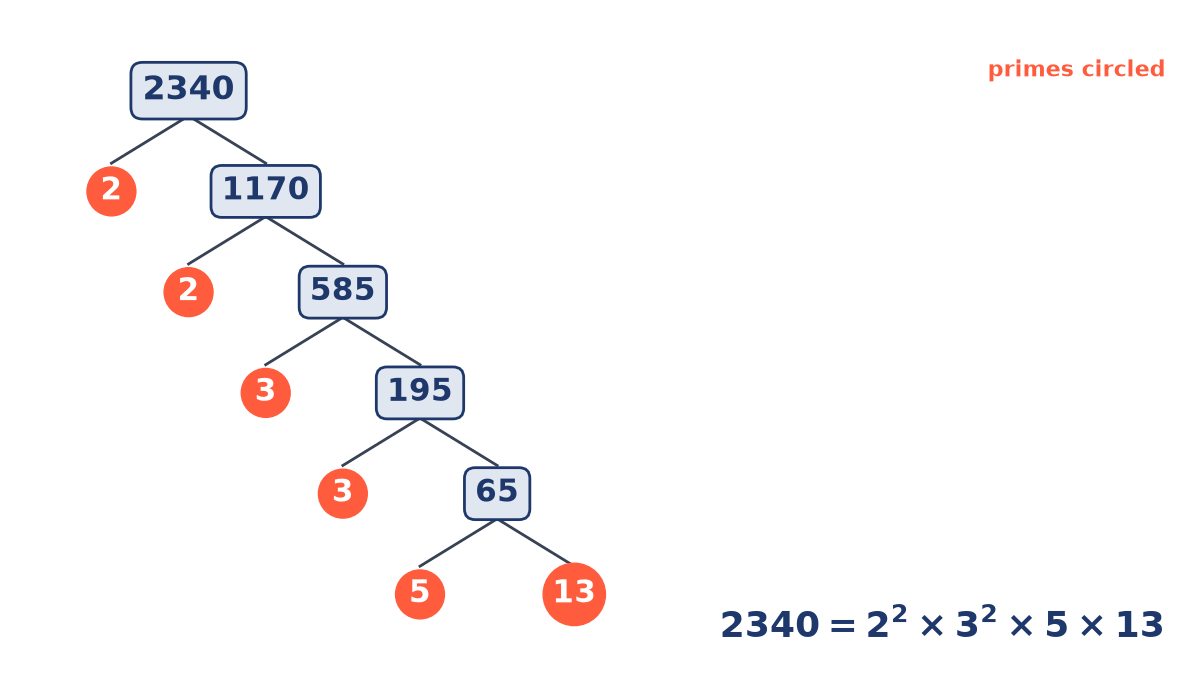
Could this go on for ever? No. Each step makes the number strictly smaller, and a whole number cannot keep shrinking for ever while staying above , so the process must stop.
The theorem
Fundamental Theorem of Arithmetic. Every composite number can be written as a product of primes, and that factorisation is unique apart from the order in which the factors are written.
Read that sentence again, slowly. Two separate claims are packed into it, and most students only notice the first.
Existence: a factorisation into primes can always be found. That is what the calculation above shows.
Uniqueness: there is only one such factorisation. Writing is not a correct answer; it is the answer. Reordering the factors as changes nothing, because order is not part of what is being claimed.
Uniqueness is what makes the theorem so useful. Think of the prime factorisation as a number's fingerprint, or its Aadhaar number: two numbers with the same prime factorisation are the same number, and a prime that appears in one factorisation of appears in every factorisation of .
Writing the standard form
To write it neatly, collect equal primes into powers and list them in increasing order:
Worked example. Factorise .
and , so
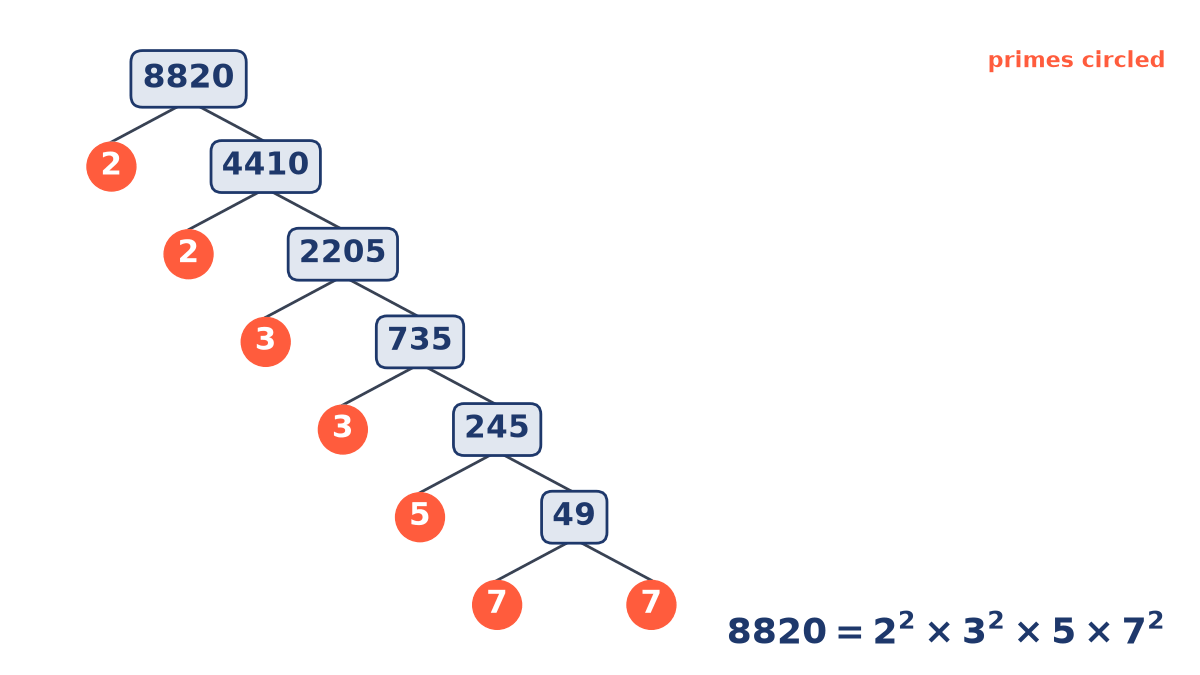
Now check by multiplying back: , , . Please make this a habit. A factorisation that multiplies back to the wrong number is the one slip that costs you every mark that follows it.
Two things the theorem lets you decide at a glance
Whether one number divides another. Take and . Every prime in appears in with at least as large an exponent, so divides , no long division needed. Had carried a , no amount of arithmetic could have made it divide.
Whether a number can end in . A number ends in zero exactly when it is divisible by , so its factorisation must contain both a and a . never ends in , for any , because no and no can appear.
A caution about
is not prime, and the theorem is stated for composite numbers. Students sometimes ask why it is left out. Here's why: if counted as a prime, uniqueness would collapse at once, since , and every number would have infinitely many "different" factorisations. So leaving out isn't fussiness; it is exactly what keeps the theorem true.
Practice
- Write as a product of prime powers: (a) , (b) , (c) .
- Does divide ? Answer using prime factorisations only, not division.
- Can ever end in the digit ? Give a reason.
- . How many of the numbers , , , , divide ?
- A number has exactly three prime factors, all different, and equals . Find them.
Answers
Show answers
- (a) . (b) . (c) .
- and . Each prime of appears in with a larger or equal exponent, so yes, divides .
- No. A number ending in is divisible by , so would have to appear in its prime factorisation. Only and appear in , and by uniqueness no other prime can be hiding there.
- Four of them: , , and all divide . does not, because carries only one factor of .
- .