Why bother?
You've found HCF and LCM before by long division and by listing multiples, and it can be slow. Once a number is written as a product of prime powers, though, its HCF and LCM can be read straight off, without a single division. Let's see the rule, why it works, and a handy identity that gives you one from the other.
Reading HCF and LCM off the factorisations
Write both numbers in prime-power form, lining up the same primes one under the other.
- HCF, take each prime that appears in both, with the smaller exponent.
- LCM, take each prime that appears in either, with the larger exponent.
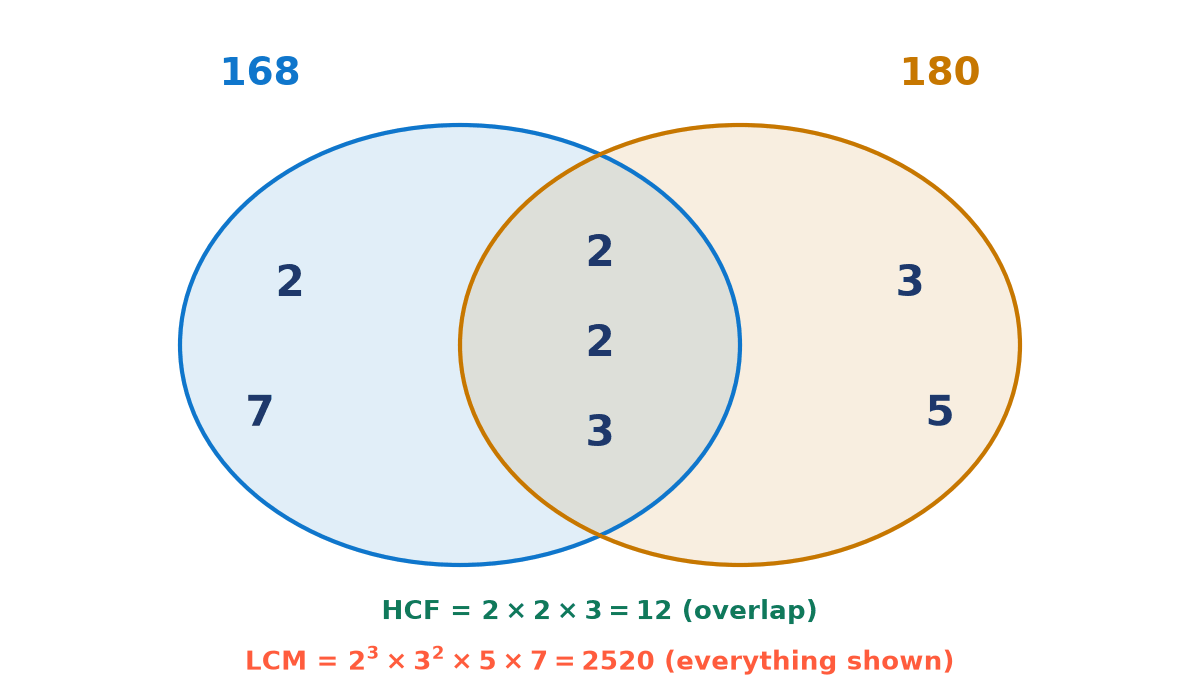
Why the smaller exponent for the HCF? A common divisor can't use more copies of than the poorer of the two numbers owns. has only , so no common divisor can contain .
And why the larger for the LCM? A common multiple must contain enough copies of to be divisible by , and that needs three of them.
The identity
For any two positive integers and ,
Check it on the pair above: , and . They agree.
You can see why by looking at the exponents. For each prime, one number supplies the smaller exponent and the other supplies the larger. The HCF takes one and the LCM takes the other, so between them they use both, which is exactly what multiplying by does.
A warning: this identity holds for two numbers only. For three it fails, and it's easy to see: take , and . Then and , so , while . Quoting the identity for three numbers is a common mistake, and an expensive one in board exams.
Worked examples
Example 1. Find the HCF and LCM of and .
Common primes are and . Smaller exponents: and .
All primes, larger exponents:
Check: . ✓
Example 2. Given , find the LCM without factorising either number.
A little tip: divide before you multiply and the numbers stay small. Since , .
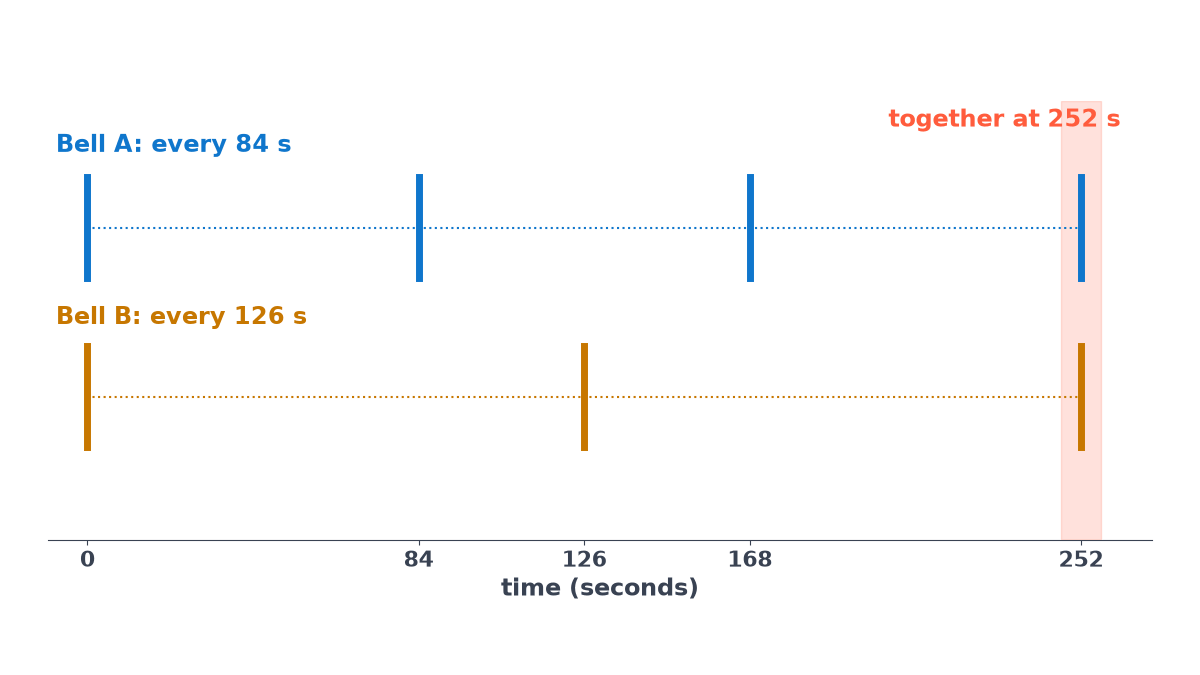
Example 3. Two bells ring at intervals of seconds and seconds. They ring together now. After how long do they next ring together?
"Together again" is a sign that the question wants the LCM.
They next ring together after seconds, which is minutes seconds.
Which one does the question want?
Word problems rarely say "HCF" or "LCM" out loud, so you have to decide from what is being asked.
- Cutting or sharing into equal parts, largest possible → HCF. The size must divide every quantity.
- Events repeating together, earliest → LCM. The time must be a multiple of every interval.
Here's a quick test to settle it: if the answer must be no larger than the numbers given, it's an HCF. If it must be no smaller, it's an LCM.
Practice
- Find the HCF and LCM of and by prime factorisation, and verify the identity.
- Given , find without factorising either number.
- Find the HCF and LCM of , and .
- Show that product, for the three numbers in question 3.
- Ribbons of length cm and cm are to be cut into equal pieces of the greatest possible length, with nothing left over. Find that length and the number of pieces.
Answers
Show answers
- , . ; . Check: . ✓
- .
- , , . ; .
- , while . They differ, so the two-number identity does not extend to three.
- and , so . The greatest possible length is cm, giving pieces.