How to use this set
These twelve questions cover the whole chapter. Work each one in the same order: first write the total number of equally likely outcomes, then the favourable count, and finally the fraction in its lowest terms. When you see "not" or "at least", pause and ask yourself whether the complement would be quicker. And when two descriptions overlap, remember to count the overlap only once.
Section A, Single draws
- A die is rolled once. Find the probability of (a) an odd number greater than , (b) a number that is not a multiple of .
- A bag has red, white and black balls. One is drawn at random. Find the probability that it is (a) white, (b) red or black, (c) not black.
- Cards numbered are placed in a box and one is drawn at random. Find the probability that the number is (a) a perfect square, (b) a multiple of , (c) a two-digit number.
- A box holds discs numbered to . Find the probability that a disc drawn at random shows (a) a number divisible by , (b) a number divisible by both and , (c) a prime less than .
Section B, Coins, dice, cards
- Three coins are tossed. Find the probability of (a) all alike, (b) exactly one tail.
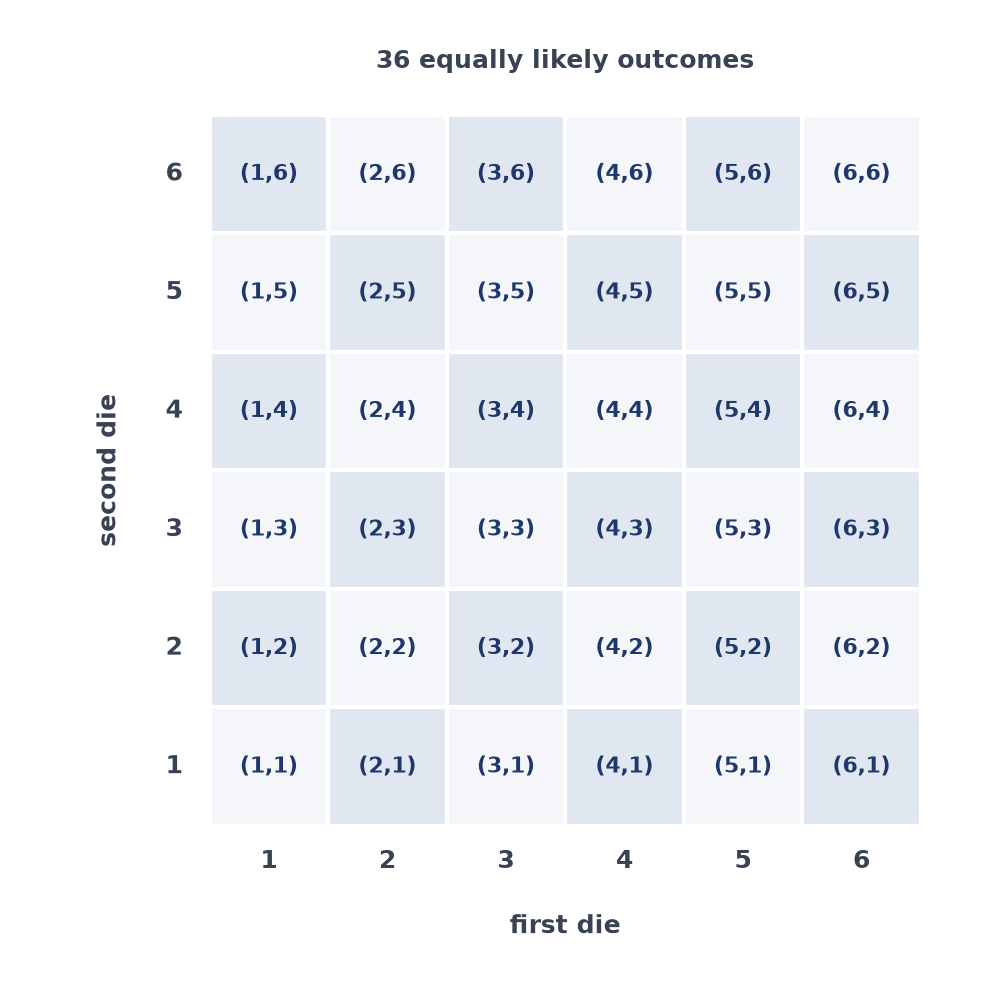
- Two dice are rolled. Find the probability that (a) the sum is , (b) at least one die shows , (c) the numbers differ by exactly .
- A card is drawn from a pack of . Find the probability of (a) a black face card, (b) a card that is neither red nor a jack, (c) an ace of hearts.
- All the hearts are removed from a pack and a card is drawn from what remains. Find the probability of (a) a queen, (b) a red card.
Section C, Unknowns and applications
- A bag has balls, some red and the rest green. The probability of drawing a green ball is . How many are red?
- A bag has black balls and white balls. If the probability of drawing a black ball is , find .
- A batch of bulbs has defective ones. One is picked at random. Find the probability it is good. Suppose it turns out to be good and is kept aside. A second bulb is then picked. Find the probability that this second one is defective.
- A child's die has the letters A, B, C, D, E, A written on its six faces. Find the probability of rolling (a) A, (b) a letter after C in the alphabet.
Answers
Show answers
- (a) : . (b) Multiples of are ; the other four: .
- Total . (a) . (b) . (c) .
- Total . (a) : . (b) : of them: . (c) to : : .
- (a) : . (b) Divisible by : : . (c) : .
- (a) : . (b) : .
- (a) Five pairs: . (b) Complement: neither shows in pairs, so . (c) and reverses: : .
- (a) : . (b) black, minus black jacks: : . (c) .
- cards. (a) queens: . (b) diamonds: .
- Green ; red .
- , so , .
- Good: . After one good bulb is removed, remain with defective: .
- (a) Two faces: . (b) D, E: .