Why bother with probability?
We say "it will probably rain" or "he is unlikely to win" all the time. Probability turns that feeling into a number between and . In this lesson you will learn the definition we use for the whole chapter: favourable outcomes divided by total outcomes, as long as every outcome is equally likely. Three simple facts follow from it, and we will look at each one: the bounds, the sure and impossible events, and the complement rule.
Outcomes and events
An experiment is something with an uncertain result: tossing a coin, rolling a die, drawing a card. Each possible result is an outcome. An event is a collection of outcomes, such as "an even number" or "a red card".
Outcomes are equally likely when there is no reason for any one of them to occur more often than another. Think of the two faces of a fair coin, the six faces of a fair die, or the fifty-two cards of a well-shuffled pack. Keep this in mind, because the definition below works only for equally likely outcomes.
The definition
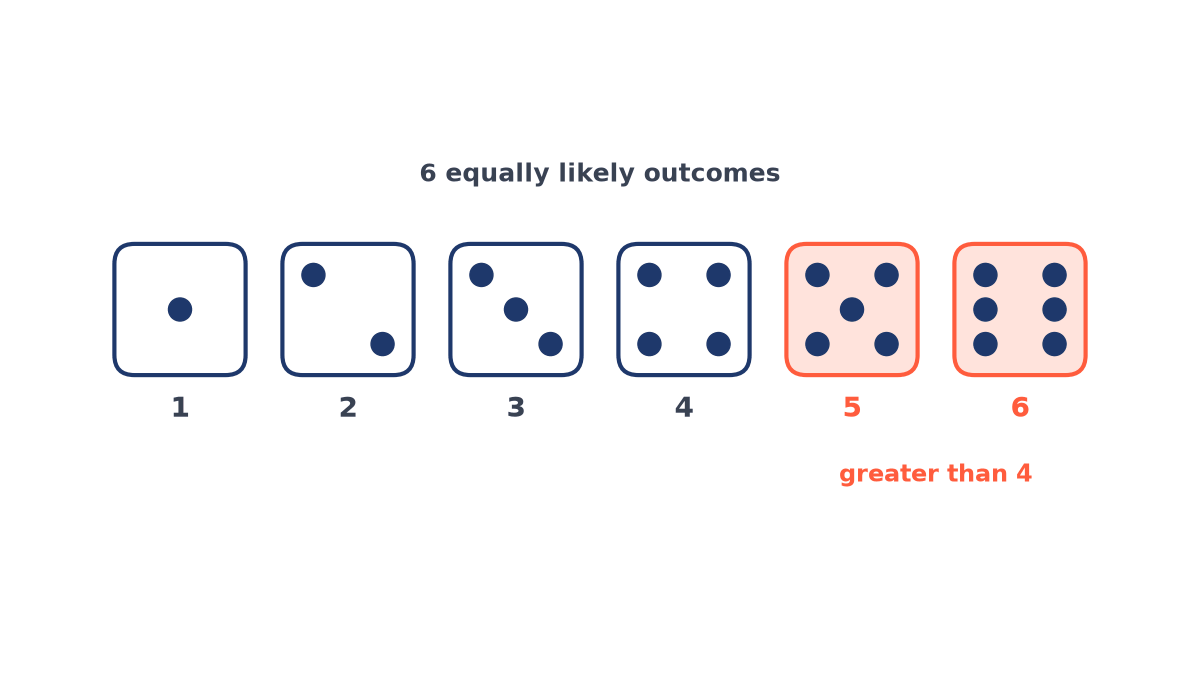
Example 1. A fair die is rolled. Find the probability of a number greater than .
There are outcomes in all. The favourable ones are , which makes . So .
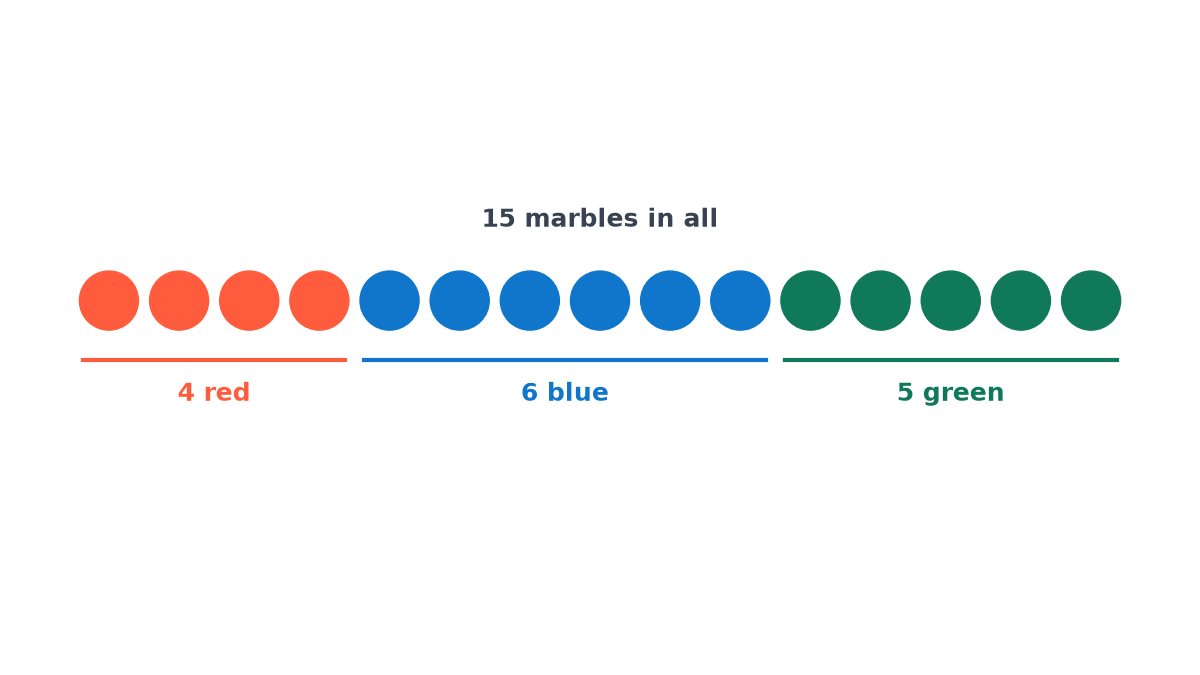
Example 2. A bag has red, blue and green marbles, all alike except colour. One is drawn at random. Find the probability that it is (i) blue, (ii) not green, (iii) red or green.
There are marbles altogether. (i) . (ii) Not green means red or blue, marbles: . (iii) .
Watch for the words "at random". They are what guarantee that every outcome is equally likely. Without them, the definition simply does not apply.
The three facts
Bounds. The favourable count is between and the total, so . So if you ever get a probability of or , stop. You have made an arithmetic error, every single time.
Sure and impossible events. An event that must happen has , and one that cannot happen has . On a die, rolling "a number less than " is certain, so . Rolling a is impossible, so .
Complement. The event "not " is written , and since every outcome is either in or not,
Example 3. The probability that it rains tomorrow is . So the probability that it does not rain is .
Example 4. A card is drawn from a pack of . The probability it is a king is , so the probability it is not a king is .
A teacher's tip: whenever you see "not" or "at least one" in a question, reach for the complement. Count what you do not want, then subtract from . It is usually much quicker.
Counting the total correctly
The total is the number of equally likely outcomes, not the number of kinds of outcome. A bag with white and black balls has outcomes, not . Many students say, "It is either white or black, so the answer is ." That is the classic mistake, and it is exactly what "equally likely" rules out.
Practice
- A die is rolled once. Find the probability of (a) a prime number, (b) a multiple of , (c) a number less than .
- A bag holds white and black balls. One is drawn at random. Find the probability that it is (a) white, (b) not white.
- A card is drawn from a well-shuffled pack of . Find the probability of (a) a red queen, (b) a spade, (c) not a face card (jack, queen or king).
- The probability of winning a game is . What is the probability of losing?
- Which of these cannot be the probability of an event: , , , , ?
- Twelve slips numbered to are in a box. One is drawn at random. Find the probability that the number is (a) a perfect square, (b) divisible by , (c) a factor of .
Answers
Show answers
- (a) : . (b) : . (c) .
- (a) . (b) .
- (a) red queens: . (b) . (c) face cards, so others: .
- .
- (greater than ) and (negative). The others are valid; is .
- (a) : . (b) : . (c) : .