The big picture
A zero of a polynomial is a number that makes it equal to zero. That sounds purely algebraic, but it has a lovely picture behind it: the zeroes are exactly the places where the graph meets the -axis. Once you see that link, you can read the number of zeroes straight off a sketch, and even predict from the degree how many there could be.
What a zero is
A real number is a zero of the polynomial if .
Take . Then and , so and are zeroes. But , so is not.
So checking a zero always comes down to substitution. There's no other test, and you don't need one.
Linear polynomials: exactly one zero
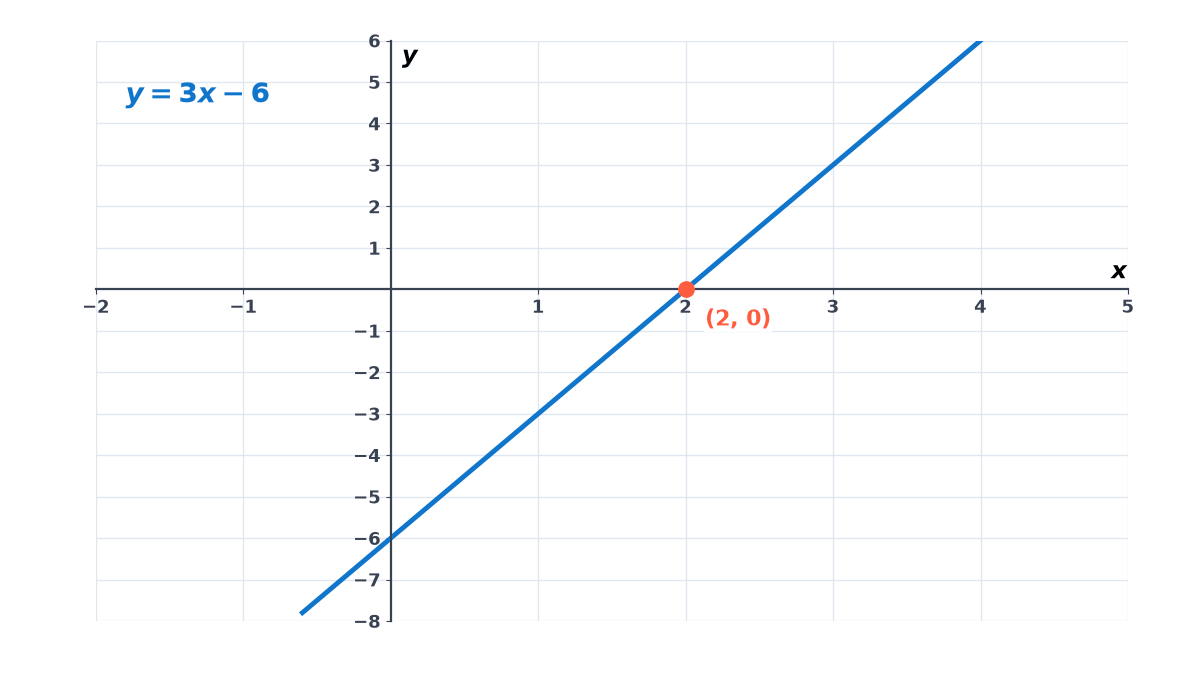
The graph of with is a straight line. A line that isn't horizontal crosses the -axis exactly once, so a linear polynomial has exactly one zero.
To find it, just set the polynomial equal to zero:
For , the zero is , and the line crosses the -axis at . Watch the sign here: the zero of is , not . If in doubt, substitute: . ✓
Quadratic polynomials: two, one or none
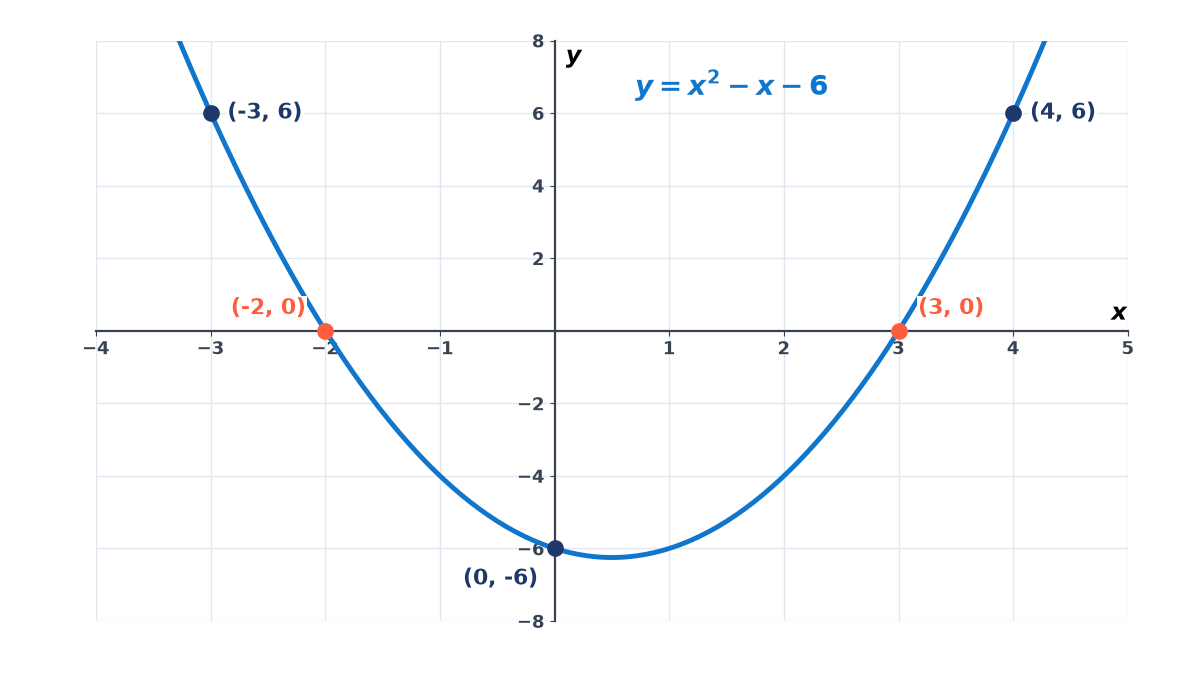
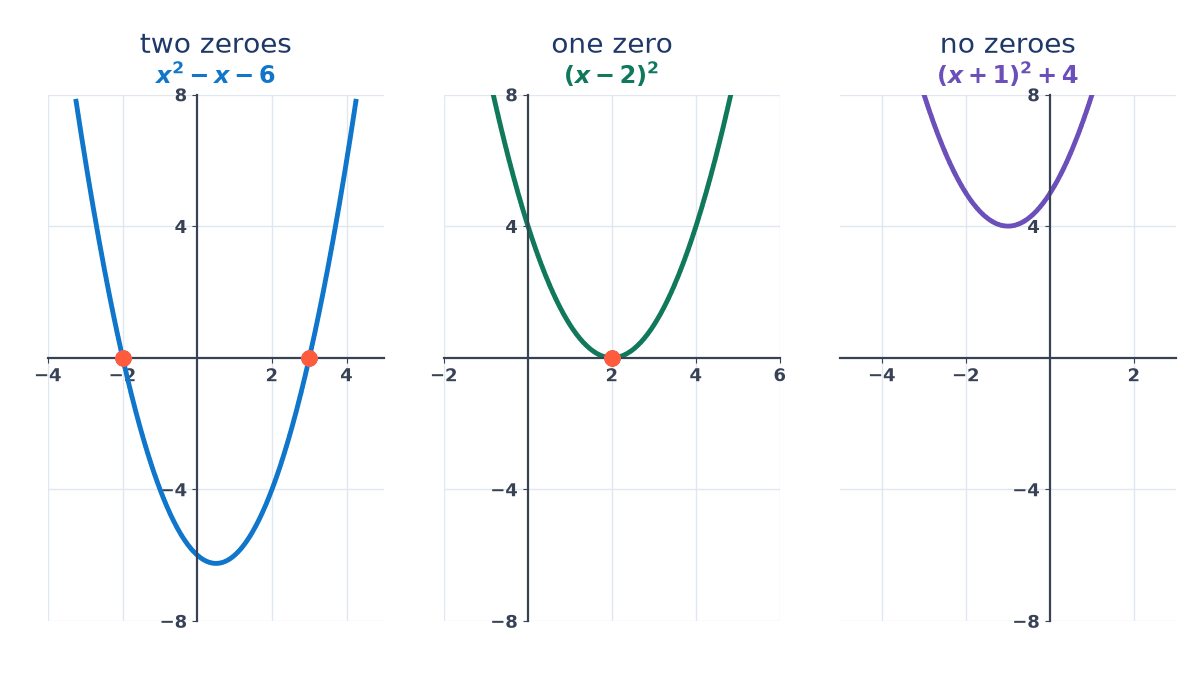
The graph of with is a parabola, a U-shape that opens upwards when and downwards when . Think of the path of a ball thrown to a friend. A parabola can meet the -axis in three different ways, and each way gives a different number of zeroes.
Two zeroes: the parabola cuts the axis at two separate points.
crosses at and . A small table of values shows the sign changing on either side of each crossing:
One zero: the parabola just touches the axis at a single point.
touches at and nowhere else. Its value is at and positive everywhere else, so the curve just kisses the axis without crossing it. The two zeroes have landed on the same spot; some books call such a zero repeated.
No zeroes: the parabola misses the axis altogether.
is never less than , so it never reaches the axis. It opens upwards and even its lowest point floats above the axis, so there is no real number with .
A relief for many of you: the syllabus doesn't ask you to plot parabolas accurately, and exams don't mark it. What they do test is reading a given graph and knowing which of the three cases a polynomial falls into.
Cubic polynomials: up to three
A cubic can cross the axis at most three times. has three zeroes: , and . But itself has only the single zero , and has two: and .
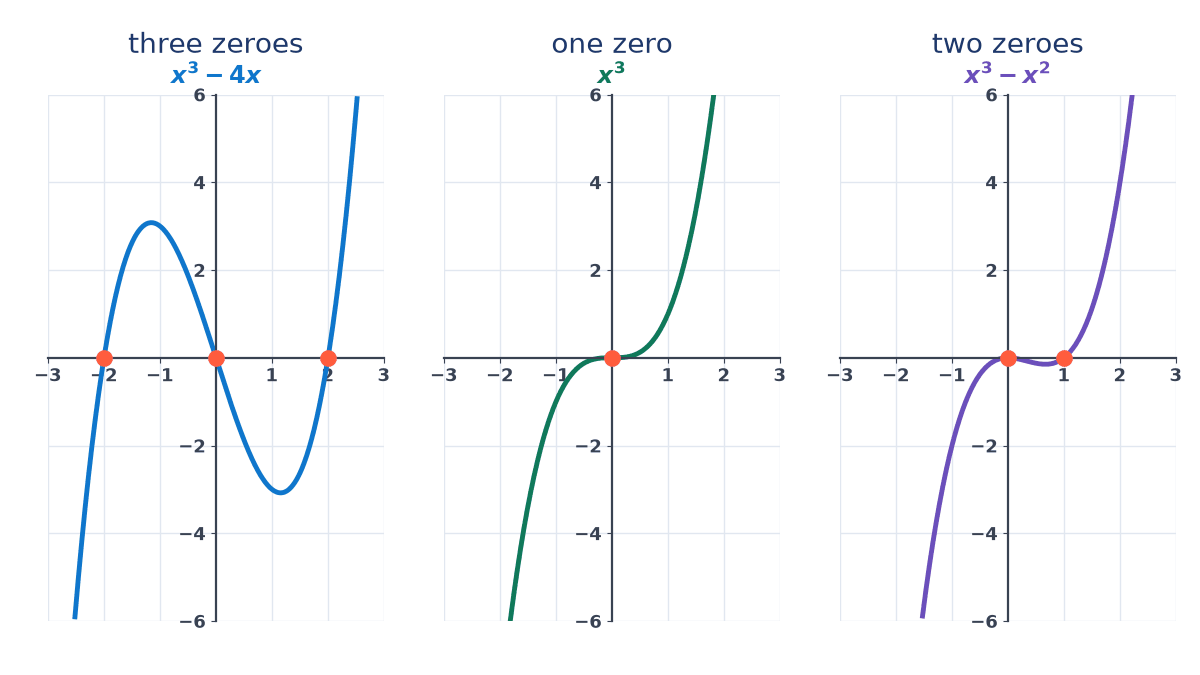
So the word "cubic" tells you the maximum, not the actual count.
The general rule
A polynomial of degree has at most zeroes.
Linear: at most . Quadratic: at most . Cubic: at most . Fewer is always possible, more never is. So if someone's sketch of a "quadratic" crosses the axis three times, you know straight away the sketch is wrong.
Reading zeroes from a graph
Given a graph, the zeroes are the -coordinates of every point where the curve meets the -axis, whether it crosses or just touches. Count those points and you have counted the zeroes. Two things regularly trip students up:
- A curve that touches and turns back still meets the axis: that counts as one zero.
- Where the curve meets the -axis is irrelevant. That is the value , not a zero.
Practice
- Which of , , , are zeroes of ?
- Find the zero of each linear polynomial: (a) , (b) , (c) .
- Without plotting, say how many zeroes each has, with a reason: (a) , (b) , (c) .
- A graph of a polynomial crosses the -axis at and and touches it at . How many zeroes does it have, and what is the smallest degree it could have?
- Sketch, roughly, a parabola opening downwards with no zeroes. Where must its highest point lie?
Answers
Show answers
- ✓ and ✓. and , so and are not zeroes. The zeroes are and .
- (a) . (b) . (c) .
- (a) Two: , zeroes and . (b) None: for every real . (c) One: , touching at .
- Three zeroes: , and . The smallest possible degree is , not . A curve that only touches the axis at has the factor twice, like in the one-zero case above, so the polynomial needs at least four linear factors, for example .
- Below the -axis. A downward parabola has its highest point at the top of the U; if that point were on or above the axis, the curve would meet the axis.