For a quadratic, the zeroes add to -b/a and multiply to c/a. Where that comes from, the cubic version, checking zeroes against coefficients, and building a polynomial from its zeroes.
Lesson 2 of 3
5 min read
6 practice questions
A hidden connection
Here's something quietly beautiful: the zeroes of a quadratic are tied to its coefficients. Add the zeroes and you get one ratio of coefficients; multiply them and you get another. We'll work out both relationships, stretch them to cubics, and then use them the two ways examiners like to ask: checking zeroes against coefficients, and building a polynomial from its zeroes.
The quadratic relationships
Let α and β be the zeroes of p(x)=ax2+bx+c, a=0. Then
α+β=−ab,αβ=ac
Why is this true? If α and β are the zeroes, then x−α and x−β are factors, so
ax2+bx+c=a(x−α)(x−β)=a(x2−(α+β)x+αβ)
Expanding the right side gives ax2−a(α+β)x+aαβ. Compare coefficients of x: b=−a(α+β), so α+β=−ab. Compare constants: c=aαβ, so αβ=ac.
Watch the sign of the sum; it's the classic slip. The sum of zeroes is −b/a, with a minus, while the product is +c/a. Write the sum as b/a and every answer after it comes out with the wrong sign.
Checking zeroes against coefficients
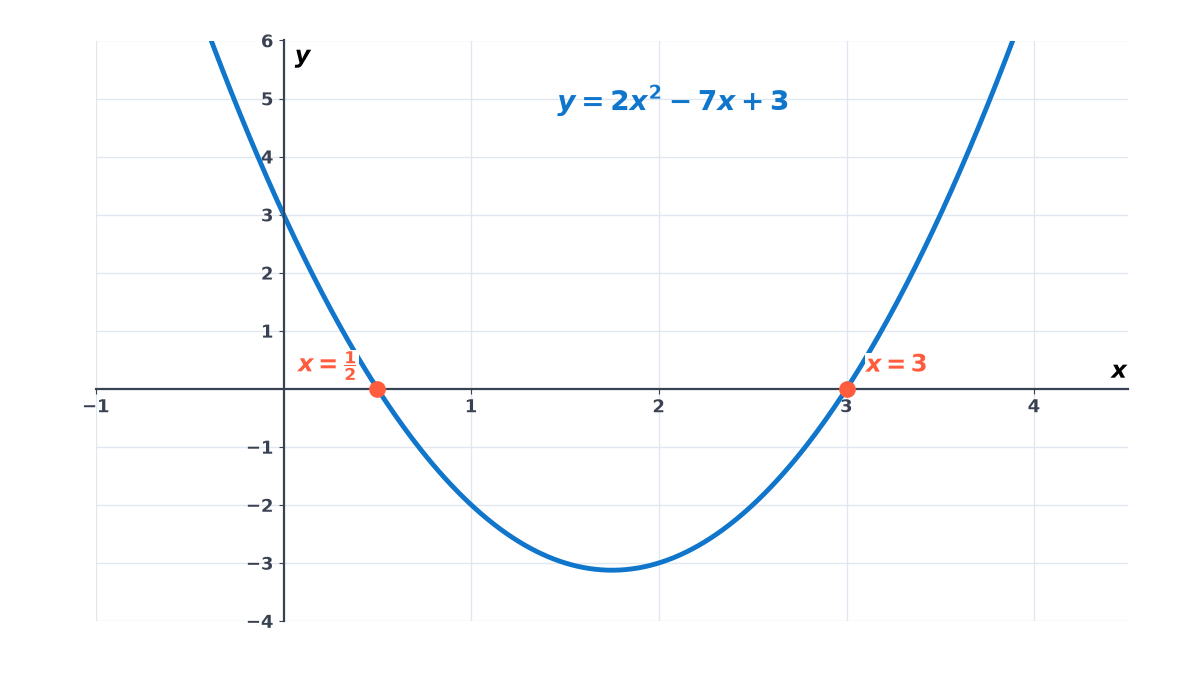
Example 1. Find the zeroes of 2x2−7x+3 and verify the relationships.
Factorise by splitting the middle term. We need two numbers with product 2×3=6 and sum −7, and a little thought gives −6 and −1.
2x2−6x−x+3=2x(x−3)−1(x−3)=(2x−1)(x−3)
Zeroes: x=21 and x=3.
Sum: 21+3=27, and −ab=−2−7=27. ✓
Product: 21×3=23, and ac=23. ✓
y = 2x squared - 7x + 3 crosses the x-axis at one half and 3
Example 2. Find the zeroes of 6x2+x−2 and verify.
Product 6×(−2)=−12, sum 1: the numbers are 4 and −3.
Now run the argument backwards. A quadratic with zeroes α and β is
x2−(α+β)x+αβ
or any non-zero multiple of it. That "multiple" is worth remembering, because x2−5x+6 and 3x2−15x+18 have exactly the same zeroes.
Example 3. Find a quadratic polynomial whose zeroes are 4 and −21.
Sum =4−21=27; product =−2.
x2−27x−2
Fractions look untidy, so multiply by 2 to clear them: 2x2−7x−4. Check by expanding (x−4)(2x+1)=2x2+x−8x−4=2x2−7x−4. ✓
Example 4. Find a quadratic polynomial with sum of zeroes 0 and product of zeroes −5.
x2−0⋅x+(−5)=x2−5
Its zeroes are 5 and −5: they sum to 0 and multiply to −5. ✓
The cubic relationships
For ax3+bx2+cx+d with zeroes α,β,γ:
α+β+γ=−ab,αβ+βγ+γα=ac,αβγ=−ad
Notice how the signs alternate: minus, plus, minus. The middle one is the sum of the products taken two at a time, and it's the one students most often get wrong, so give it an extra look.
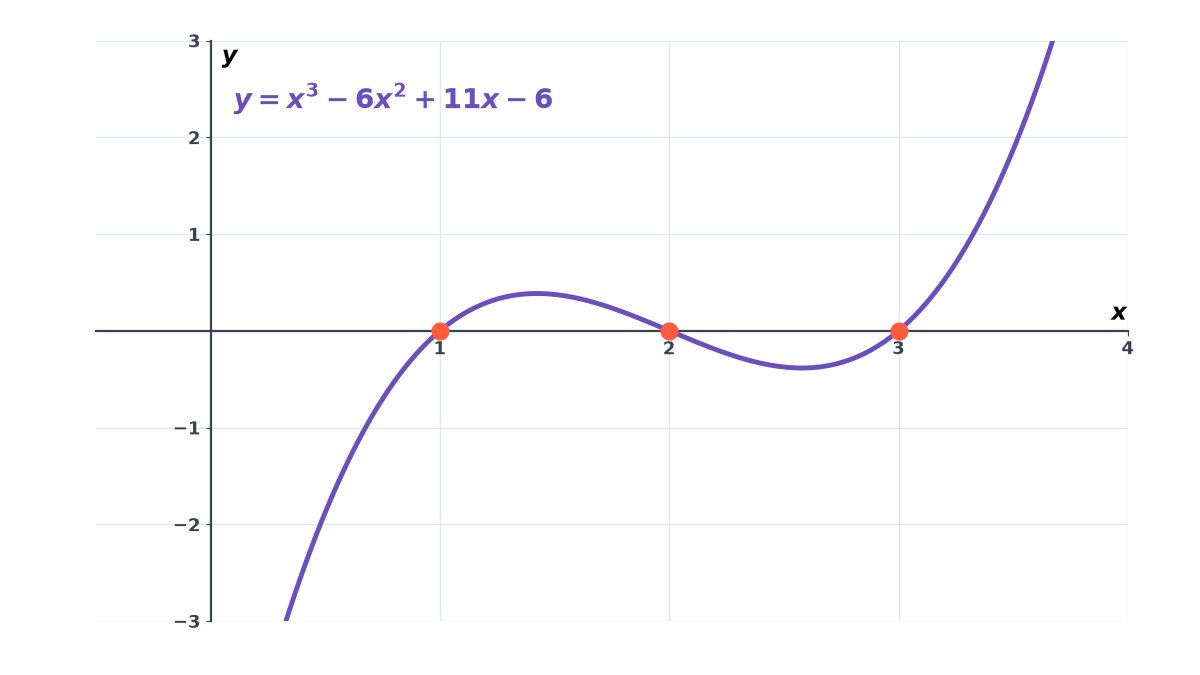
Example 5. Verify for x3−6x2+11x−6, whose zeroes are 1, 2 and 3.
Sum: 1+2+3=6=−1−6. ✓
Pairs: 1⋅2+2⋅3+3⋅1=2+6+3=11=111. ✓
Product: 1⋅2⋅3=6=−1−6. ✓
The cubic crosses the x-axis at 1, 2 and 3
Practice
Find the zeroes of x2−7x+12 and verify the relationships.
Find the zeroes of 3x2−x−4 and verify the relationships.
Find a quadratic polynomial whose zeroes are −3 and 5.
Find a quadratic polynomial whose sum of zeroes is −23 and product is −1.
If α and β are the zeroes of x2−4x+1, find α2+β2 without finding α and β.
Verify the cubic relationships for x3−2x2−5x+6, given that its zeroes are 1, −2 and 3.
Answers
Show answers
x2−7x+12=(x−3)(x−4); zeroes 3 and 4. Sum 7=−1−7 ✓; product 12=112 ✓.
Product 3×(−4)=−12, sum −1: the numbers are −4 and 3. 3x2−4x+3x−4=x(3x−4)+1(3x−4)=(x+1)(3x−4). Zeroes −1 and 34. Sum 31=−3−1 ✓; product −34=3−4 ✓.
Sum 2, product −15: x2−2x−15.
x2+23x−1, or clearing fractions, 2x2+3x−2.
α+β=4 and αβ=1. Then α2+β2=(α+β)2−2αβ=16−2=14.
Sum 1−2+3=2=−1−2 ✓. Pairs (1)(−2)+(−2)(3)+(3)(1)=−2−6+3=−5=1−5 ✓. Product (1)(−2)(3)=−6=−16 ✓.
Test yourself
Zeroes and Coefficients: Sum and Product, Quiz
Five questions on relationships between zeroes and coefficients. Pick one answer for each.