Coordinates of the point dividing a segment in a given ratio, why the weights cross over, the midpoint as the special case, running the formula backwards to find a ratio, points of trisection, and the fourth vertex of a parallelogram.
Lesson 2 of 3
4 min read
7 practice questions
Cutting a segment into pieces
Put a point on a line segment and it splits the segment into two pieces. The section formula tells you where that point is, given the ratio of the pieces. Run it backwards and it tells you the ratio, given the point. The midpoint is simply the special case, and it's the one you'll use most often.
The section formula
Suppose P lies on segment AB, with A(x1,y1) and B(x2,y2), and divides it internally in the ratio m:n, which means AP:PB=m:n. Then
P=(m+nmx2+nx1,m+nmy2+ny1)
Look at the criss-cross. The number m, which belongs to the piece next to A, multiplies B's coordinates, and n multiplies A's. This is the thing students most often get backwards. Here's a quick sanity check: if m is much bigger than n, then P should be close to B, and indeed the formula gives B the heavier weight m.
Why it works. Drop perpendiculars from A, P, B to the x-axis. Parallel lines cut transversals proportionally, so the horizontal pieces are in the same ratio as AP:PB. That puts the x-coordinate of P exactly m:n of the way from x1 to x2. The same argument works for y.
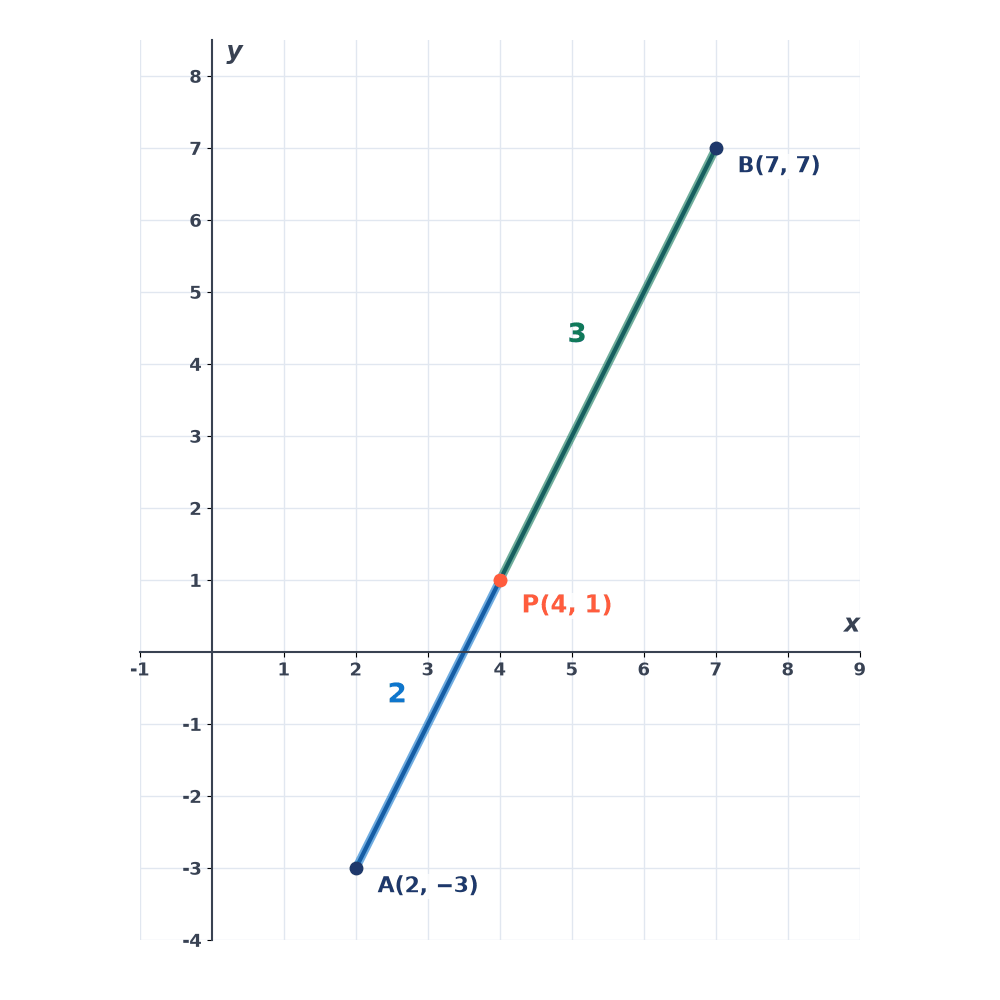
Example 1. Find the point dividing A(2,−3) and B(7,7) in the ratio 2:3.
x=52⋅7+3⋅2=520=4,y=52⋅7+3⋅(−3)=55=1
So P=(4,1).
Example 1: P divides AB in the ratio 2 : 3
The midpoint
When m=n, the formula shrinks to just the average of the coordinates:
M=(2x1+x2,2y1+y2)
Example 2. The midpoint of (−4,5) and (6,−1) is (22,24)=(1,2).
Finding the ratio
If you know the dividing point but not the ratio, call the ratio k:1 and use one coordinate to solve for k. Then check with the other coordinate. If the two disagree, the point isn't on the segment at all.
Example 3. In what ratio does (−1,2) divide the segment from (−3,6) to (2,−4)?
Let the ratio be k:1. Using x:
k+12k−3=−1⟹2k−3=−k−1⟹k=32
So the ratio is 2:3. Checking with y: 32+1−4⋅32+6=35310=2 ✓.
Example 4. In what ratio does the y-axis divide the segment joining (−4,3) and (6,−2)? Find the point too.
On the y-axis, x=0. So k+16k−4=0, which gives k=32: the ratio is 2:3. Then y=35−2⋅32+3=3535=1, so the point is (0,1).
Points of trisection
To cut a segment into three equal parts you need two points. The first divides it 1:2 and the second 2:1.
Example 5. Trisect the segment from (1,−2) to (7,4).
The first point, at 1:2, is (37+2,34−4)=(3,0). The second, at 2:1, is (314+1,38−2)=(5,2).
A shortcut for the second one: it's the midpoint of the first point and B, so (23+7,20+4)=(5,2) ✓.
Example 5: the two points of trisection
The fourth vertex of a parallelogram
The diagonals of a parallelogram bisect each other, which means both diagonals have the same midpoint. That one fact does all the work here.
Example 6.A(1,2), B(4,3), C(6,6) are three vertices of parallelogram ABCD, taken in order. Find D.
Set the midpoint of AC equal to the midpoint of BD. From 21+6=24+x we get x=3, and from 22+6=23+y we get y=5. So D=(3,5).
Example 6: both diagonals share one midpoint
Practice
Find the point dividing (−2,5) and (3,−5) in the ratio 3:2.
Find the midpoint of (7,−2) and (−3,8).
In what ratio does (2,5) divide the segment from (−1,2) to (5,8)?
In what ratio does the x-axis divide the segment joining (2,−3) and (5,6)? Find the point as well.
The ends of a diameter of a circle are (−3,7) and (5,−1). Find the centre.
Find the points of trisection of the segment from (−2,−1) to (4,8).
A(−2,1), B(1,4), C(5,3) are three vertices of parallelogram ABCD, in order. Find D.
Answers
Show answers
(59−4,5−15+10)=(1,−1).
(2,3).
k+15k−1=2 gives k=1, so the ratio is 1:1 and (2,5) is the midpoint. Check y: 28+2=5 ✓.
Every point on that axis has y=0, so k+16k−3=0, giving k=21 and the ratio 1:2. Then x=2325+2=3, so the point is (3,0).
The centre is the midpoint of the diameter: (1,3).
At 1:2 you get (34−4,38−2)=(0,2), and at 2:1 you get (38−2,316−1)=(2,5).
2−2+5=21+x gives x=2, and 21+3=24+y gives y=0. So D=(2,0).
Test yourself
The Section Formula and the Midpoint, Quiz
Five questions on the section formula and the midpoint. Pick one answer for each.