Twelve questions on distance and section formulas, squares and rhombuses told apart by their diagonals, ratios found from a point, the other end of a diameter, and a parallelogram with two unknown coordinates, with full answers.
Lesson 3 of 3
3 min read
How to use this set
These twelve questions mix the distance formula with the section formula. Before you calculate anything, make a quick sketch of the points. A rough picture will catch a sign error faster than any check you do afterwards. Keep surds simplified, and when a question has two answers, give both of them.
Section A: Distance
Find the distance between (4,−3) and (−2,5).
Find a if (a,2) is at a distance 5 from (2,6).
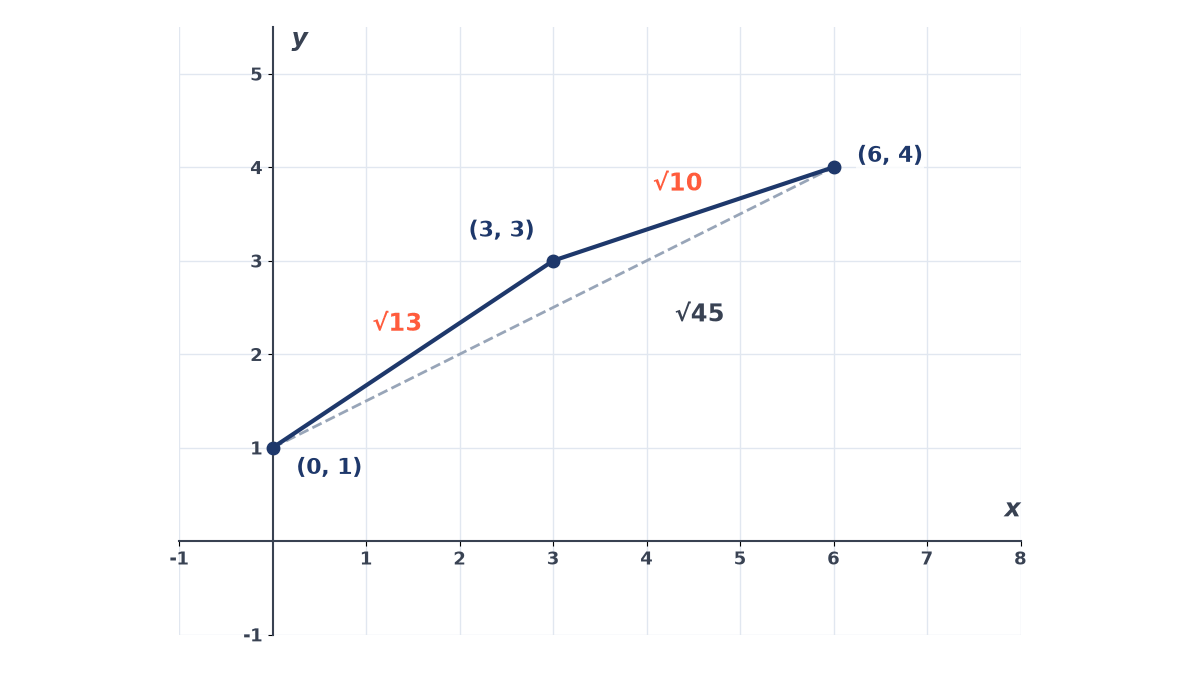
Decide whether (1,2), (4,8) and (6,12) are collinear, and then whether (0,1), (3,3) and (6,4) are.
What type of triangle has vertices (2,−3), (3,5) and (4,−3)?
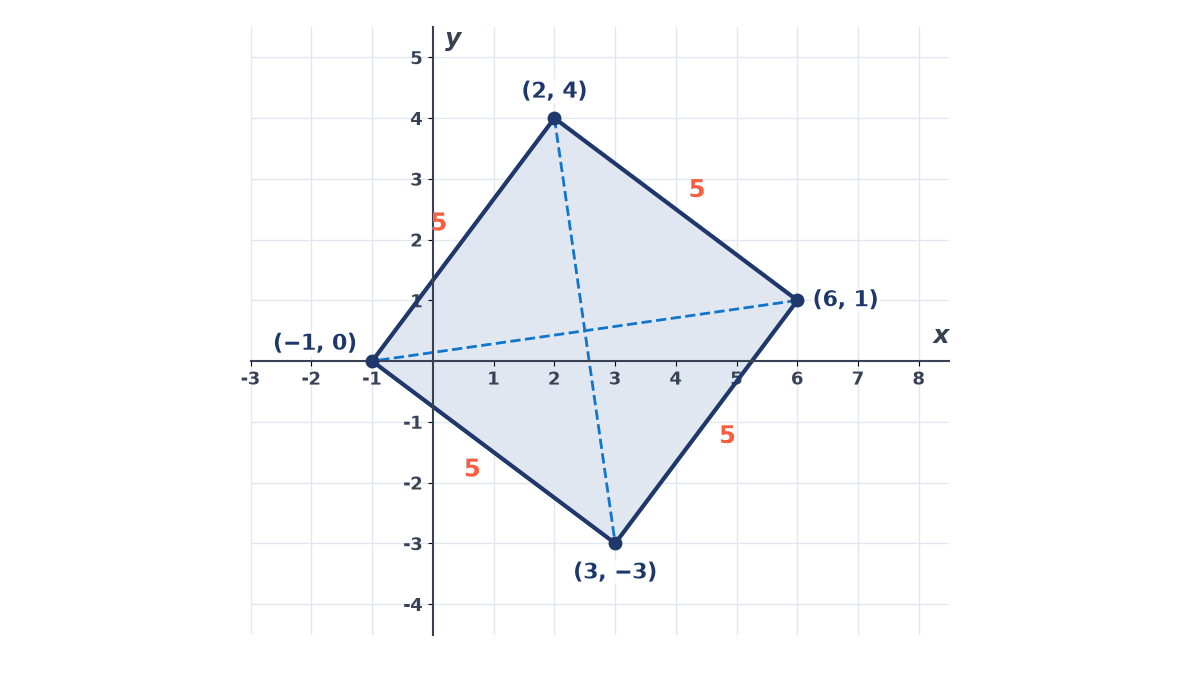
Show that (2,4), (6,1), (3,−3) and (−1,0) are the vertices of a square.
Question 3: the second set of points bends, so it is not a lineQuestion 5: the four points joined in order
Section B: Section formula
Find the point that divides the segment from (4,−1) to (−2,−3) in the ratio 1:2.
Find the midpoint of (−5,4) and (3,−2).
The point (−3,p) divides the segment from (−5,−4) to (−2,3). Find the ratio and p.
In what ratio does the x-axis divide the segment from (1,−3) to (4,5)? Find the point where it cuts.
Section C: Mixed
A circle has centre (2,−3), and one end of a diameter is (1,4). Find the other end.
A parallelogram has vertices (2,1), (5,y), (x,7) and (4,6), taken in order round the figure. Find x and y.
Find the point on the x-axis that is equally far from (7,6) and (−3,4).
Answers
Show answers
36+64=10.
(a−2)2+16=25, so (a−2)2=9, which gives a=5 or a=−1.
For the first set, 35+25=55, so they are collinear. For the second set the distances are 13, 10, 45, and 13+10≈6.77=45≈6.71. Close, but not equal, so these are not collinear.
AB=1+64=65, BC=1+64=65, CA=2. Two equal sides, so it's isosceles.
Each side is 16+9=5. For the diagonals, (2,4) to (3,−3) is 1+49=50, and (6,1) to (−1,0) is 49+1=50. Equal sides and equal diagonals, so it's a square.
(3−2+8,3−3−2)=(2,−35).
(−1,1).
Take the ratio as k:1. Then k+1−2k−5=−3, so −2k−5=−3k−3 and k=2. The ratio is 2:1, and p=33⋅2−4=32.
Every point on that axis has y=0, so k+15k−3=0, giving k=53 and the ratio 3:5. Then x=584⋅53+1=58517=817, so the point is (817,0).
The centre is the midpoint of the diameter. So 21+x=2 gives x=3, and 24+y=−3 gives y=−10. The other end is (3,−10).
The diagonals share a midpoint. So 22+x=25+4 gives x=7, and 21+7=2y+6 gives y=2. Check: AB and DC both come out as the displacement (3,1) ✓.
Take the point as (x,0). Then (x−7)2+36=(x+3)2+16, so −14x+85=6x+25, and x=3. The point is (3,0). Check: 16+36=52=36+16 ✓.
Test yourself
Coordinate Geometry: Mixed Practice, Quiz
Five questions on the whole Coordinate Geometry chapter. Pick one answer for each.