What Is a Quadratic Equation? Standard Form and Examples
Learn what makes an equation quadratic, how to write it in standard form, how to test untidy equations by expanding them, and how to turn word problems about a prayer hall, marbles and toys into quadratic equations.
A quadratic equation is an equation in which the highest power of the unknown is 2, such as 2x2+x−300=0. Quadratic equations turn up whenever two unknown quantities are multiplied together: the area of a room, the product of two ages, the total cost when the price depends on the quantity, or the time taken when speed changes. This lesson, based on Chapter 4 of the NCERT Class 10 textbook, explains what makes an equation quadratic, how to write it in standard form, how to turn a word problem into one, and how to test whether an untidy equation is really quadratic.
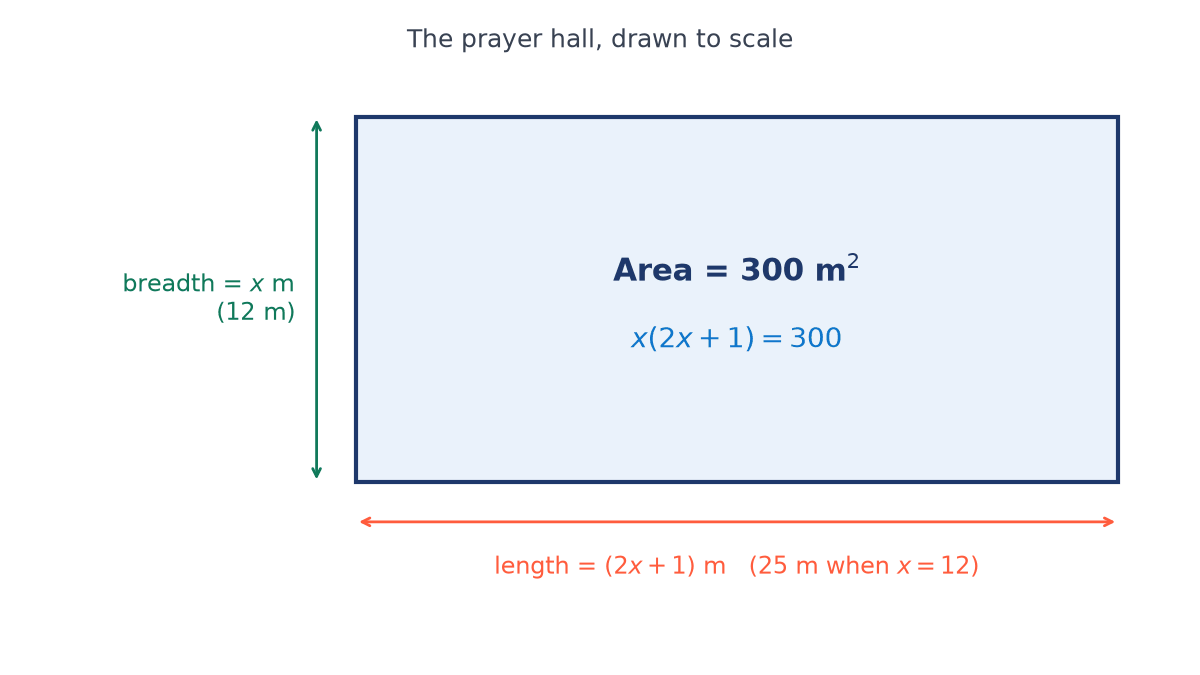
A charity trust wants to build a prayer hall. The carpet area must be exactly 300 square metres, and the length of the hall must be one metre more than twice its breadth. What should the length and breadth be?
Give the unknown a letter. Let the breadth of the hall be x metres. The length is "one metre more than twice the breadth", so the length is (2x+1) metres. Now use the area:
area=length×breadth=(2x+1)×x=2x2+x
The area is 300 square metres, so 2x2+x=300. Moving every term to one side gives
2x2+x−300=0
The prayer hall: breadth x m, length (2x+1) m, area 300 m². It is drawn at the true answer, x=12, which the next lesson finds.
This equation is different from the linear equations you already know, such as 3x+5=20, where x appears only to the first power. Here x is squared, and that changes how the equation must be solved. That is why such equations get their own name and their own chapter.
A quadratic equation in the variable x is an equation of the form
ax2+bx+c=0,a=0
where a, b and c are real numbers. The condition a=0 is essential. If a were 0, the x2 term would disappear and we would be left with bx+c=0, which is a linear equation.
More generally, any equation of the form p(x)=0, where p(x) is a polynomial of degree 2, is a quadratic equation.
a is the coefficient of x2 (also called the leading coefficient);
b is the coefficient of x;
c is the constant term.
When the terms are written in descending order of powers and set equal to zero, the equation is in standard form. The prayer hall equation 2x2+x−300=0 is already in standard form, with a=2, b=1 and c=−300.
The equations 2x2−3x+1=0 and 4x−3x2+2=0 are both quadratic. The second is not written in standard form, because the squared term is not first. Rearranging from the highest power to the lowest gives −3x2+4x+2=0, so a=−3, b=4 and c=2. If you prefer a positive leading coefficient, multiply every term by −1 to get 3x2−4x−2=0; this is the same equation, with the same roots.
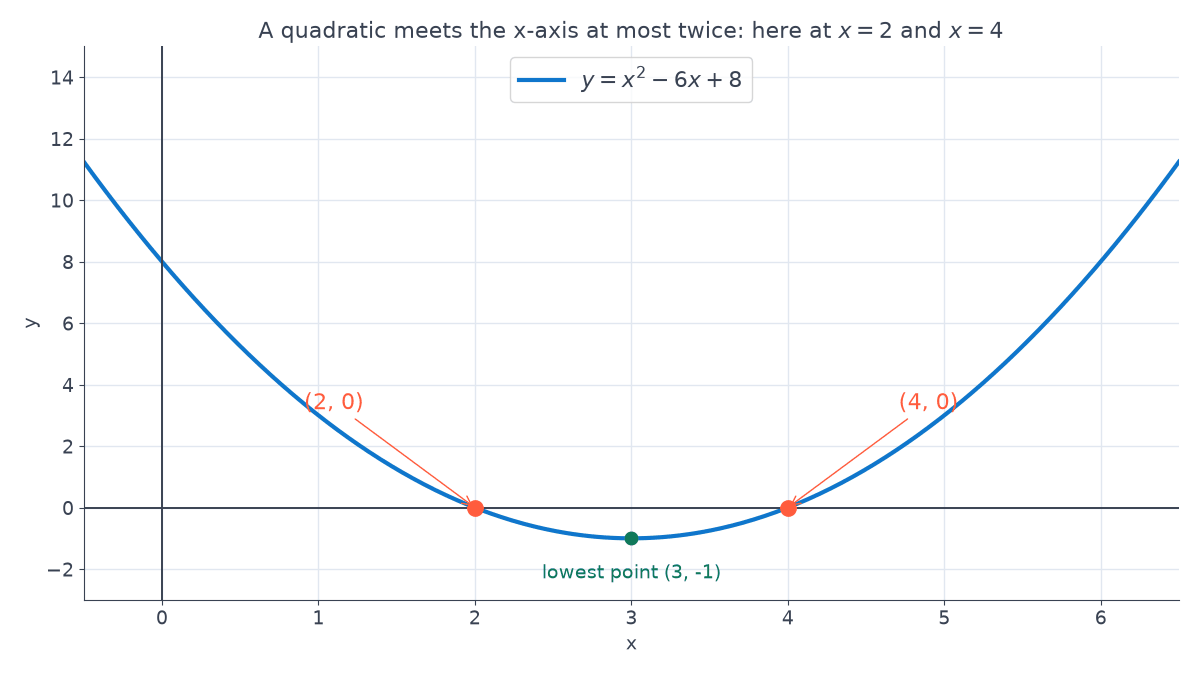
A quadratic polynomial has at most two zeroes, so a quadratic equation has at most two roots. On a graph, the curve y=ax2+bx+c (a parabola) meets the x-axis at most twice. You will use this idea again when you study the discriminant.
The graph of y=x2−6x+8 crosses the x-axis at x=2 and x=4: two roots, and no more.
Expand every bracket on both sides, using identities such as (a+b)2=a2+2ab+b2 and (a+b)3=a3+3a2b+3ab2+b3.
Bring all terms to one side so that the other side is 0.
Collect like terms and simplify.
Look at the highest power of x that survives. If it is x2 with a non-zero coefficient, the equation is quadratic. If the x2 terms cancel and only x remains, it is linear. If an x3 term survives, it is cubic.
Example 1. Is (x−2)2+1=2x−3 a quadratic equation?
Expand the left-hand side: (x−2)2+1=x2−4x+4+1=x2−4x+5. So the equation is x2−4x+5=2x−3. Bringing everything to the left:
x2−4x−2x+5+3=0⟹x2−6x+8=0
This has the form ax2+bx+c=0 with a=1=0. It is a quadratic equation. (Its graph is the one shown above.)
Example 2. Is x(x+1)+8=(x+2)(x−2) a quadratic equation?
The left-hand side is x2+x+8 and the right-hand side is x2−4. So x2+x+8=x2−4. The x2 term appears on both sides with the same coefficient, so it cancels:
x+8+4=0⟹x+12=0
No x2 term is left. This is a linear equation. It is not a quadratic equation, even though it looked like one at first.
Example 3. Is x(2x+3)=x2+1 a quadratic equation?
The left-hand side is 2x2+3x, so 2x2+3x=x2+1, which rearranges to
2x2−x2+3x−1=0⟹x2+3x−1=0
Here 2x2 and x2 do not cancel completely. It is a quadratic equation.
Example 4. Is (x+2)3=x3−4 a quadratic equation?
Using the cube identity, (x+2)3=x3+3x2(2)+3x(22)+23=x3+6x2+12x+8. So
x3+6x2+12x+8=x3−4
The x3 terms cancel, leaving 6x2+12x+12=0. Dividing every term by 6:
x2+2x+2=0
The equation looked cubic, but after simplification it is a quadratic equation. The lesson from all four checks: never judge an equation by its appearance. Expand, simplify, and only then decide.
Turning a word problem into a quadratic equation#
Example 5. John and Jivanti together have 45 marbles. Each of them loses 5 marbles, and the product of the numbers they now have is 124. Form an equation to find how many marbles each had at the start.
Let John have had x marbles. Then Jivanti had 45−x. After losing 5 each, John has x−5 and Jivanti has 45−x−5=40−x. The product is 124:
(x−5)(40−x)=124
Expand the left-hand side carefully:
(x−5)(40−x)=40x−x2−200+5x=−x2+45x−200
So −x2+45x−200=124, that is, −x2+45x−324=0. Multiplying every term by −1 to make the leading coefficient positive:
x2−45x+324=0
This is the required quadratic equation. Solving it in the next lesson gives x=9 or x=36.
Example 6. A cottage industry makes a certain number of toys in a day. The cost of producing each toy (in rupees) is 55 minus the number of toys made that day. On a particular day the total cost of production was ₹750. Form an equation to find the number of toys made that day.
Let x be the number of toys made that day. The cost of each toy is ₹(55−x), so the total cost is x(55−x) rupees. Therefore
x(55−x)55x−x2−x2+55x−750x2−55x+750=750=750=0=0
This is the required quadratic equation. Its roots, found by factorisation, are 25 and 30, and both make sense: check that 25×30=750 and 30×25=750.
Quadratic equations are very old. The Babylonians are believed to have been the first to solve them: they could find two positive numbers from their sum and their product, which is the same as solving x2−px+q=0. Euclid gave a geometric way of finding lengths that, in today's language, are roots of quadratic equations. Brahmagupta (598–665 CE) gave an explicit formula for equations of the form ax2+bx=c, and Sridharacharya (about 1025 CE) derived the formula now known as the quadratic formula. The Arab mathematician Al-Khwarizmi (about 800 CE) studied quadratic equations of different types, and Abraham bar Hiyya Ha-Nasi, in his book Liber embadorum published in Europe in 1145 CE, gave complete solutions of different quadratic equations.
Deciding an equation is quadratic because it contains x2 somewhere, without simplifying. If the x2 terms cancel, as in Example 2, it is not quadratic.
Deciding an equation is not quadratic because it contains x3. If the x3 terms cancel, as in Example 4, it may well be quadratic.
Forgetting the condition a=0 in the definition.
Sign errors when expanding a product such as (x−5)(40−x): expand term by term and write every sign.
Reading off a, b and c before putting the equation in standard form, for example taking a=4 in 4x−3x2+2=0.
Forgetting to say what the letter stands for, with units, in a word problem.
Is (x+3)2=x2+6 a quadratic equation? Answer: No. It simplifies to 6x+3=0, which is linear.
Is x(x−4)+2=(2x−1)(x+1) a quadratic equation? Answer: Yes. It simplifies to x2+5x−3=0.
Write 5−2x2+3x=0 in standard form and state a, b and c. Answer: −2x2+3x+5=0, so a=−2, b=3, c=5 (equivalently 2x2−3x−5=0).
The product of two consecutive positive even integers is 168. Form the quadratic equation, taking the smaller integer as x. Answer: x2+2x−168=0.
The sum of a non-zero number and its reciprocal is 310. Form the quadratic equation. Answer: 3x2−10x+3=0.
Is (x−1)3=x3+x a quadratic equation? Answer: Yes. It simplifies to −3x2+2x−1=0, that is, 3x2−2x+1=0.
No. Multiplying every term by the same non-zero number gives an equivalent equation with exactly the same roots, so −x2+45x−324=0 and x2−45x+324=0 have the same solutions.
Do I have to solve the equation when a question says "represent the situation mathematically"?#
No. Such a question only asks for the equation in standard form. Solving it is the next step, covered in the lesson on factorisation.