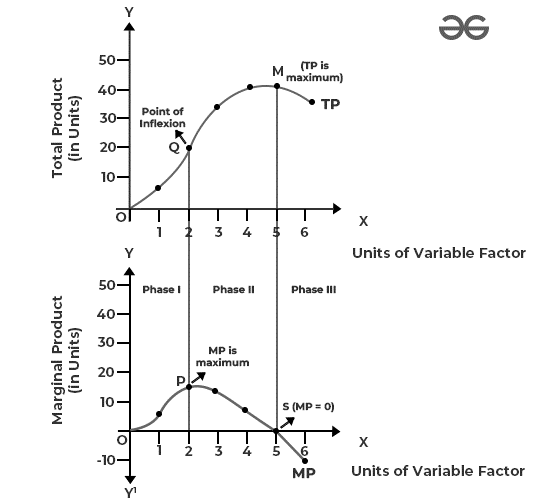
When more and more of one input is added to a fixed input, total product first rises quickly, then slowly, and finally falls. A worked table shows the three phases.
Imagine that a farmer is cultivating wheat only by using more and more labour in a circumstance where land is a fixed factor and labour is a variable factor. Here is the key question: will each extra worker on the same field add the same amount of wheat? In other words, will the marginal product (MP) of labour stay the same for every new worker? It cannot.
A country like India would have produced more and more wheat by employing more and more labour on the same piece of land, if the MP of labour remained constant (regardless of how much labour is used). There would never have been a food shortage. In reality, MP must eventually fall. The reason is simple: there is always a best ratio between the factors of production. Suppose labour (L) and capital (K) are used together and K is fixed. The marginal product of labour (MPL) is highest near the best K:L ratio. Once that ratio is passed, each extra unit of L means the fixed factor is spread more thinly over more workers and is overused. Therefore, MPL must begin to decrease. It might eventually get to the point where adding a new labour unit (on the same land) does not affect overall output. This implies that MPL becomes zero. As previously stated, MP might even become negative in exceptional circumstances. This is how the Law of Returns or the Law of Varying Proportions works.
Returns to Factor: Law of Variable Proportions#
Returns to a factor refer to the change in total product that results from increasing just one factor while holding the other factors constant. The production of the firm displays the Law of Variable Proportions in the short term when one input is variable, and the other inputs are fixed.
The Law of Variable Proportions states that as we increase the quantity of only one input while keeping other inputs fixed, the total product(TP) increases initially at an increasing rate, then at a decreasing rate, and finally at a negative rate.
As per the law of variable proportions, the changes in TP and Marginal Product (MP) can be categorised into three phases:
Phase 1: TP rises at an increasing rate, and MP increases.
Phase 2: TP rises at decreasing rate, MP decreases and is positive.
Phase 3: TP falls, and MP becomes negative.
Assumptions of the Law of Variable Proportions#
It operates in the short run because the factors are categorized as variable and fixed.
The law applies to all fixed factors, including land.
The law of variable proportions allows for the combination of several variable units with fixed factors.
This law primarily applies to the production sector.
It is simple to calculate the impact of a change in output caused by a change in variable factors.
It is considered that after a certain point, factors of production become imperfect substitutes for one another.
For this law to function, it is assumed that the state of technology would remain constant.
All variable factors are thought to be equally effective.
For example, say a farmer has 1 acre of land (i.e., fixed factor) and wants to use labour (i.e., variable factor) to improve the production of rice there. The output increased initially at an increasing rate, then at a decreasing rate, and finally at a negative rate as he employed more and more units of labour. The below table displays the output behaviour in this case.
Fixed Factor
(Land)
Variable Factor
(Labour)
TP
(units)
MP
(units)
Phase
1
1
5
5
Phase I: Increasing Returns to a Factor
1
2
20
15
1
3
32
12
Phase II: Decreasing Returns to a Factor
1
4
40
8
1
5
40
0
1
6
35
-5
Phase III: Negative Returns to a Factor
Phase I: Increasing Returns to a Factor (TP increases at an increasing rate)#
In the initial stage, each additional variable component raises the total production by an increasing amount. This indicates that each variable’s MP rises and that TP rises at an increasing rate.
It occurs as a result of the initial variable input quantity being too small in comparison to the fixed input. Due to the division of labour, efficient use of the fixed input during manufacturing increases the productivity of the variable input.
One labour generates 5 units, as shown in the schedule and diagram, whereas two labours produce 20 units. It means that MP rises until it reaches its maximum point at point P, which signifies the end of the first phase, while TP rises at an increasing rate (up to point Q).
Point of Inflexion A point from where the slope of TP curve changes is known as point of inflexion. Up to the point of inflexion, TP increases at an increasing rate; from this point onwards, it increases at a diminishing rate.
Phase II: Decreasing Returns to a Factor (TP increases at a decreasing rate)#
In the second phase, each extra unit of the variable factor adds a smaller and smaller amount to output. This indicates that when the variable factor increases, MP decreases, and TP rises at a decreasing rate. This stage is known as the diminishing returns to a factor.
This occurs as a result of pressure on fixed inputs that results in a decline in variable input productivity after a certain level of output.
When MP is zero (point S), and TP is at its maximum (point M) at 40 units, the second phase comes to an end.
The second phase is highly important because a rational producer will always try to produce during this time because MP and TP are both positive for each variable factor.
Phase III: Negative Returns to a Factor (TP falls)#
The third phase shows a decline in TP due to the use of more variable factors. MP has now become negative. As a result, this stage is referred to as negative returns to a factor.
It occurs when the amount of variable input exceeds the fixed input by a great difference, which causes TP to decrease.
The third phase in the above graph begins after points S on the MP curve and M on the TP curve.
In the third phase, MP for each variable factor is negative. Therefore, no company would deliberately decide to operate at this phase.
A logical or rational producer will always attempt to operate in Phase II of the Law of Variable Proportion at all times.
In Phase I, every additional unit of the variable factor raises the marginal product. Adding more units keeps raising output faster, so there is scope for greater profit, and a rational producer will not stop in this phase.
In Phase III, each variable’s marginal product is negative. Therefore, this phase is eliminated due to technical inefficiency, and a rational manufacturer would never engage in the third phase of production.
So a producer will choose to operate in Phase II, where the MP of the variable factor is positive and TP is still rising towards its maximum.
The reasons for the three phases of the law of variable proportions are:
Reasons for Increasing Returns to a Factor (Phase I)#
The operation of increasing returns to a factor is carried out for three key reasons:
1. More Effective Use of Fixed Factor: In the initial stage, a number of fixed factors are available, while there aren’t enough variable factors. The fixed factor is therefore not completely utilised. The fixed factor is better used, and output increases at an increasing rate when the variable factors are increased and combined with fixed factors.
2. Increased Efficiency of Variable Factor: The variable factors must be increased and combined with the fixed factor, in order to use the former more efficiently. Besides, there is a high degree of specialisation and increased cooperation among the different units of the variable factors.
3. Fixed Factor Indivisibility: In general, fixed factors that are integrated with variable factors are not divisible. It means that these elements cannot be divided into smaller parts. As more units of the variable components are given, the utilisation of the fixed factor improves after an investment has been made in an indivisible fixed factor. Increasing returns continue until the ideal combination of variable and fixed factors is reached.
Reasons for Decreasing Returns to a Factor (Phase II)#
The occurrence of diminishing returns to a factor is due to these three key reasons:
1. Optimum Combination of Factors: There is only one optimal combination between a variable and a fixed factor where the overall product is maximum. The marginal return of the variable factor begins to decrease after the fixed factor has been utilised to its fullest potential. For instance, if a machine (fixed factor) is being used to its full potential with 4 workers, adding a fifth worker will improve TP only slightly, and MP will begin to decline.
2. Over-utilization of Resources: The fixed component finally reaches its limits and begins to produce diminishing returns as one continues increasing the variable factor.
3. Imperfect Substitutes: Fixed and variable factors are imperfect substitutes for one another, which results in diminishing returns to a factor. There is an extent to which one factor of production can be substituted for another. For instance, until a certain point, capital may be used in place of labour or labour may be used in place of capital. Beyond that point, one cannot make up for the other, and returns decline.
Reasons for Negative Returns to a Factor (Phase III)#
The occurrence of negative returns to a factor is due to these three major reasons:
1. Limitation of Fixed Factor: The reason why some production factors have negative returns is that they are fixed in nature and cannot be raised in the short run together with an increase in the variable factor.
2. Lack of Coordination: When the variable factor dominates the fixed factor, they interfere with one another. It causes a lack of coordination between the fixed and the variable factor. As a result, total output falls rather than rises, and the marginal product becomes negative.
3. Decrease in Efficiency of Variable Factor: The benefits of specialisation and the division of labour begin to diminish as variable factors continue to increase. It causes inefficiencies of variable factors, which is another element that finally leads to negative returns.