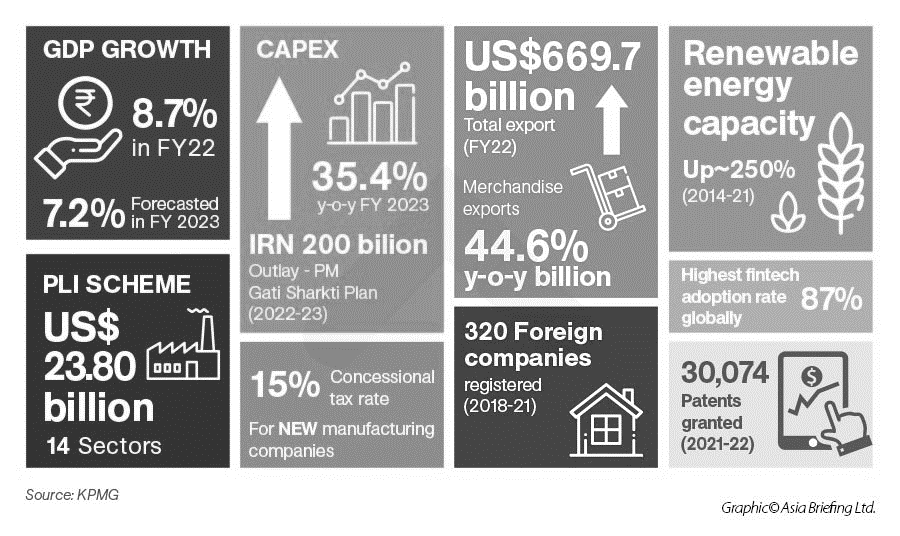
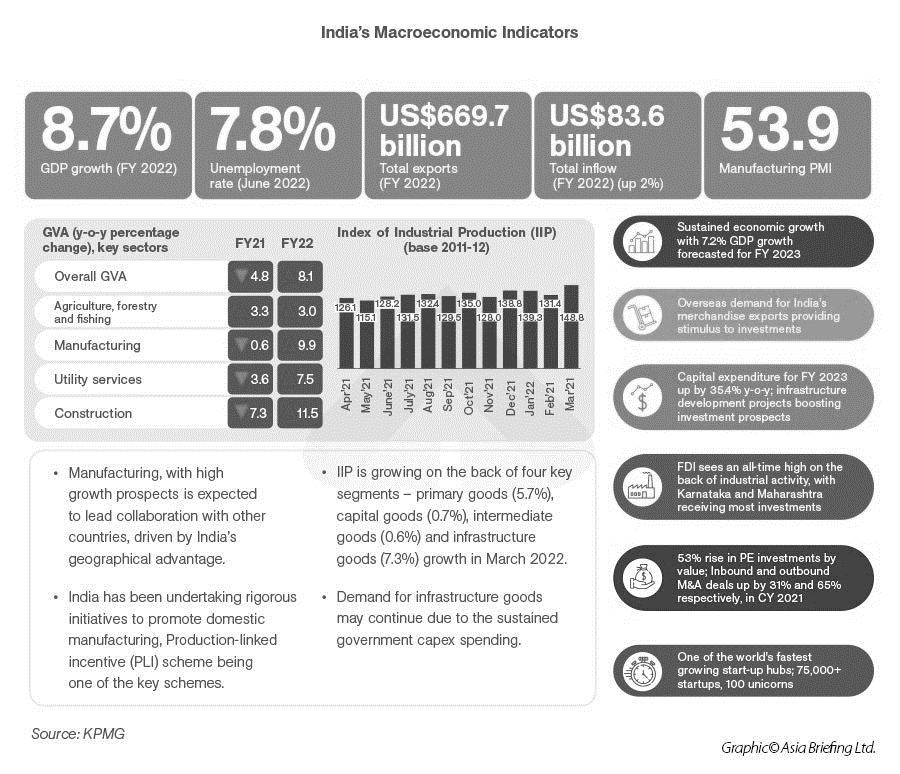
According to estimates from the International Monetary Fund (IMF), India’s economy surpassed that of the United Kingdom in terms of size in 2022 and rose to become the fifth largest in the world with a 7.2 percent growth forecast for FY 2023.
Despite global headwinds, India is well positioned to register impressive growth, backed by robust demand from its large domestic markets. A recent World Bank report titled “Navigating the Storm” underlines that Indian economy has proved remarkably resilient to the ongoing impacts of the deteriorating external environment, growing faster than most major emerging market economies (EMEs).
With the banking system in good health to support the nation’s economic recovery, it is anticipated that private sector investment will rise in the forthcoming year, making India the bright spot in the Asian business and investment landscape.
Factors facilitating ease of doing business in India#
At the heart of ease of doing business reforms in India has been an extensive focus on rationalization and digitalization of regulatory compliances, encompassing the entire business cycle from start to exit. Rationalization of regulatory compliances received the topmost priority in India. In 2022, the government has worked to simplify, rationalize and digitize 33,000 compliances across federal ministries, departments and States.
Trade facilitation has also seen a flurry of reforms recently, where India’s global ranking jumped up from 146th position in 2018 to 68th position in 2020. Initiatives such as the shift towards paperless compliance system, greater clearances through Risk Management System, etc. have helped lower dwell-time and transaction costs for exporters and importers.
Rigorous reform measures introduced as part of Business Reform Action Plan (BRAP) since 2014, entailing their annual assessment and rankings, have also contributed to sustained improvement in the business environment at a pan-India level.