In Koutsoyiannis's words, returns to scale refer to the change in output when all factors of production are changed at the same time and in the same proportion.
Liebhafsky describes returns to scale as the behaviour of total output when all inputs are changed together. Because every input can be changed only in the long run, it is a long-run concept.
Increasing returns to scale (diminishing costs)#
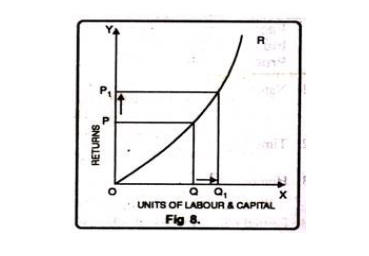
Increasing returns to scale, also called diminishing costs, occur when increasing all the factors of production raises output by a greater proportion.
For instance, if all inputs are doubled, output more than doubles.
This comes from things like the division of labour and economies of scale, and is shown below.
The x-axis (OX) shows labour and capital, and the y-axis (OY) shows output. When labour and capital rise from Q to Q1, output rises from P to P1, a proportionately larger increase than in the inputs.
Diminishing returns to scale (increasing costs)#
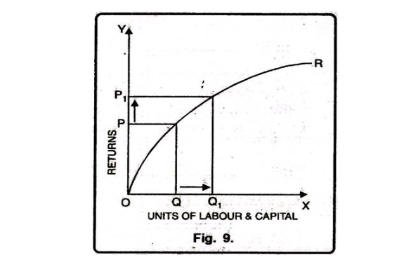
Diminishing returns to scale, also called increasing costs, occur when increasing all the factors of production in the same proportion raises output by a smaller proportion.
In other words, doubling all inputs less than doubles output.
This happens when internal and external diseconomies outweigh the economies of scale.
The x-axis (OX) shows the quantities of labour and capital, and the y-axis (OY) shows output. When inputs rise from Q to Q1, output rises only from P to P1, a proportionately smaller increase. Inputs have grown faster than output, which is what diminishing returns to scale means.
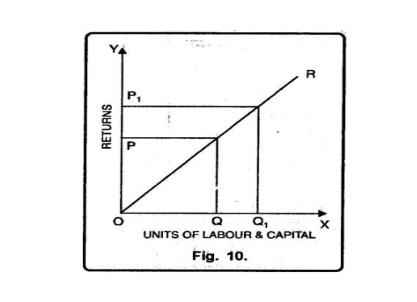
Constant returns to scale, also called constant costs, occur when output increases in exactly the same proportion as the factors of production: double the inputs, and output doubles.
This happens when economies and diseconomies of scale balance each other, usually beyond a certain level of production.
The straight line shows that a given proportionate increase in labour and capital brings exactly the same proportionate increase in output.