Finding the right Maths tutor in Vijayawada can feel like solving a hard equation. There are coaching centres all the way from Benz Circle to Poranki, and each promises results. This guide is for parents who want to look past the signboard and judge the person who will actually teach their child.
Its angle is the tutor rather than the building: how a good Maths teacher explains, notices mistakes and builds confidence, and how you can see those qualities for yourself in a demo class. It describes the approach of Expresswala Academy, which the article regards as the leading choice locally, and answers the questions parents most often ask.
The article’s view is that personalised, expert-led mentoring works better for most students than crowded classrooms. Whatever you choose, the checks below will help you decide with evidence.
The tutor behind Expresswala Academy
According to the article, the academy’s approach rests on its teacher. Classes are led by Ravindra Reddy Kondamadugula, who brings over 25 years of experience. The article describes the academy as a benchmark for Mathematics teaching in Vijayawada.
A concept-first method
Many tutors concentrate on memorising the steps to a problem. The method described here puts the “why” before the “how”. Whether the topic is simple addition for a Class 2 student or calculus for an Intermediate student, the aim is full conceptual clarity.
Small batches
The article notes that some coaching centres in the city seat around 60 students in a room, while Expresswala limits batches to 8–15 students. A small group lets the tutor see exactly where a student is struggling, whether it is a gap in the foundation or a simple calculation slip, and correct it on the spot.
From Maths phobia to confidence
The academy works with students who are anxious about numbers and helps them become confident problem-solvers. The article states that parents from Poranki, Kanuru and Tadigadapa consistently rate it as their top choice.
Programmes by stage
The article describes three programme tracks.
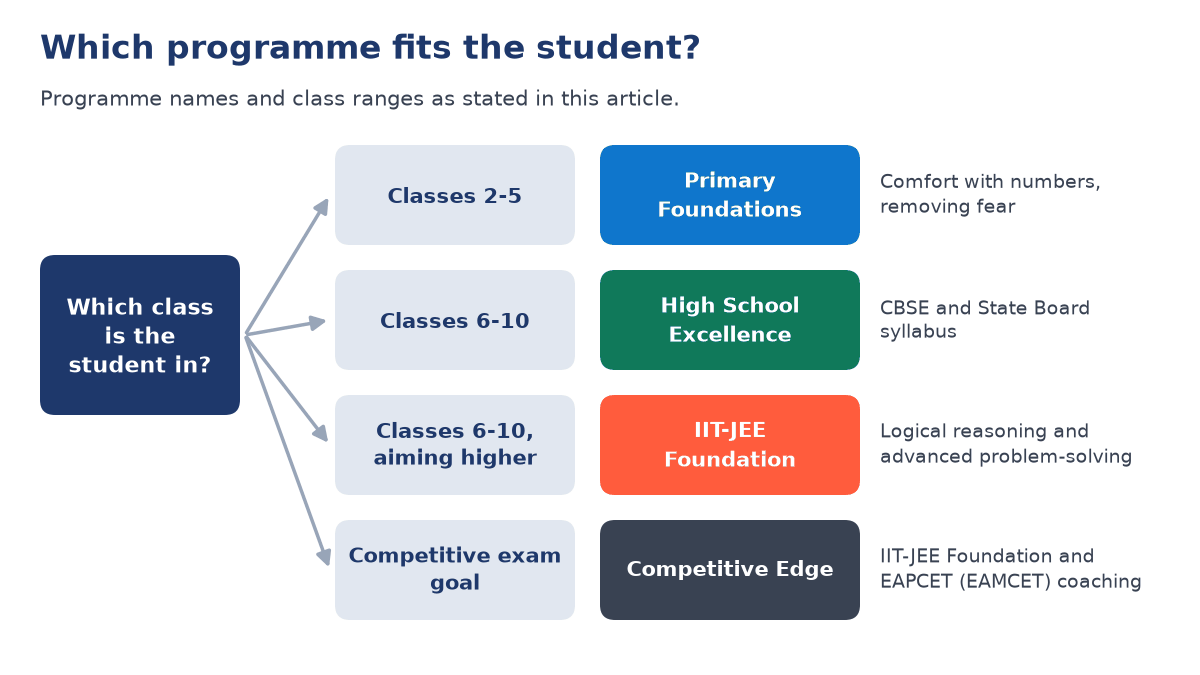
- Primary Foundations (Classes 2–5): building a liking for numbers through interactive learning.
- High School Excellence (Classes 6–10): working through the CBSE and State Board curricula.
- Competitive Edge: coaching for IIT-JEE Foundation and EAPCET (EAMCET).
Locations and timings
The academy is located in RTC Colony (Poranki) and Tulasi Nagar (Kanuru), with timings meant to fit around a family’s schedule:
- Early sessions from 5:45 AM.
- Late evening batches until 10:00 PM.
- Sunday support for doubt clearing from 8:30 AM to 10:00 PM.
How to judge a Maths tutor in a demo class
A tutor’s qualifications and years of experience matter, but the clearest evidence is a real lesson. Sit in, or ask your child to describe the class afterwards, and look for these signs.
- Explanation before procedure. Does the tutor say why a method works before asking students to repeat it?
- Response to a wrong answer. A good tutor asks the student to explain their thinking and finds the exact step that went wrong, without embarrassment.
- Checking understanding. Listen for questions such as “why did we do that?” rather than only “is that clear?”
- Attention to quiet students. Notice whether every student is drawn in, not only the quickest ones.
- Written work. See whether the tutor looks at students’ notebooks and corrects the setting-out of answers.
- Pace. The lesson should move steadily, with time for practice, not rush through a chapter.
Signs that the match is working
After a few weeks, a student who is well matched with a tutor usually asks more questions, attempts unfamiliar problems instead of skipping them, and can explain a method in their own words. If none of this appears, talk to the tutor before deciding anything.
Questions to ask before you enrol
- Who will teach my child each week, and for how long has that teacher taught this level?
- How many students are in this batch?
- How will you find out where my child’s gaps are?
- What study material and practice are given, and how is homework checked?
- How often are tests held, and how is feedback shared with parents?
- Is the batch aligned with my child’s board?
Common mistakes
- Judging a tutor only by qualifications, without watching a lesson.
- Expecting quick marks while skipping the rebuilding of weak basics.
- Moving a child from tutor to tutor every few weeks before any method can work.
- Choosing a competitive-exam track when the student first needs school-level confidence.
- Not telling the tutor about the student’s specific difficulties at the start.
Key terms
- Conceptual clarity
- Understanding why a rule or method works, so it can be applied to unfamiliar questions.
- Maths phobia
- Anxiety about Mathematics that makes a student avoid practice and freeze in tests.
- Batch size
- The number of students taught together; smaller groups allow more individual attention.
- CBSE
- The Central Board of Secondary Education, a national school board using NCERT textbooks.
- ICSE
- A school examination conducted by the Council for the Indian School Certificate Examinations.
- State Board
- The state government’s school board, with its own syllabus and exam pattern.
- IIT-JEE Foundation
- School-stage preparation that builds the reasoning needed for engineering entrance exams.
Common questions
These answers are the academy’s own, as given in the article.
My child is very weak in Maths. Can a tutor really help?
Yes. The academy says it specialises in rebuilding foundations: it goes back to basics such as tables, division and logic so that the student feels confident before moving to the current class syllabus.
Is there a difference between school tuition and IIT-JEE Foundation?
Yes. Regular tuition aims at scoring well in school exams (CBSE/State Board). IIT-JEE Foundation, offered for Classes 6–10, focuses on logical reasoning and advanced problem-solving for national entrance exams. The academy offers both, depending on the student’s goals.
Why choose Expresswala over a large coaching centre?
The academy says that in big centres a child can be one of 60+ students, while its batches of 8–15 students let the tutor know each child’s name, weaknesses and progress.
Do you provide study materials or only classroom teaching?
The academy states that it provides structured study material, regular assignments and access to its learning app for revision, and conducts weekly tests with feedback shared with parents.
Are there separate batches for CBSE and State Board students?
The academy says that while core Mathematics is the same, it tailors teaching to the exam patterns and textbook requirements of CBSE, ICSE and the AP State Board.
Contact Expresswala Academy
- Poranki branch: Plot 31, Road No 1, RTC Colony, Poranki.
- Kanuru branch: Flat 201, Vasanth Gopal App, Tulasi Nagar 4th Line.
- Call/WhatsApp: +91 9059912593
- Website: expresswala.in
References
- Central Board of Secondary Education. Curriculum for Secondary and Senior Secondary Classes. CBSE, New Delhi.
- Council for the Indian School Certificate Examinations. ICSE and ISC regulations and syllabuses. CISCE, New Delhi.
- Board of Secondary Education, Andhra Pradesh. SSC examinations. BSEAP, Vijayawada.
- National Testing Agency. Joint Entrance Examination (Main) information bulletin. NTA, New Delhi.