You already know how to find the H.C.F of two numbers such as and . In algebra the same question is asked about terms that contain letters, like and . And the answer means the same thing it always did: the biggest thing that divides every term exactly. Why bother? Because you will need it the moment you start factorising: to factorise you first take out the H.C.F of the two terms.
What a monomial is
A monomial is a single algebraic term: a number multiplied by letters, with whole-number powers. , and are monomials. is not, because it has two terms joined by a plus sign.
Every monomial has two parts. The coefficient is the number in front. The variable part is the letters with their powers. In the coefficient is and the variable part is .
Remember what a power means. is , three s multiplied together. So a power simply counts how many copies of a letter the term holds. Keep hold of that idea of counting copies, because everything that follows rests on it.
The rule
The H.C.F of given monomials is the common factor having greatest coefficient and highest powers of the variables.
Remember. The rule above works in two halves. For the numbers, find the H.C.F of the coefficients. For each letter, take it only if it appears in every term, and take the smallest power that appears. The phrase "highest powers" means the highest power that still divides every term, and that is always the smallest power you can see.
Why the smallest power? Take and . The first holds three copies of , the second only two. A common factor can use only as many copies as both terms can spare, so it can use two. would not divide .
The method, step by step
- Write each monomial as its coefficient broken into primes, times its letters.
- Find the H.C.F of the coefficients.
- List the letters that appear in every monomial. A letter missing from even one term is left out.
- For each of those letters, take the smallest power.
- Multiply the results together.
The academy's examples
Ex: 1) Find H.C.F of and .
Sol:
Here is what happened in Example 1. The coefficients and share . The powers of are and , so we take . The powers of are and , so we take . The picture lines the factors up in columns so you can see this.
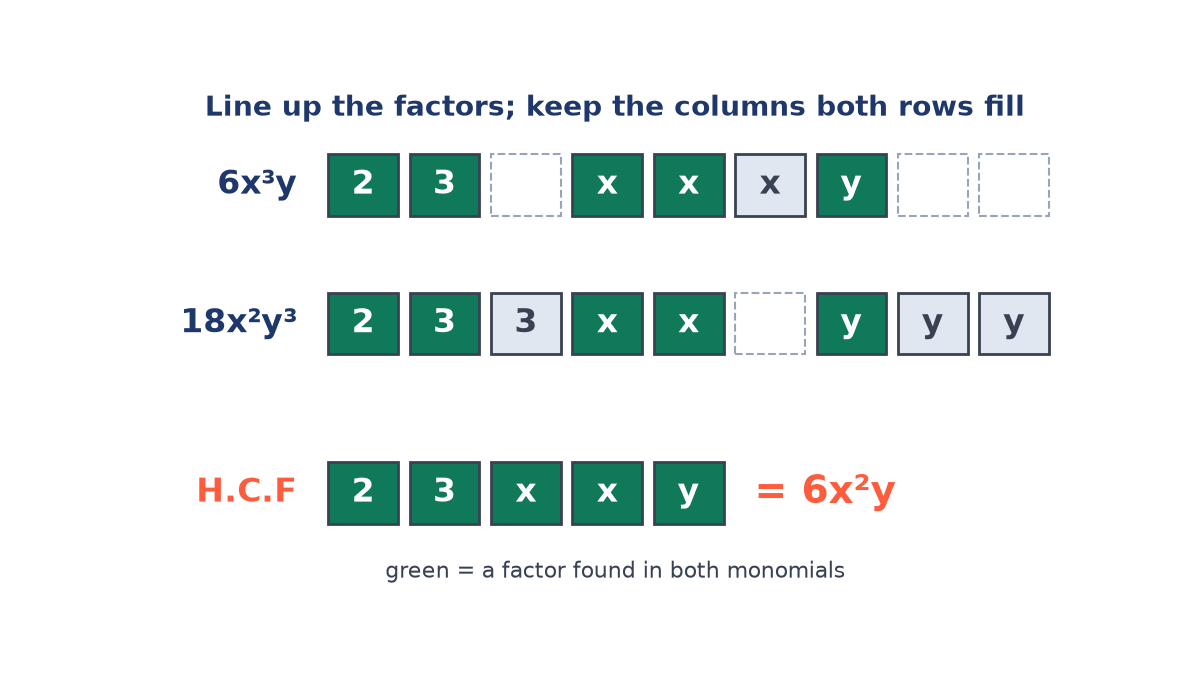
Check it by dividing: and . Both divisions come out with nothing left over, and and share nothing more, so really is the highest.
Ex: 2) Find H.C.F of and .
Sol:
In Example 2 the letter appears in but not in . So cannot be part of the H.C.F. The coefficients and have H.C.F , and appears once in each, giving .
The next four come with their answers already given. Cover the reasons below and try each one yourself first; then check.
Ex: 3) H.C.F of and is 3ab
Ex: 4) H.C.F of and is 2
Ex: 5) H.C.F of and is 12
Ex: 6) H.C.F of and is 7pq
Why those four answers are right
- and : the H.C.F of and is ; the smaller power of is ; the smaller power of is . So .
- and : the H.C.F of and is . The term has no , so no letter is taken. So .
- and : divides , so the H.C.F of the numbers is , and again has no . So .
- and : the H.C.F of and is ; and are in both; is in only one. So .
More worked examples
Example 7: three monomials
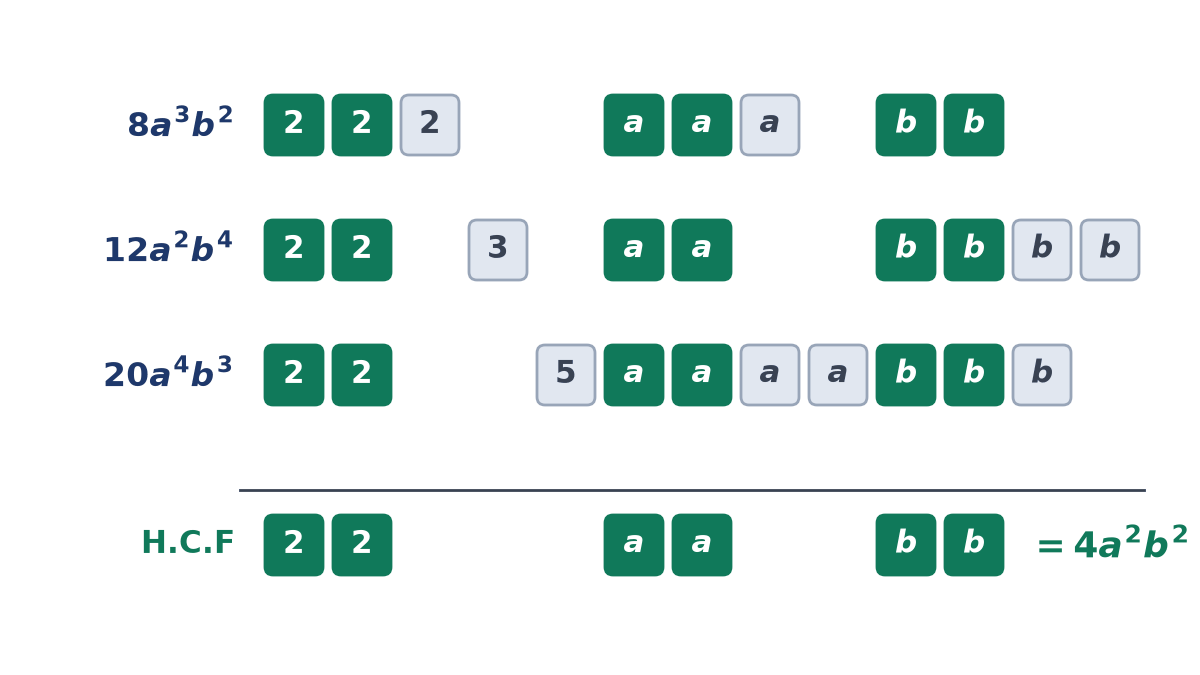
Find the H.C.F of , and .
The only prime in all three coefficients is , and the smallest count of it is two. The smallest power of is , and the smallest power of is .
Example 8: a letter in one term only
Find the H.C.F of and .
The letter is left out, because has none.
Example 9: nothing in common
Find the H.C.F of and . The coefficients and are different primes, so their H.C.F is . The two terms share no letter. So the H.C.F is . Don't be worried by such an answer. It is perfectly correct, and it simply tells you the terms share no common factor except .
Where this is used
The H.C.F is exactly what you take out when you factorise. Because is the H.C.F of and , you can write
Multiply the bracket back out to check: and .
When a coefficient is negative
Signs do not change the method. Find the H.C.F of and by ignoring the minus sign while you work. The H.C.F of and is ; the smaller power of is ; the smaller power of is . So the H.C.F is . By custom the H.C.F is written as a positive term. When you factorise, the minus sign simply stays inside the bracket: .
How to check any answer
Here is a habit worth building: before you move on, test your H.C.F in two ways.
- Does it divide every term? Divide each monomial by your answer. Each result must be a monomial with a whole-number coefficient and no negative powers.
- Is it the highest? Look at the results of those divisions. If they still share a number bigger than , or a letter, your answer was too small.
For Example 7, dividing by gives , and . No number other than divides , and , and no letter is in all three. So passes both tests.
Suppose a student had written instead. It does divide all three terms, so it passes the first test. But dividing gives , and , which still share . So is a common factor, but not the highest one.
Your turn
Find the H.C.F of each set of monomials.
- and
- and
- and
- and
- , and
- and
- and
- and
Common mistakes
- Taking the largest power instead of the smallest. The H.C.F of and is , not .
- Including a letter that is missing from one of the terms, such as putting in the H.C.F of and .
- Finding the L.C.M of the coefficients by mistake, for example giving instead of for and .
- Forgetting the coefficient altogether and writing only the letters.
- Thinking an answer of is wrong. When terms share nothing, the H.C.F is .
Key terms
- Monomial
- A single algebraic term, such as .
- Coefficient
- The number that multiplies the letters in a term.
- Variable
- A letter that stands for a number.
- Power (exponent)
- The small raised number that counts how many copies of a letter are multiplied.
- Common factor
- Something that divides every given term exactly.
- H.C.F of monomials
- The common factor with the greatest coefficient and the highest powers that divide every term.
Answers
Show answers
- , because the terms share no factor.
- . The minus sign belongs to one term only, so the H.C.F is taken as positive.