Equa­tions about change

A dif­fer­en­tial equa­tion ties a func­tion to its own deriv­a­tives. Many real sit­u­a­tions are nat­u­rally described this way: a pop­u­la­tion that grows faster the big­ger it gets, or a cup of tea cool­ing down to room tem­per­a­ture. We will learn the words first (order, degree, gen­eral and par­tic­u­lar solu­tions), see how to form such an equa­tion by get­ting rid of con­stants, and then solve the sim­plest kind, where the vari­ables can be sep­a­rated.

Order, degree and solu­tions

The order is sim­ply the order of the high­est deriv­a­tive present. The degree is the power of that high­est deriv­a­tive when the equa­tion is a poly­no­mial in the deriv­a­tives (if it is not, we say the degree is not defined).

Exam­ple 1. (d2ydx2)3+(dydx)4+y=0\displaystyle \left(\tfrac{d^2y}{dx^2}\right)^3 + \left(\tfrac{dy}{dx}\right)^4 + y = 0 has order 22 and degree 33. But y′′+sin⁡y′=0y'' + \sin y' = 0 has order 22 and no defined degree, because of the sine.

A gen­eral solu­tion car­ries as many arbi­trary con­stants as the order of the equa­tion. A par­tic­u­lar solu­tion is what you get once the given con­di­tions fix those con­stants.

Exam­ple 2. y=Ae3x+Be−3xy = Ae^{3x} + Be^{-3x} is a solu­tion of y′′=9yy'' = 9y. Just dif­fer­en­ti­ate twice: y′′=9Ae3x+9Be−3xy'' = 9Ae^{3x} + 9Be^{-3x}.

Form­ing a dif­fer­en­tial equa­tion

The recipe: dif­fer­en­ti­ate as many times as there are con­stants, then elim­i­nate them.

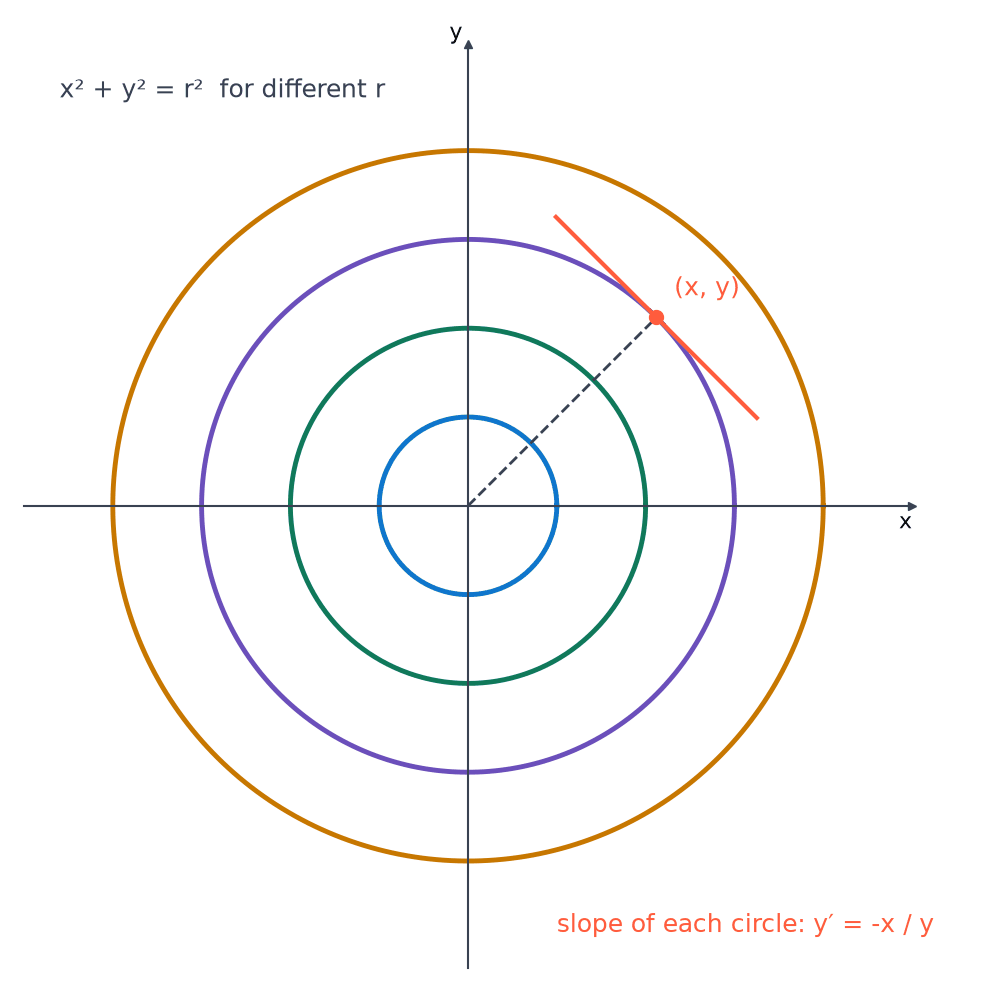
Exam­ple 3. Take the cir­cles of radius rr cen­tred at the ori­gin. Dif­fer­en­ti­at­ing x2+y2=r2x^2 + y^2 = r^2 gives x+yy′=0x + yy' = 0.

Four concentric circles x squared + y squared = r squared centred at the origin, with a radius and the tangent drawn at a point (x, y) on one of them, where the slope is -x/y.
One dif­fer­en­tial equa­tion, x + yy' = 0, describes every cir­cle cen­tred at the ori­gin.

Exam­ple 4. y=asin⁡2x+bcos⁡2xy = a\sin 2x + b\cos 2x: y′′=−4yy'' = -4y, so y′′+4y=0y'' + 4y = 0.

Exam­ple 5. For the parabo­las y2=4axy^2 = 4ax: 2yy′=4a=y2x\displaystyle 2yy' = 4a = \tfrac{y^2}{x}, so 2xy′=y2xy' = y.

Vari­ables sep­a­ra­ble

If dydx=g(x)h(y)\displaystyle \tfrac{dy}{dx} = g(x)h(y), gather every­thing involv­ing one vari­able on one side: dyh(y)=g(x) dx\displaystyle \frac{dy}{h(y)} = g(x)\,dx and then inte­grate both sides.

Exam­ple 6. dydx=x2y\displaystyle \tfrac{dy}{dx} = \tfrac{x^2}{y}: y dy=x2 dxy\,dy = x^2\,dx, y22=x33+C\displaystyle \tfrac{y^2}{2} = \tfrac{x^3}{3} + C.

Exam­ple 7. dydx=(1+y2)ex\displaystyle \tfrac{dy}{dx} = (1 + y^2)e^x with y(0)=0y(0) = 0. Sep­a­rat­ing and inte­grat­ing, tan⁡−1y=ex+C\tan^{-1}y = e^x + C. The con­di­tion gives C=−1C = -1, so y=tan⁡(ex−1)y = \tan(e^x - 1).

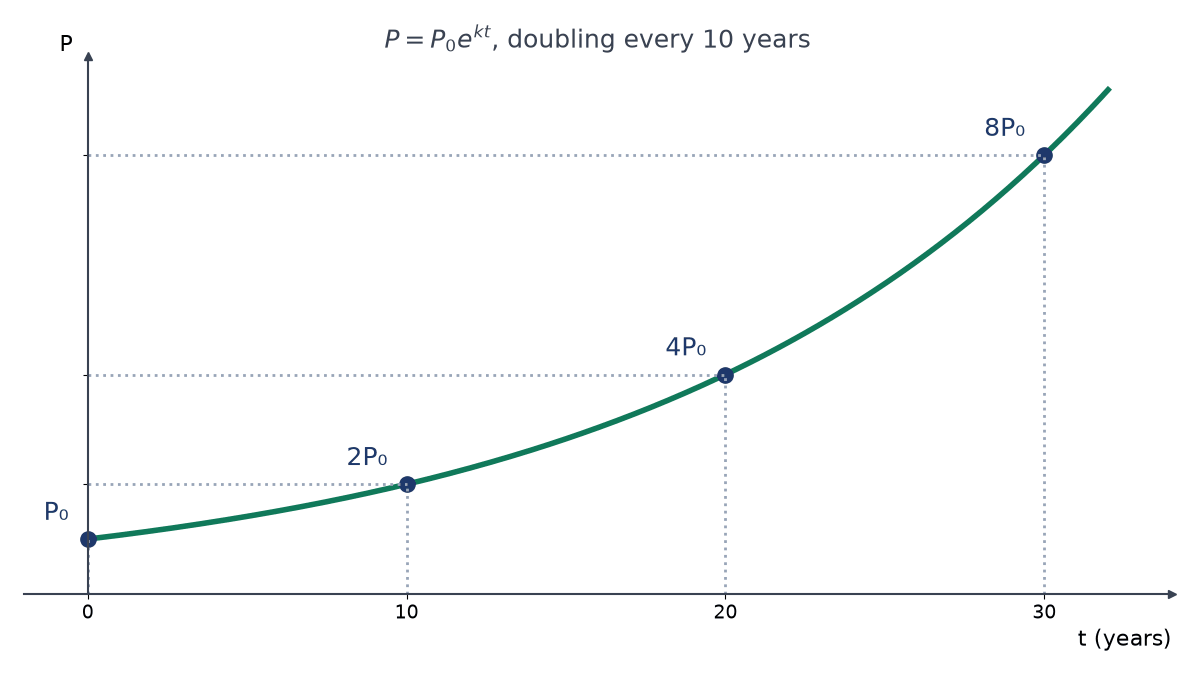
Exam­ple 8 (growth). A pop­u­la­tion grows at a rate pro­por­tional to its size, so dPdt=kP\displaystyle \tfrac{dP}{dt} = kP, which gives P=P0ektP = P_0 e^{kt}. If it dou­bles in 1010 years, k=log⁡210\displaystyle k = \tfrac{\log 2}{10}, and it becomes 88 times as large in 3030 years, since that is three dou­blings.

Exponential growth curve of population P against time t in years, passing through P0 at t = 0, 2P0 at 10 years, 4P0 at 20 years and 8P0 at 30 years.
Dou­bling every 10 years: 2, 4 and then 8 times the start after 30 years.

Exam­ple 9. A bank pays inter­est com­pounded con­tin­u­ously at 6%6\% a year. Then dAdt=0.06A\displaystyle \tfrac{dA}{dt} = 0.06A, A=A0e0.06tA = A_0e^{0.06t}. ₹10,00010{,}000 grows to 10,000e0.6≈10{,}000e^{0.6} \approx ₹18,22118{,}221 in 1010 years.

Try these your­self

  1. State the order and degree: y′′′+2y′′−y′=0y''' + 2y'' - y' = 0; (y′)2+3y=cos⁡x(y')^2 + 3y = \cos x; (1+(y′)2)3/2=y′′\left(1 + (y')^2\right)^{3/2} = y'' (square both sides first).
  2. Ver­ify that y=e−x+2x−2y = e^{-x} + 2x - 2 sat­is­fies y′+y=2xy' + y = 2x.
  3. Ver­ify that y=1+x2y = \sqrt{1 + x^2} sat­is­fies yy′=xyy' = x.
  4. Form the dif­fer­en­tial equa­tion of y=ae2x+be−xy = ae^{2x} + be^{-x}.
  5. Form the dif­fer­en­tial equa­tion of all cir­cles touch­ing the yy-axis at the ori­gin (x2+y2=2axx^2 + y^2 = 2ax).
  6. Solve: dydx=1+y1+x\displaystyle \tfrac{dy}{dx} = \tfrac{1 + y}{1 + x}; extan⁡y dx+(1−ex)sec⁡2y dy=0e^x\tan y\,dx + (1 - e^x)\sec^2 y\,dy = 0.
  7. Solve dydx=2xy\displaystyle \tfrac{dy}{dx} = 2xy with y(0)=3y(0) = 3.
  8. Solve dydx=yx\displaystyle \tfrac{dy}{dx} = \tfrac{y}{x} with y(1)=4y(1) = 4.
  9. A radioac­tive sub­stance decays at a rate pro­por­tional to the amount present; half dis­ap­pears in 5050 years. How long until 18\displaystyle \tfrac{1}{8} remains?
  10. The slope of a curve at (x,y)(x, y) is 2yx\displaystyle \tfrac{2y}{x} and it passes through (1,3)(1, 3). Find it.

Answers to check against

Show answers
  1. 33, 11; 11, 22; 22, 22.
  2. y′=−e−x+2y' = -e^{-x} + 2; y′+y=2xy' + y = 2x.
  3. y′=x1+x2\displaystyle y' = \tfrac{x}{\sqrt{1 + x^2}}.
  4. y′′−y′−2y=0y'' - y' - 2y = 0.
  5. 2xyy′=y2−x22xyy' = y^2 - x^2.
  6. 1+y=C(1+x)1 + y = C(1 + x); tan⁡y=C(1−ex)\tan y = C(1 - e^x).
  7. y=3ex2y = 3e^{x^2}.
  8. y=4xy = 4x.
  9. That is three half-lives, so 150150 years.
  10. dyy=2dxx\displaystyle \tfrac{dy}{y} = \tfrac{2dx}{x}: y=3x2y = 3x^2.