Undo­ing a matrix

Arrange the cofac­tors of a matrix, trans­pose them, and you have the adjoint. Divide that by the deter­mi­nant and you have the inverse. Why should you care? Because then a whole sys­tem of lin­ear equa­tions AX=BAX = B can be solved in one stroke as X=A−1BX = A^{-1}B. We will find adjoints and inverses, learn to check whether a sys­tem has a solu­tion at all, solve sys­tems, and end with mixed prac­tice.

Adjoint and inverse

The adjoint of AA is the trans­pose of its matrix of cofac­tors, adj⁡A=[Aij]T\operatorname{adj} A = [A_{ij}]^T. The key fact about it is

A(adj⁡A)=(adj⁡A)A=∣A∣I.A(\operatorname{adj}A) = (\operatorname{adj}A)A = \lvert A \rvert I.

So AA can be inverted exactly when ∣A∣≠0\lvert A \rvert \ne 0 (non-sin­gu­lar), and A−1=1∣A∣adj⁡A\displaystyle A^{-1} = \frac{1}{\lvert A \rvert}\operatorname{adj}A.

For a 2×22 \times 2 matrix there is a quick rule: adj⁡[abcd]=[d−b−ca]\operatorname{adj}\begin{bmatrix} a & b \\ c & d \end{bmatrix} = \begin{bmatrix} d & -b \\ -c & a \end{bmatrix}. Swap the diag­o­nal entries and change the sign of the other two.

Exam­ple 1. A=[5231]A = \begin{bmatrix} 5 & 2 \\ 3 & 1 \end{bmatrix}. Here ∣A∣=−1\lvert A \rvert = -1, so A−1=−[1−2−35]=[−123−5]A^{-1} = -\begin{bmatrix} 1 & -2 \\ -3 & 5 \end{bmatrix} = \begin{bmatrix} -1 & 2 \\ 3 & -5 \end{bmatrix}.

Exam­ple 2. A=[102210031]A = \begin{bmatrix} 1 & 0 & 2 \\ 2 & 1 & 0 \\ 0 & 3 & 1 \end{bmatrix}: ∣A∣=1(1)−0+2(6)=13\lvert A \rvert = 1(1) - 0 + 2(6) = 13. The cofac­tors are A11=1A_{11} = 1, A12=−2A_{12} = -2, A13=6A_{13} = 6; A21=6A_{21} = 6, A22=1A_{22} = 1, A23=−3A_{23} = -3; A31=−2A_{31} = -2, A32=4A_{32} = 4, A33=1A_{33} = 1. Putting them in place and trans­pos­ing, A−1=113[16−2−2146−31]\displaystyle A^{-1} = \tfrac{1}{13}\begin{bmatrix} 1 & 6 & -2 \\ -2 & 1 & 4 \\ 6 & -3 & 1 \end{bmatrix}.

Sys­tems of equa­tions

Write the equa­tions a1x+b1y+c1z=d1a_1x + b_1y + c_1z = d_1, … in matrix form as AX=BAX = B. Then look at the deter­mi­nant.

  • If ∣A∣≠0\lvert A \rvert \ne 0: unique solu­tion X=A−1BX = A^{-1}B (con­sis­tent).
  • If ∣A∣=0\lvert A \rvert = 0: find (adj⁡A)B(\operatorname{adj}A)B. If it is not OO, there is no solu­tion (incon­sis­tent). If it is OO, there may be infi­nitely many solu­tions or none, so you must check fur­ther.

Exam­ple 3. x+2z=7x + 2z = 7, 2x+y=42x + y = 4, 3y+z=113y + z = 11. The coef­fi­cient matrix is the AA of Exam­ple 2, and B=[7411]B = \begin{bmatrix} 7 \\ 4 \\ 11 \end{bmatrix}. X=113[7+24−22−14+4+4442−12+11]=113[93441]\displaystyle X = \tfrac{1}{13}\begin{bmatrix} 7 + 24 - 22 \\ -14 + 4 + 44 \\ 42 - 12 + 11 \end{bmatrix} = \tfrac{1}{13}\begin{bmatrix} 9 \\ 34 \\ 41 \end{bmatrix}. Always check: in the first equa­tion, 9+8213=7\displaystyle \tfrac{9 + 82}{13} = 7. ✓

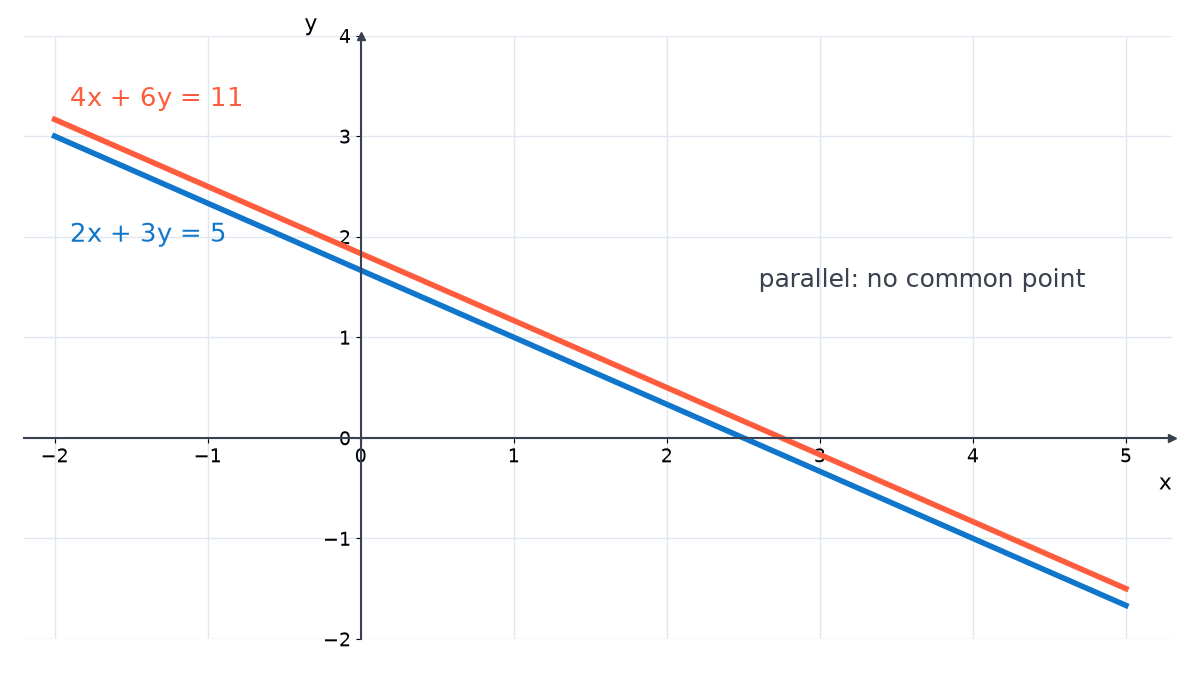
Exam­ple 4. 2x+3y=52x + 3y = 5, 4x+6y=114x + 6y = 11. Here ∣A∣=0\lvert A \rvert = 0, and (adj⁡A)B=[6−3−42][511]=[−32]≠O(\operatorname{adj}A)B = \begin{bmatrix} 6 & -3 \\ -4 & 2 \end{bmatrix}\begin{bmatrix} 5 \\ 11 \end{bmatrix} = \begin{bmatrix} -3 \\ 2 \end{bmatrix} \ne O, so the sys­tem is incon­sis­tent. Geo­met­ri­cally, the two lines are par­al­lel.

The lines 2x + 3y = 5 and 4x + 6y = 11 drawn on one grid: they are parallel and never meet, so the system of two equations has no solution.
The two equa­tions are par­al­lel lines, so the sys­tem is incon­sis­tent.

Exam­ple 5. At a kirana shop you can buy 22 kg rice, 11 kg dal and 33 kg sugar for ₹370370; 11 kg rice, 22 kg dal and 11 kg sugar for ₹310310; 33 kg rice, 11 kg dal and 22 kg sugar for ₹380380. Call the prices r,d,sr, d, s per kg. The sys­tem has ∣A∣=2(4−1)−1(2−3)+3(1−6)=−8\lvert A \rvert = 2(4 - 1) - 1(2 - 3) + 3(1 - 6) = -8 and solu­tion r=60r = 60, d=100d = 100, s=50s = 50.

Mixed prac­tice

  1. Find adj⁡A\operatorname{adj}A and A−1A^{-1} for A=[4−132]A = \begin{bmatrix} 4 & -1 \\ 3 & 2 \end{bmatrix}.
  2. Find A−1A^{-1} for A=[210011103]A = \begin{bmatrix} 2 & 1 & 0 \\ 0 & 1 & 1 \\ 1 & 0 & 3 \end{bmatrix} and ver­ify AA−1=IAA^{-1} = I.
  3. Ver­ify A(adj⁡A)=∣A∣IA(\operatorname{adj}A) = \lvert A \rvert I for A=[1−1202130−1]A = \begin{bmatrix} 1 & -1 & 2 \\ 0 & 2 & 1 \\ 3 & 0 & -1 \end{bmatrix}.
  4. Which of these are sin­gu­lar? [3624]\begin{bmatrix} 3 & 6 \\ 2 & 4 \end{bmatrix}; [123456789]\begin{bmatrix} 1 & 2 & 3 \\ 4 & 5 & 6 \\ 7 & 8 & 9 \end{bmatrix}; [201110021]\begin{bmatrix} 2 & 0 & 1 \\ 1 & 1 & 0 \\ 0 & 2 & 1 \end{bmatrix}.
  5. Is each sys­tem con­sis­tent or incon­sis­tent? x+3y=4x + 3y = 4, 2x+6y=92x + 6y = 9; 3x−y=23x - y = 2, 6x−2y=46x - 2y = 4.
  6. Solve by matri­ces: 3x−2y=73x - 2y = 7, 5x+4y=195x + 4y = 19.
  7. Solve by matri­ces: 2x+y+z=72x + y + z = 7, x−y+2z=5x - y + 2z = 5, 3x+2y−z=63x + 2y - z = 6.
  8. For A=[231−4]A = \begin{bmatrix} 2 & 3 \\ 1 & -4 \end{bmatrix} and B=[1−2−13]B = \begin{bmatrix} 1 & -2 \\ -1 & 3 \end{bmatrix}, ver­ify (AB)−1=B−1A−1(AB)^{-1} = B^{-1}A^{-1}.
  9. If A=[3211]A = \begin{bmatrix} 3 & 2 \\ 1 & 1 \end{bmatrix}, find a,ba, b with A2+aA+bI=OA^2 + aA + bI = O and use it to find A−1A^{-1}.
  10. Three friends buy fruit: 22 apples, 33 oranges, 11 mango cost ₹115115; 11 apple, 22 oranges, 22 man­goes cost ₹9595; 33 apples, 11 orange, 22 man­goes cost ₹130130. Find the price of each fruit.

Answers to check against

Show answers
  1. adj⁡A=[21−34]\operatorname{adj}A = \begin{bmatrix} 2 & 1 \\ -3 & 4 \end{bmatrix}; A−1=111[21−34]\displaystyle A^{-1} = \tfrac{1}{11}\begin{bmatrix} 2 & 1 \\ -3 & 4 \end{bmatrix}.
  2. ∣A∣=2(3)−1(−1)+0=7\lvert A \rvert = 2(3) - 1(-1) + 0 = 7; A−1=17[3−3116−2−112]\displaystyle A^{-1} = \tfrac{1}{7}\begin{bmatrix} 3 & -3 & 1 \\ 1 & 6 & -2 \\ -1 & 1 & 2 \end{bmatrix}.
  3. ∣A∣=1(−2)+1(−3)+2(−6)=−17\lvert A \rvert = 1(-2) + 1(-3) + 2(-6) = -17; the prod­uct is −17I-17I.
  4. The first and the sec­ond.
  5. Incon­sis­tent; infi­nitely many solu­tions (the same line).
  6. ∣A∣=22\lvert A \rvert = 22; X=122[42−53][719]=[31]\displaystyle X = \tfrac{1}{22}\begin{bmatrix} 4 & 2 \\ -5 & 3 \end{bmatrix}\begin{bmatrix} 7 \\ 19 \end{bmatrix} = \begin{bmatrix} 3 \\ 1 \end{bmatrix}.
  7. x=2x = 2, y=1y = 1, z=2z = 2.
  8. AB=[−155−14]AB = \begin{bmatrix} -1 & 5 \\ 5 & -14 \end{bmatrix}; both sides come to 1−11[−14−5−5−1]\displaystyle \tfrac{1}{-11}\begin{bmatrix} -14 & -5 \\ -5 & -1 \end{bmatrix}.
  9. A2=[11843]A^2 = \begin{bmatrix} 11 & 8 \\ 4 & 3 \end{bmatrix}; a=−4a = -4, b=1b = 1; A−1=4I−A=[1−2−13]A^{-1} = 4I - A = \begin{bmatrix} 1 & -2 \\ -1 & 3 \end{bmatrix}.
  10. 2a+3o+m=1152a + 3o + m = 115, a+2o+2m=95a + 2o + 2m = 95, 3a+o+2m=1303a + o + 2m = 130; ∣A∣=11\lvert A \rvert = 11: apple ₹2525, orange ₹1515, mango ₹2020.