Inte­grals as areas

Ask a farmer the area of an oddly shaped field with one curved bound­ary and the usual for­mu­las give up. The def­i­nite inte­gral does not. In this les­son you will use it to find areas bounded by a curve and the xx- or yy-axis, areas of par­a­bolic regions, cir­cles and ellipses, and finally the area trapped between two curves.

Area under a curve

If f(x)≥0f(x) \ge 0 on [a,b][a, b], the area between y=f(x)y = f(x), the xx-axis and the lines x=ax = a, x=bx = b is

A=∫aby dx.\displaystyle A = \int_a^b y\,dx.

Two cau­tions. If the curve lies below the axis, the inte­gral comes out neg­a­tive, so take its absolute value. If the curve crosses the axis, split the inter­val at the cross­ing and add the pieces sep­a­rately. For area mea­sured against the yy-axis, between y=cy = c and y=dy = d, use ∫cdx dy\displaystyle \int_c^d x\,dy.

Exam­ple 1. The area under y=x2+1y = x^2 + 1 from x=0x = 0 to x=3x = 3 is [x33+x]03=12\displaystyle \left[\tfrac{x^3}{3} + x\right]_0^3 = 12.

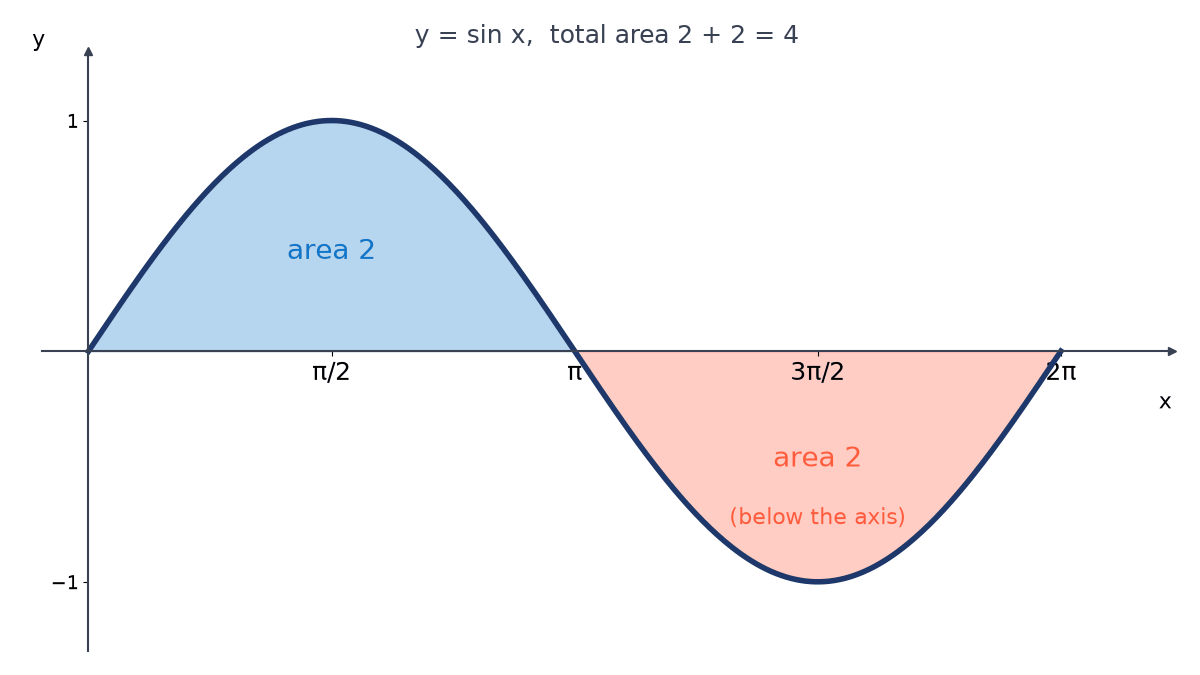
Exam­ple 2. Here is where the cau­tion mat­ters. The area between y=sin⁡xy = \sin x and the xx-axis for 0≤x≤2π0 \le x \le 2\pi: ∫0πsin⁡x dx+∣∫π2πsin⁡x dx∣=2+2=4\displaystyle \int_0^\pi\sin x\,dx + \left\lvert\int_\pi^{2\pi}\sin x\,dx\right\rvert = 2 + 2 = 4. The plain inte­gral over [0,2π][0, 2\pi] would have given 00, which is clearly not the area.

Graph of y = sin x from 0 to 2 pi: the hump above the axis from 0 to pi is shaded with area 2 and the hump below the axis from pi to 2 pi with area 2, total 4.
The part below the axis counts as pos­i­tive area: 2 + 2 = 4.

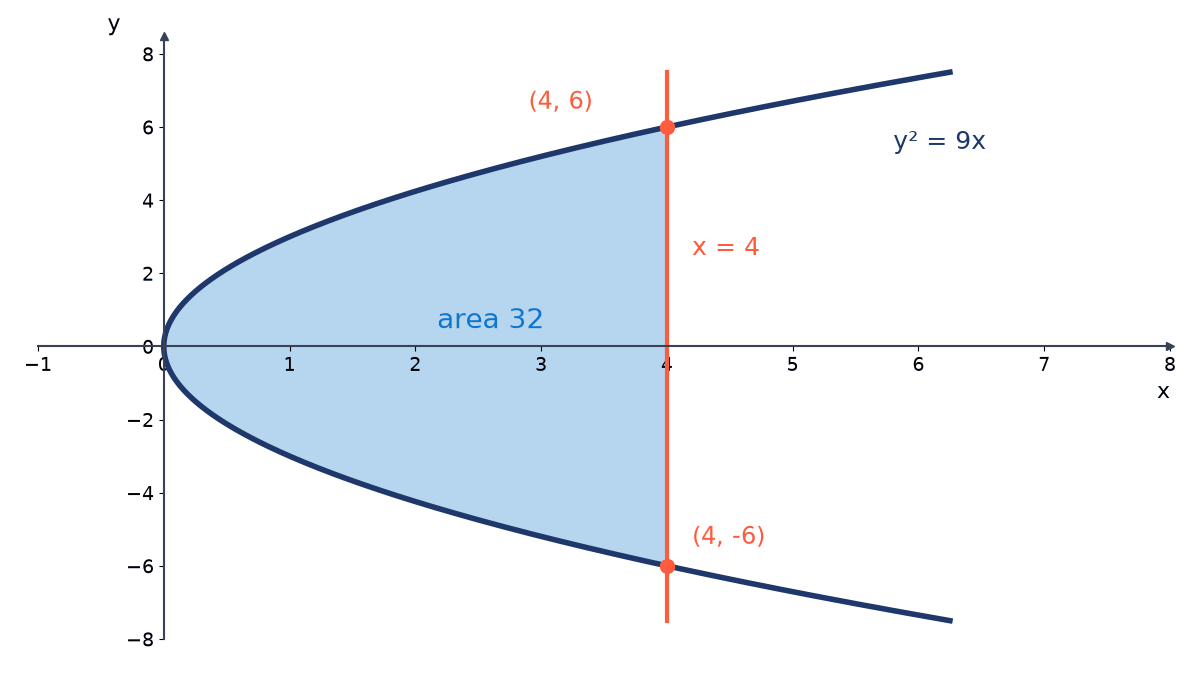
Exam­ple 3. For the region bounded by y2=9xy^2 = 9x and the line x=4x = 4, use sym­me­try about the hor­i­zon­tal axis: 2∫043x dx=6⋅23⋅8=32\displaystyle 2\int_0^4 3\sqrt{x}\,dx = 6 \cdot \tfrac{2}{3} \cdot 8 = 32.

The parabola y squared = 9x opening to the right, cut by the vertical line x = 4 at (4, 6) and (4, -6); the region between them is shaded, area 32.
The region bounded by y squared = 9x and x = 4, sym­met­ric about the x-axis.

Exam­ple 4. Now the famil­iar for­mula for the cir­cle x2+y2=r2x^2 + y^2 = r^2 drops out: 4∫0rr2−x2 dx=4⋅πr24=πr2\displaystyle 4\int_0^r\sqrt{r^2 - x^2}\,dx = 4 \cdot \tfrac{\pi r^2}{4} = \pi r^2. In the same way, the ellipse x2a2+y2b2=1\displaystyle \tfrac{x^2}{a^2} + \tfrac{y^2}{b^2} = 1 has area 4∫0abaa2−x2 dx=πab\displaystyle 4\int_0^a\tfrac{b}{a}\sqrt{a^2 - x^2}\,dx = \pi ab.

Exam­ple 5. For the area between x2=4yx^2 = 4y, the yy-axis and the lines y=1y = 1, y=4y = 4 in the first quad­rant, inte­grate along the ver­ti­cal axis: ∫142y dy=43(8−1)=283\displaystyle \int_1^4 2\sqrt{y}\,dy = \tfrac{4}{3}(8 - 1) = \tfrac{28}{3}.

Area between two curves

If f(x)≥g(x)f(x) \ge g(x) on [a,b][a, b], the area between them is ∫ab(f−g) dx\displaystyle \int_a^b (f - g)\,dx. Always find where the curves meet first; those give you the lim­its.

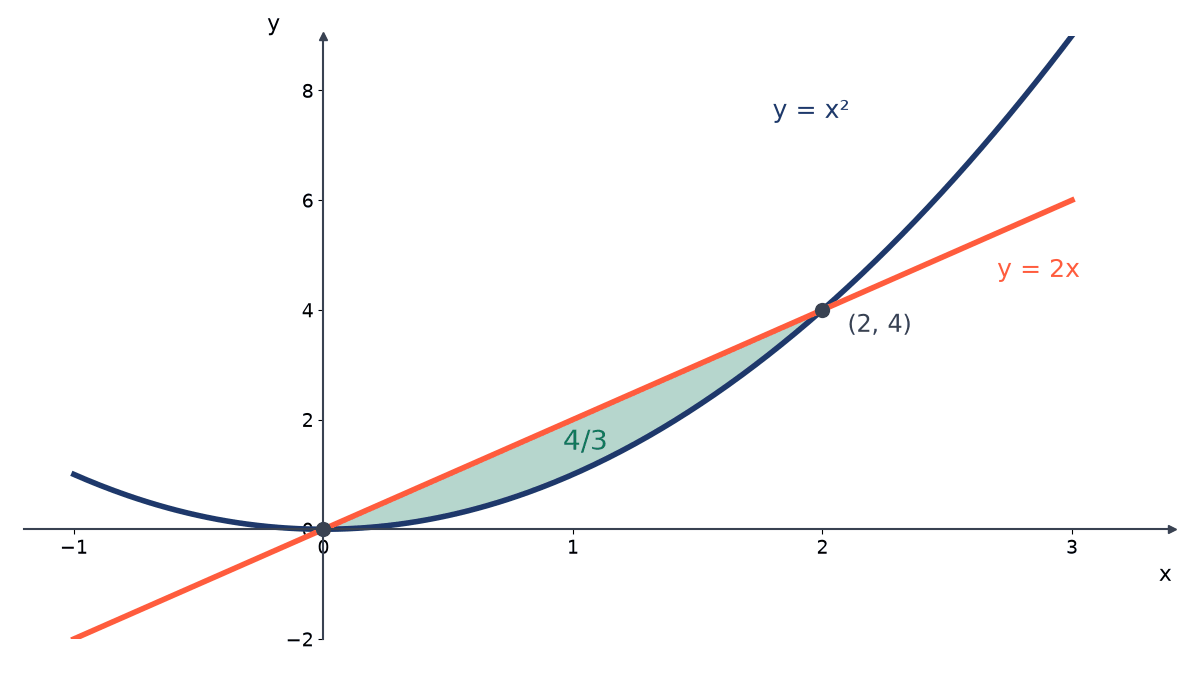
Exam­ple 6. y=x2y = x^2 and y=2xy = 2x meet at x=0,2x = 0, 2, and the line is on top, so the area is ∫02(2x−x2) dx=4−83=43\displaystyle \int_0^2(2x - x^2)\,dx = 4 - \tfrac{8}{3} = \tfrac{4}{3}.

The parabola y = x squared and the line y = 2x meeting at (0, 0) and (2, 4); the region between them, with the line on top, is shaded and marked 4/3.
Between x = 0 and x = 2 the line lies above the parabola.

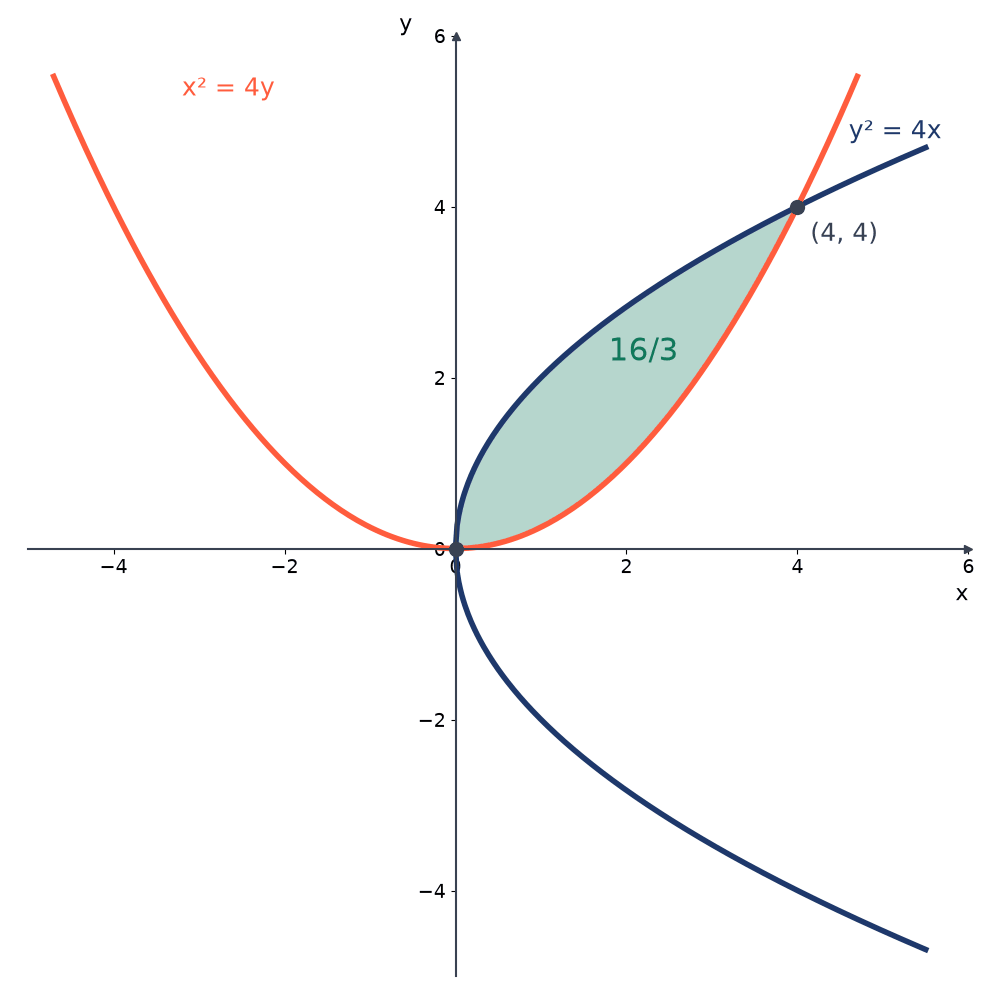
Exam­ple 7. y2=4xy^2 = 4x and x2=4yx^2 = 4y meet at (0,0)(0, 0) and (4,4)(4, 4), giv­ing the area ∫04(2x−x24)dx=323−163=163\displaystyle \int_0^4\left(2\sqrt{x} - \tfrac{x^2}{4}\right)dx = \tfrac{32}{3} - \tfrac{16}{3} = \tfrac{16}{3}.

The parabolas y squared = 4x (opening right) and x squared = 4y (opening up) meeting at (0, 0) and (4, 4); the lens-shaped region between them is shaded and marked 16/3.
The two parabo­las enclose a lens of area 16/3.

Try these your­self

  1. Find the area under y=3x2y = 3x^2 from x=1x = 1 to x=2x = 2.
  2. Find the area bounded by y=x3y = x^3, the xx-axis and x=−1x = -1, x=2x = 2.
  3. Find the area enclosed by y2=8xy^2 = 8x and the line x=2x = 2.
  4. Find the area of the ellipse x225+y29=1\displaystyle \tfrac{x^2}{25} + \tfrac{y^2}{9} = 1.
  5. Find the area bounded by y=cos⁡xy = \cos x and the xx-axis for 0≤x≤π0 \le x \le \pi.
  6. Find the area between y=xy = x and y=x2y = x^2.
  7. Find the area between the parabola y=4−x2y = 4 - x^2 and the xx-axis.
  8. Find the area bounded by y=x2y = x^2 and the line y=x+2y = x + 2.
  9. Find the area of the smaller region cut from the cir­cle x2+y2=16x^2 + y^2 = 16 by the line x=2x = 2.
  10. Find the area of the tri­an­gle with ver­tices (0,0)(0, 0), (4,0)(4, 0), (2,3)(2, 3) by inte­gra­tion.

Answers to check against

Show answers
  1. [x3]12=7\left[x^3\right]_1^2 = 7.
  2. 14+4=174\displaystyle \tfrac{1}{4} + 4 = \tfrac{17}{4}.
  3. 2∫0222x dx=323\displaystyle 2\int_0^2 2\sqrt{2}\sqrt{x}\,dx = \tfrac{32}{3}.
  4. 15π15\pi.
  5. 1+1=21 + 1 = 2.
  6. 12−13=16\displaystyle \tfrac{1}{2} - \tfrac{1}{3} = \tfrac{1}{6}.
  7. ∫−22(4−x2) dx=323\displaystyle \int_{-2}^{2}(4 - x^2)\,dx = \tfrac{32}{3}.
  8. They meet at x=−1,2x = -1, 2: ∫−12(x+2−x2) dx=92\displaystyle \int_{-1}^{2}(x + 2 - x^2)\,dx = \tfrac{9}{2}.
  9. 2∫2416−x2 dx=16π3−43\displaystyle 2\int_2^4\sqrt{16 - x^2}\,dx = \tfrac{16\pi}{3} - 4\sqrt{3}.
  10. The sides are the lines y=3x2\displaystyle y = \tfrac{3x}{2} and y=6−3x2\displaystyle y = 6 - \tfrac{3x}{2}: ∫023x2dx+∫24(6−3x2)dx=3+3=6\displaystyle \int_0^2\tfrac{3x}{2}dx + \int_2^4\left(6 - \tfrac{3x}{2}\right)dx = 3 + 3 = 6.