What we are looking for
Some sequences go up, or down, by the same amount at every step. We call these linear patterns, and a linear polynomial in the step number describes them exactly. In this lesson you will learn to read that polynomial straight off a table. Then you can use it to predict terms far ahead, or to work out which term has a given value. We will also name the two directions such a pattern can take: linear growth and linear decay.
A growing pattern
A design is built from square tiles. Stage 1 has tiles, and every stage after that adds more.
| Stage | ||||||
|---|---|---|---|---|---|---|
| Tiles |
Look at the gaps. The difference between one entry and the next is always . So what is the rule for stage ? The tile count is times the stage number, plus . Let us check it. Stage gives ✓; stage gives ✓.
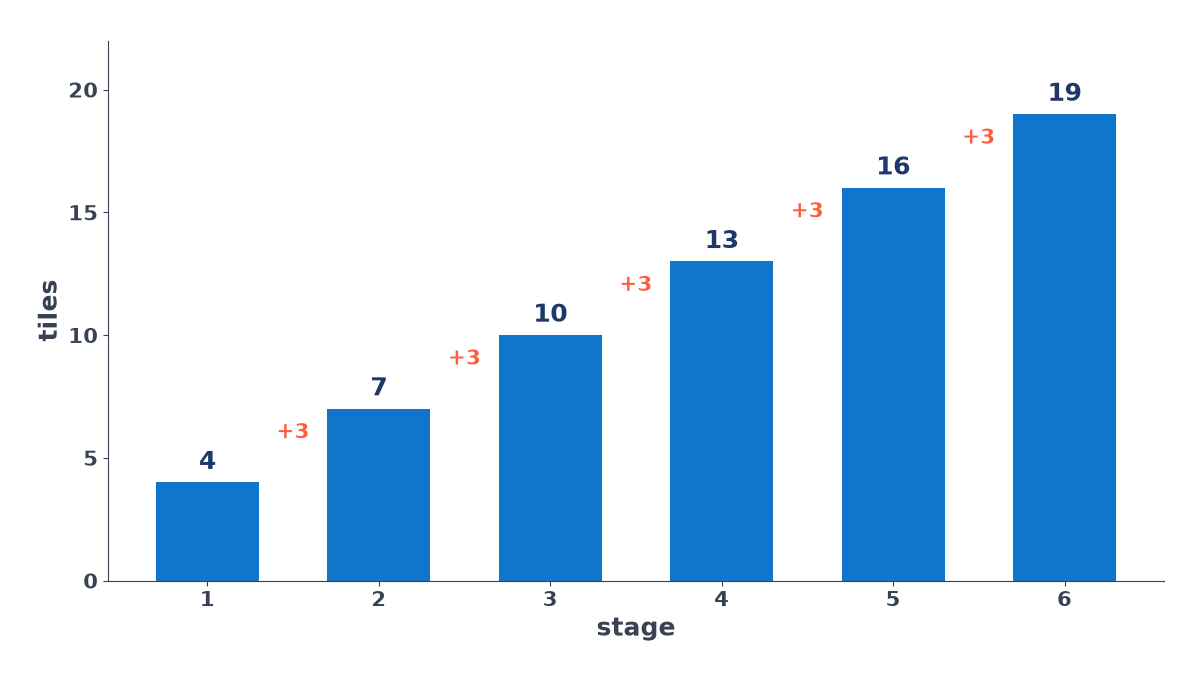
Each part of the rule has a meaning. The coefficient is the constant difference. The constant is what the rule would give at "stage ", one step before the pattern begins.
Finding a rule in general. If a table has constant difference and its first entry (at ) is , then the entry at stage is , which simplifies to . For our tiles this gives , just as we found.
Example 1. How many tiles at stage ? Which stage has tiles?
. So stage has tiles, and by luck that answers the second question as well. Let us try a harder one. Which stage has tiles? Solving gives .
Example 2. A pattern of dots has dots. Find the rule and the number of dots at stage .
The difference is and the first term is . So the rule is , and at stage there are dots.
Linear growth
Example 3. A savings jar starts with ₹, and ₹ is added at the end of every month.
| Month | |||||
|---|---|---|---|---|---|
| Amount (₹) |
After months the jar holds rupees. After a whole year that is . When will it first hold more than ₹? Set it up as an inequality: means , , so it happens in month .
When a quantity goes up by a fixed amount over each equal interval of time, we say it shows linear growth. Its polynomial has a positive coefficient.

Example 4. A taxi charges ₹ for the first km and ₹ for each kilometre after that. Find the fare for km () and for a km trip.
The fare is , so a km trip costs rupees. We can also go backwards. For what distance is the fare ₹? , km.
Linear decay
Example 5. Priya has ₹ of pocket money and spends ₹ a day.
| Day | |||||
|---|---|---|---|---|---|
| Left (₹) |
After days she has rupees left. When will she be down to ₹? From we get . And when is it all gone? From we get days.
When a quantity goes down by a fixed amount over each equal interval, we call it linear decay. This time the coefficient is negative.

Example 6. A water tank is m deep at the start of the dry season and the level falls m a month. The height after months is , so after months the water is m deep. The tank runs dry when , months.
Recognising a linear pattern
How do you know a pattern is linear in the first place? Check the differences. If they are all the same number, the pattern is linear, and that number is the coefficient. If they are not, the rule is not a linear polynomial. For instance, has differences , so it is not linear.
Practice
- A pattern has pieces. Find the rule for stage , the number at stage , and the stage with pieces.
- A club has members and gains every month. Write the membership after months and find when it passes .
- A tank holds litres and leaks litres an hour. Write the volume after hours, find the volume after hours, and find when it is empty.
- A book has pages; a reader finishes pages a day. How many pages remain after days? After days? On which day is the book finished?
- A phone bought for ₹ loses ₹ in value every year. Write its value after years and find when it is worth ₹.
- Which of these sequences are linear patterns? (a) ; (b) ; (c) ; (d) . For each linear one, give the rule.
- A rectangle has fixed length cm. Write its area when the breadth is cm and show that area grows linearly as increases by cm each time.
Answers
Show answers
- Difference , first term : . Stage : . , .
- . , , so after months.
- . After hours: litres. Empty at hours.
- . After days: . , , so the book is finished on day .
- . , , years.
- (a) Linear, difference : . (b) Not linear (differences ). (c) Linear, difference : . (d) Not linear (differences ).
- Area . Increasing by adds cm² each time, a constant step, so linear.