How to use this set

Here are four­teen ques­tions from across the chap­ter. Two small habits will make your work much stronger. When­ever you fac­torise, mul­ti­ply back to check your answer. And when­ever you eval­u­ate a num­ber, say which iden­tity you chose and why it was the con­ve­nient one.

Sec­tion A, Expand­ing

  1. Expand: (a) (−2x+5)2(-2x + 5)^2; (b) (3s+4)(3s−4)(3s + 4)(3s - 4); (c) (m+13)(m−13)\displaystyle \left(m + \dfrac{1}{3}\right)\left(m - \dfrac{1}{3}\right); (d) (a−3b+2c)2(a - 3b + 2c)^2; (e) (t−3u)(t2+3tu+9u2)(t - 3u)(t^2 + 3tu + 9u^2); (f) (4y+1)3(4y + 1)^3.
  2. Eval­u­ate with an iden­tity: (a) 19×2119 \times 21; (b) 108×92108 \times 92; (c) 73273^2; (d) 1962196^2; (e) 1013101^3; (f) (−99)3(-99)^3.

Sec­tion B, Fac­tor­ing

  1. Fac­tor: (a) x2−22x+121x^2 - 22x + 121; (b) 49p2−25q2\displaystyle \dfrac{4}{9}p^2 - 25q^2; (c) x2+72x+32\displaystyle x^2 + \dfrac{7}{2}x + \dfrac{3}{2}; (d) 8a3−27b38a^3 - 27b^3; (e) 16y2−40yz+25z2−916y^2 - 40yz + 25z^2 - 9; (f) m3+8n3+p3−6mnpm^3 + 8n^3 + p^3 - 6mnp.
  2. Fac­tor: (a) r2+2r−48r^2 + 2r - 48; (b) 6x2−5x−66x^2 - 5x - 6; (c) 64u3+48u2+12u+164u^3 + 48u^2 + 12u + 1; (d) 9a2+4b2+c2−12ab−4bc+6ca9a^2 + 4b^2 + c^2 - 12ab - 4bc + 6ca.
  3. Sim­plify (denom­i­na­tors nonzero): (a) 9x2−6x+19x2−1\displaystyle \dfrac{9x^2 - 6x + 1}{9x^2 - 1}; (b) a3+64a2−4a+16\displaystyle \dfrac{a^3 + 64}{a^2 - 4a + 16}; (c) s2−3s−402s2−128\displaystyle \dfrac{s^2 - 3s - 40}{2s^2 - 128}.

Sec­tion C, Shapes

  1. A rec­tan­gle has area 49a2−42ab+9b249a^2 - 42ab + 9b^2. What could its sides be?
  2. A rec­tan­gle has area 81s2−16t281s^2 - 16t^2. What could its sides be?
  3. A cuboid has vol­ume 4p2q−36q34p^2q - 36q^3. Give pos­si­ble dimen­sions.
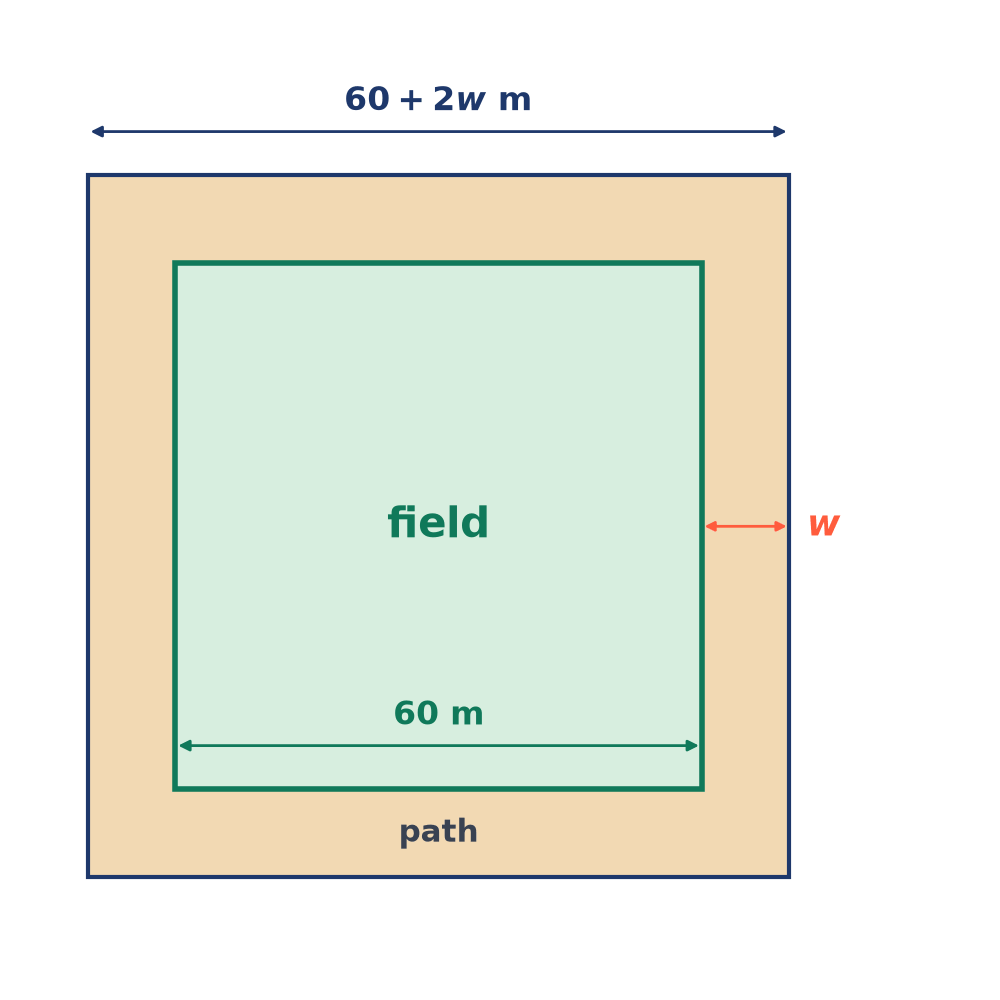
  4. A square field of side 6060 m has a path of width ww m run­ning round its out­side. Write the area of the path as a poly­no­mial in ww.
  5. A rec­tan­gu­lar tank has area 3x2+11x+63x^2 + 11x + 6 square units and width x+3x + 3. Find its length.
A square field of side 60 m surrounded by a path of width w m on all four sides, so the outer square has side 60 + 2w m; the path is the shaded border.
Ques­tion 9: the path is the bor­der between the two squares.

Sec­tion D, Rea­son­ing

  1. When a num­ber is added to its rec­i­p­ro­cal, the result is 44. Find the sum of the num­ber's square and the square of its rec­i­p­ro­cal. Then find the sum of their cubes.
  2. If x−3x - 3 and x+1x + 1 are both fac­tors of ax2+bx−6ax^2 + bx - 6, find aa and bb.
  3. If a+b+c=7a + b + c = 7 and ab+bc+ca=12ab + bc + ca = 12, find a3+b3+c3−3abca^3 + b^3 + c^3 - 3abc.
  4. Show that (n+2)2−n2(n + 2)^2 - n^2 is a mul­ti­ple of 44 for every inte­ger nn, and say which mul­ti­ples of 44 arise.

Answers

Show answers
  1. (a) 4x2−20x+254x^2 - 20x + 25. (b) 9s2−169s^2 - 16. (c) m2−19\displaystyle m^2 - \dfrac{1}{9}. (d) a2+9b2+4c2−6ab−12bc+4caa^2 + 9b^2 + 4c^2 - 6ab - 12bc + 4ca. (e) t3−27u3t^3 - 27u^3. (f) 64y3+48y2+12y+164y^3 + 48y^2 + 12y + 1.
  2. (a) (20−1)(20+1)=399(20 - 1)(20 + 1) = 399. (b) (100+8)(100−8)=9936(100 + 8)(100 - 8) = 9936. (c) (70+3)2=5329(70 + 3)^2 = 5329. (d) (200−4)2=38416(200 - 4)^2 = 38416. (e) (100+1)3=1030301(100 + 1)^3 = 1030301. (f) −(100−1)3=−970299-(100 - 1)^3 = -970299.
  3. (a) (x−11)2(x - 11)^2. (b) (23p+5q)(23p−5q)\displaystyle \left(\dfrac{2}{3}p + 5q\right)\left(\dfrac{2}{3}p - 5q\right). (c) Sum 72\displaystyle \dfrac{7}{2}, prod­uct 32\displaystyle \dfrac{3}{2}: 33 and 12\displaystyle \dfrac{1}{2}: (x+3)(x+12)\displaystyle (x + 3)\left(x + \dfrac{1}{2}\right). (d) (2a−3b)(4a2+6ab+9b2)(2a - 3b)(4a^2 + 6ab + 9b^2). (e) (4y−5z)2−32=(4y−5z+3)(4y−5z−3)(4y - 5z)^2 - 3^2 = (4y - 5z + 3)(4y - 5z - 3). (f) (m+2n+p)(m2+4n2+p2−2mn−2np−pm)(m + 2n + p)(m^2 + 4n^2 + p^2 - 2mn - 2np - pm).
  4. (a) (r+8)(r−6)(r + 8)(r - 6). (b) AC=−36AC = -36, sum −5-5: −9,4-9, 4: (2x−3)(3x+2)(2x - 3)(3x + 2). (c) (4u+1)3(4u + 1)^3. (d) (3a−2b+c)2(3a - 2b + c)^2.
  5. (a) (3x−1)2(3x−1)(3x+1)=3x−13x+1\displaystyle \dfrac{(3x - 1)^2}{(3x - 1)(3x + 1)} = \dfrac{3x - 1}{3x + 1}. (b) a+4a + 4. (c) (s−8)(s+5)2(s−8)(s+8)=s+52(s+8)\displaystyle \dfrac{(s - 8)(s + 5)}{2(s - 8)(s + 8)} = \dfrac{s + 5}{2(s + 8)}.
  6. (7a−3b)2(7a - 3b)^2: both sides 7a−3b7a - 3b.
  7. (9s+4t)(9s−4t)(9s + 4t)(9s - 4t).
  8. 4q(p2−9q2)=4q(p+3q)(p−3q)4q(p^2 - 9q^2) = 4q(p + 3q)(p - 3q).
  9. Outer square side 60+2w60 + 2w: (60+2w)2−602=240w+4w2(60 + 2w)^2 - 60^2 = 240w + 4w^2 square metres.
  10. 3x2+11x+6=(3x+2)(x+3)3x^2 + 11x + 6 = (3x + 2)(x + 3): length 3x+23x + 2.
  11. Let the num­ber be nn with n+1n=4\displaystyle n + \dfrac{1}{n} = 4. Square: n2+2+1n2=16\displaystyle n^2 + 2 + \dfrac{1}{n^2} = 16, so n2+1n2=14\displaystyle n^2 + \dfrac{1}{n^2} = 14. Cubes: n3+1n3=(n+1n)3−3(n+1n)=64−12=52\displaystyle n^3 + \dfrac{1}{n^3} = \left(n + \dfrac{1}{n}\right)^3 - 3\left(n + \dfrac{1}{n}\right) = 64 - 12 = 52.
  12. (x−3)(x+1)=x2−2x−3(x - 3)(x + 1) = x^2 - 2x - 3, and ax2+bx−6=2(x2−2x−3)ax^2 + bx - 6 = 2(x^2 - 2x - 3) since the con­stants must match: a=2a = 2, b=−4b = -4.
  13. a2+b2+c2=49−24=25a^2 + b^2 + c^2 = 49 - 24 = 25. Then 7(25−12)=917(25 - 12) = 91.
  14. (n+2)2−n2=(n+2−n)(n+2+n)=2(2n+2)=4(n+1)(n + 2)^2 - n^2 = (n + 2 - n)(n + 2 + n) = 2(2n + 2) = 4(n + 1). Every mul­ti­ple of 44 arises, since n+1n + 1 runs through all inte­gers.