A carpenter's puzzle
Here is a real problem. A carpenter has two thin strips of wood and a length of thread. She wants to cross the strips and run the thread around their ends so that the thread makes a rectangle. How long should the second strip be? Where should the strips cross, and at what angle? If we answer this by reasoning rather than by trial and error, we discover every property of the rectangle along the way, and we find that a rectangle can be defined in more than one way. The same reasoning then takes care of the square.
Quadrilaterals
A quadrilateral (from the Latin quadri, four, and latus, side) is a closed figure with four straight sides meeting at four corners. Its angles are the angles between neighbouring sides. The two segments joining opposite corners are its diagonals.
The carpenter's problem
Think of the strips as the diagonals and of a quadrilateral , crossing at . Say cm. We have three questions: how long is , where is , and what is the angle at ?
We start from the definition you already know: a rectangle is a quadrilateral with four right angles and equal opposite sides.
Deduction 1: the diagonals are equal. Look at triangles and . We have , , and is shared. By SAS, , so . The second strip must also be cm.
Deduction 2: the diagonals bisect each other. Now look at triangles and . , since they are vertically opposite. . And , because both are minus the angle the diagonal makes with a side: and, in triangle , , which gives , alternate angles across the parallel sides. By AAS, , so and . The strips cross at their midpoints; in other words, they bisect each other.
Deduction 3: the angle does not matter. This is the surprising one. Suppose two equal segments bisect each other at , with an angle between them. Triangle is isosceles (), so each of its base angles is . Triangle is also isosceles, with apex angle , so each of its base angles is . The quadrilateral's angle at is the sum of the two: . The same happens at every corner, and congruent triangles give and . So whatever the angle, the figure is a rectangle.
The carpenter's answer, then, is two equal strips joined at their midpoints, at any angle she likes. Carpenters in Europe and house-builders in Mozambique use exactly this trick.
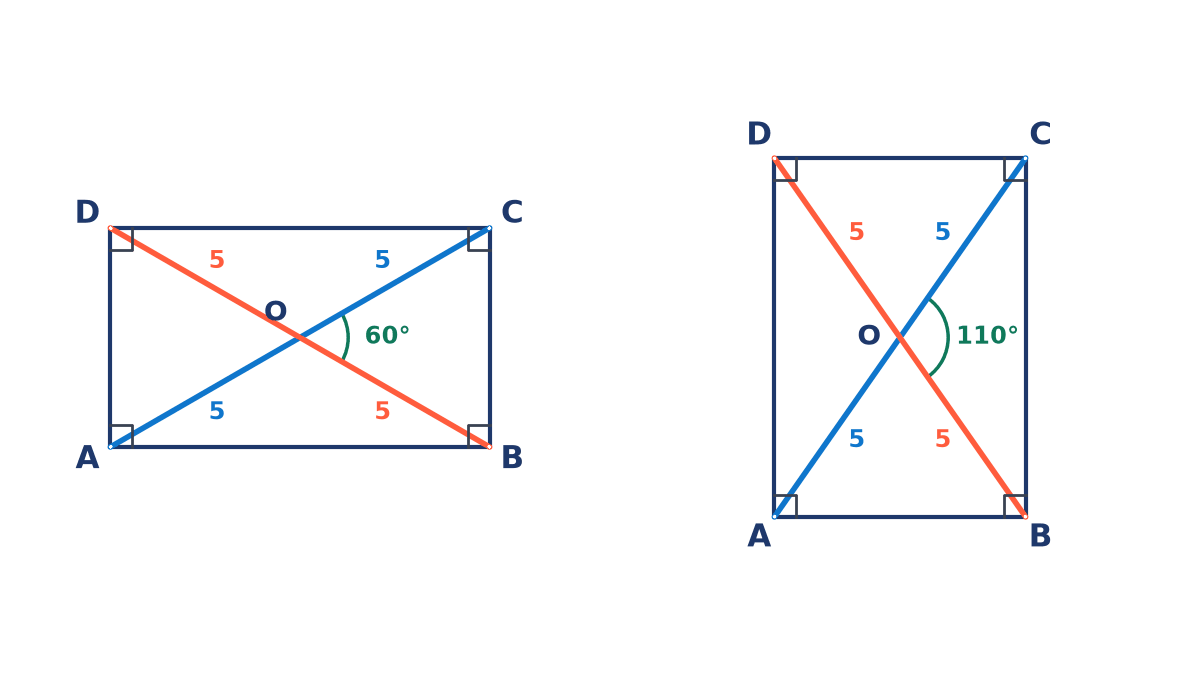
This gives us a second definition: a rectangle is a quadrilateral whose diagonals are equal and bisect each other.
Conjecture versus proof
Suppose you measure a few rectangles and find that the diagonals bisect each other every time. That gives you a conjecture, a confident guess. It cannot tell you what the thousandth rectangle will do. Only a deduction from the definition, like the ones above, settles the matter for every rectangle. A useful habit: when a proof is hard to find, experiment first. The measurements often suggest what you should try to prove.
Can the definition be shortened?
Deduction 4: four right angles are enough. Let every angle of be , and join . In triangles and : ; is shared; and by the same " minus" argument as before. AAS gives congruence, so and . The equal opposite sides come for free from the right angles; we never needed to assume them.
Rectangle: a quadrilateral in which all angles are .
A word of caution. The order of letters in a congruence statement matters. pairs with , with , and with . Writing would pair with , and that is false.
Properties of a rectangle
- All angles are .
- Opposite sides are equal.
- Opposite sides are parallel, because are co-interior angles for and with transversal .
- The diagonals are equal and bisect each other.
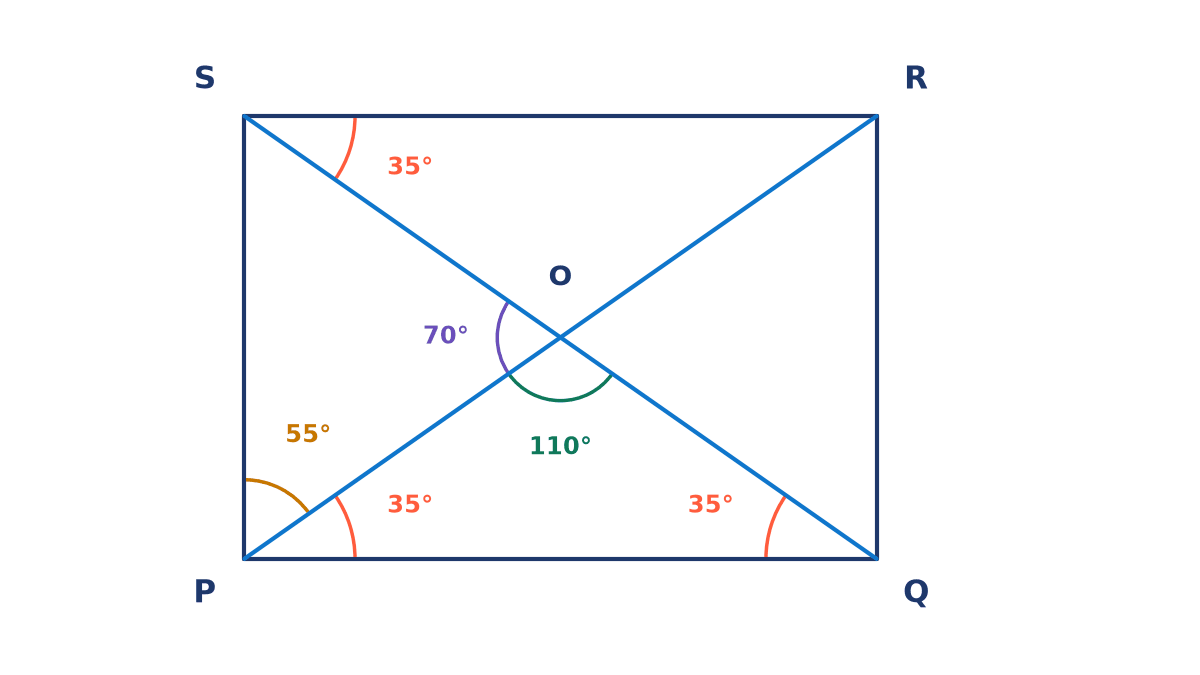
Example 1. In rectangle the diagonals meet at , and . Then (the triangle is isosceles, as ), , , , and (alternate to ).
The square
A square is a quadrilateral with all angles and all sides equal. So every square is a rectangle, but not every rectangle is a square. In a Venn diagram, the set of squares sits inside the set of rectangles. It is like being a Malayali and an Indian at the same time.
Deduction 5: the diagonals of a square are perpendicular. Let be a square with diagonals meeting at . Triangles and have , , and shared, so they are congruent by SSS. That makes , and since together they make , each is .
So the carpenter's strips make a square when they are equal, joined at their midpoints, and at right angles.
Property 5: the diagonals bisect the angles. In triangle , and , so .
Practice
- In rectangle with diagonals meeting at , . Find , and .
- In rectangle , where is the crossing of the diagonals. Find and .
- Draw a quadrilateral whose diagonals are both cm, bisect each other, and cross at (a) , (b) , (c) . Name each figure.
- Two diameters and of a circle are perpendicular. What is ? Prove it.
- Two sticks of equal length and a thread: how do you make an exact right angle?
- Is "a quadrilateral with opposite sides equal and parallel" a valid definition of a rectangle? Draw a figure to support your answer.
- Explain why in a rectangle cannot be written .
- A quadrilateral has three right angles. Must the fourth be a right angle? (Use: the angles of a quadrilateral add to .)
Answers
Show answers
- , so . . (alternate angles).
- Isosceles triangle : . .
- All three are rectangles (equal diagonals bisecting each other); (b) is a square.
- A square: its diagonals are equal (diameters), bisect each other (at the centre) and are perpendicular.
- Cross the sticks at their midpoints and run the thread round the four ends. The figure is a rectangle, so each corner is .
- No. A slanted parallelogram has equal, parallel opposite sides and no right angle.
- Congruence pairs vertices in order: , , . Writing would pair with . In a rectangle happens to hold, but the letters must still follow the matching vertices, so is the correct way to write it.
- Yes: .