How to use this set
Here are fourteen puzzles, and every one of them gives way once you name the unknown and write down what the story tells you about it. Write the equation before you start solving. When you have an answer, put it back into the story, not just into your equation. And where a puzzle can be cracked without letters, say by imagining "suppose they were all hens", try that way as well and compare the two.
Section A: Tricks and pyramids
- Think of a number, multiply by , add , divide by , subtract . What do you get? Change the trick so that the result is always double the number.
- In the date trick with and (where you subtract ), someone announces . Is that a valid date?
- A pyramid has bottom row and top . Find .
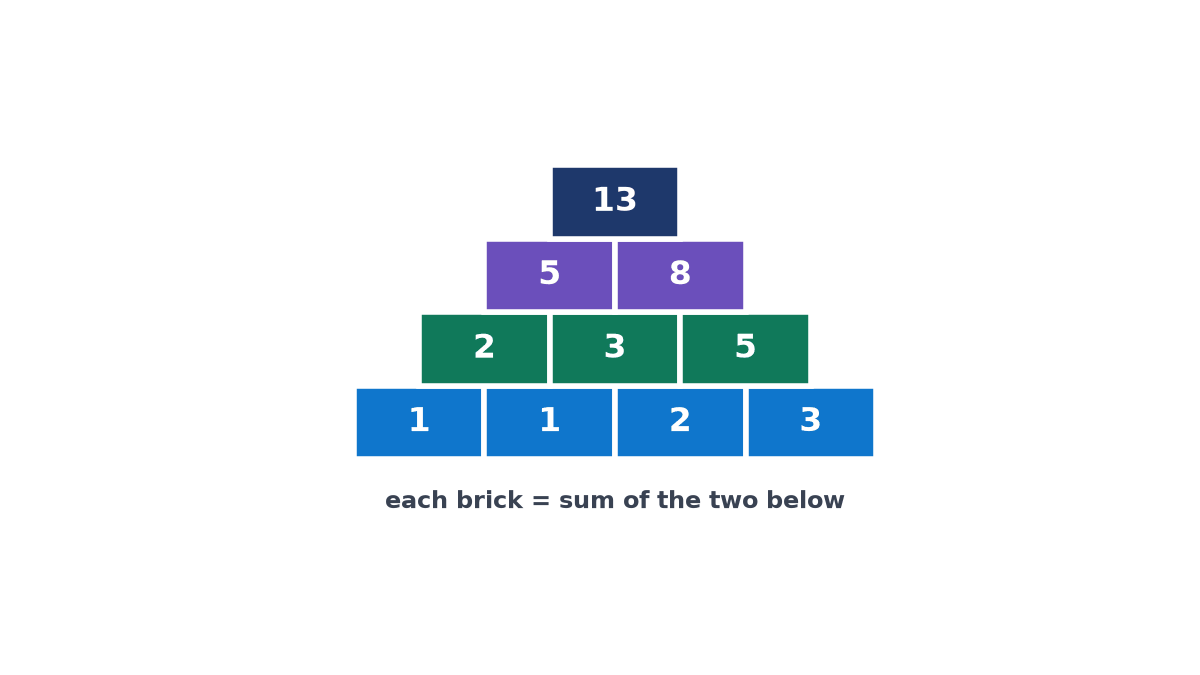
- A four-row pyramid has bottom row . Fill it in. Is every brick a Virahāṅka number?
Section B: Grids and digits
- On a calendar, an L-shape made of a date, the date to its right and the date just below the first adds up to . Find the three dates.
- Put into for the largest product. Then put into and find the largest product by trying the four candidates that have the two largest digits in the tens places.
- Reverse a three-digit number to get and subtract (assume ). Show that the middle digit of the answer is always and that the outer digits add up to . Check with .
Section C: Word puzzles
- Someone dips flowers into three magic ponds, one after another. Each dip doubles the flowers, and after each dip flowers are offered at a shrine. After the third offering, nothing is left. How many flowers were there at the start?
- A farm has cows and ducks, with heads and legs in all. How many of each are there? Solve it with a letter, and also without one.
- A mother is four times as old as her daughter. In years she will be three times as old. How old is the daughter?
- Two friends have marbles, and one has twice as many as the other. If the richer one gave the poorer one , they would have the same. How many does each have?
- A tea stall pays rent of ₹ a day, and each cup costs ₹ to make. (a) To make a profit of ₹ by selling cups, what should a cup cost? (b) If cups sell at ₹, how many must be sold for a ₹ profit?
- Work out , , , . What pattern do you see, and why does it happen?
- A genie doubles the coins in your pocket every time you walk round a tree, and takes coins after each round. After three rounds you have exactly coins, and the genie takes those too. (a) How many coins did you start with? (b) With that start, what fee per round would leave you better off after three rounds? (c) If the genie knows you have coins, what fee should it set to take everything in three rounds?
Answers
Show answers
- . For double the number: multiply by , add , divide by , subtract , and you get .
- gives month , which does not exist. Somebody slipped up in the arithmetic.
- , so .
- The rows are ; then ; then . Yes, every one is.
- , so and the dates are . (A total such as or is impossible, because must be more than a multiple of .)
- . The candidates are , , (the same) and (the same). The largest is .
- , and for to gives . Each has middle digit and outer digits adding to . Check: ✓.
- Work backwards. Before the third offering there were , and before the third dip . Before the second offering, , and before the second dip . Before the first offering , and before the first dip , which is not a whole number. So with per shrine there is no whole-number answer. With per shrine it works: , so you start with . (With an offering of , the start is .)
- Let the cows be : , so and ; there are ducks. Without letters: if all were ducks there would be legs. The extra legs come from cows, which have extra legs each, so there are cows.
- Let the daughter be and the mother : , so .
- Let the poorer friend have and the richer : , so . They have and .
- (a) , so ₹. (b) , so (because has to be rounded up).
- : every one equals . The top is (the first odd numbers), and the bottom is the next odd numbers, which add to .
- (a) Work backwards. The final , before the last fee, was before the third doubling. Then before the second fee, which was before the second doubling. Then before the first fee, which was before the first doubling. You started with . In general, with a fee of the start is . (b) Starting with and paying each time, after three rounds you hold . That is more than when , that is, : any fee under coins. (c) Set : , which is a whole number only when is a multiple of .