Where we are going
You already know how to square a number. Now we run the film backwards: if you know the area of a square, can you find its side? That is what a square root does. You will see three ways to find one (listing, subtracting odd numbers, and prime factorisation), and a way to estimate a root when the number is not a perfect square. Then we do the same for cubes and cube roots, meet the famous taxicab number , and finish with the story behind the words square, cube and root.
Square roots
If , then is a square root of . Think of a square tile of area cm². Its side must be cm, because .
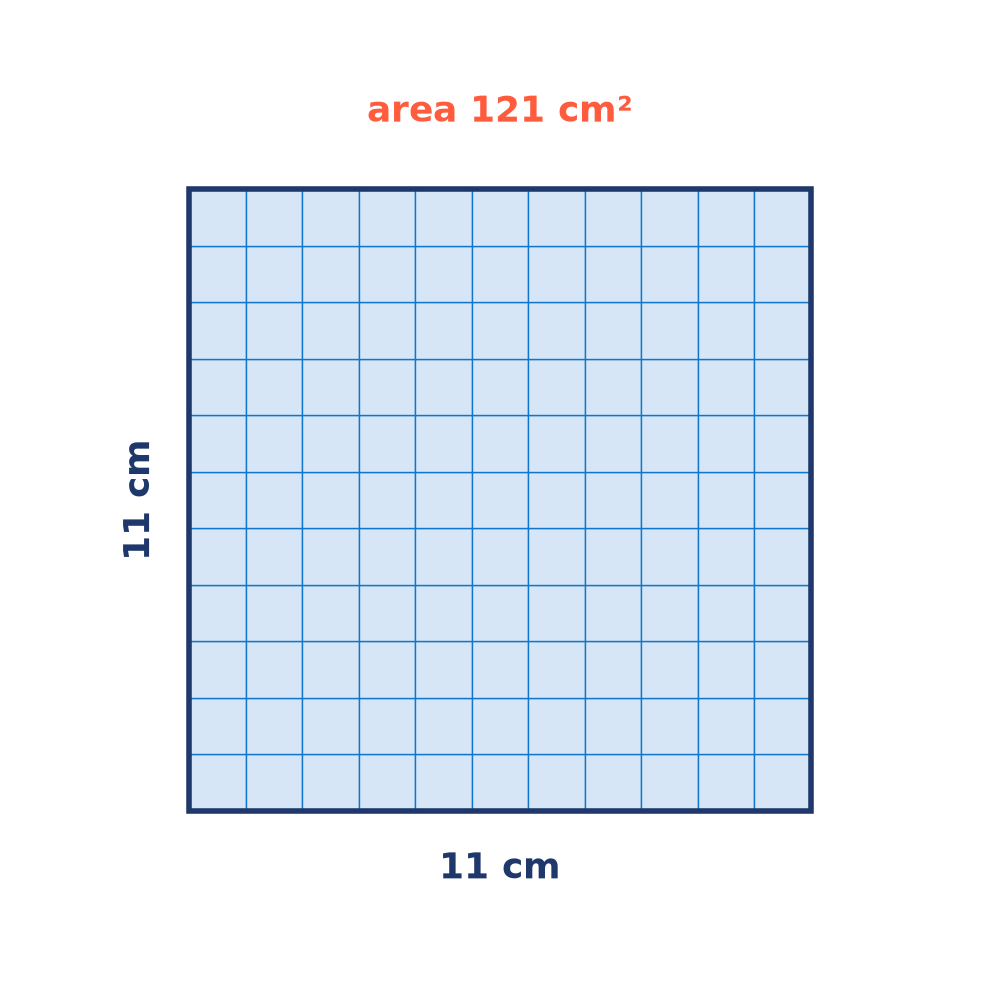
Every positive perfect square actually has two integer square roots, since and as well. The symbol always means the positive one, so . In this chapter we work only with positive roots.
Is it a square, and what is its root?
Method 1, listing. Suppose you want to test . Walk up the squares: , , , . So . It works, but it gets slow for big numbers.
Method 2, subtracting odd numbers. Take . Keep taking away odd numbers in order: . You reach zero after twelve subtractions, so . It never lets you down, though it becomes tiring once the number runs into a few hundred.
Method 3, prime factorisation. This is the one you will use most. The prime factors of a perfect square always split into two identical groups.
so . Look at the pairs, : every prime turns up an even number of times.
Now try . Here the appears three times and the only once, so cannot be a square. But we can repair it. Multiply by and every prime is paired: .
Example 1. Is a square? Factorise: . Yes, and .
Example 2. Find the smallest square divisible by , and . Start with the LCM, . To make every exponent even, multiply by . That gives .
Estimating a square root
Here is a neat bit of detective work. Take . It sits between and . The last digit is , so the root must end in or , which means or . Since , the root is above , so it is . Always check: ✓.
When the number is not a square, you can still trap it between two neighbours. For : and , so , and it is nearer .
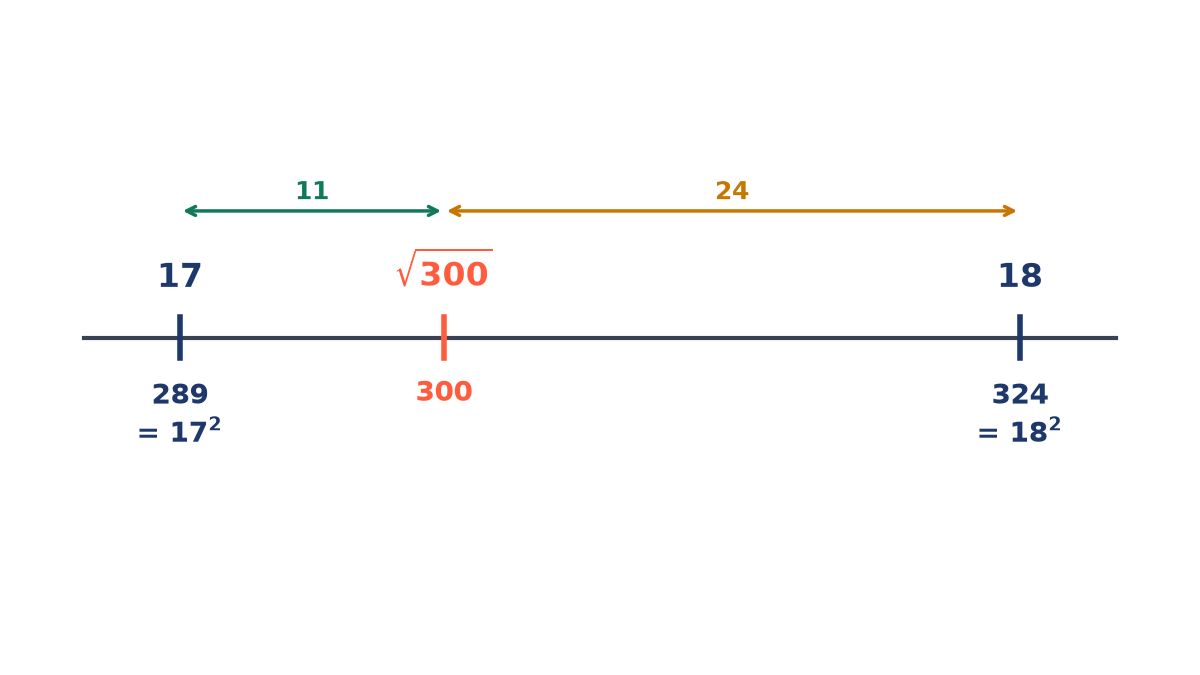
Example 3. You have a square sheet of area cm² and want to cut out the largest square with a whole-number side. Since , the answer is cm.
Cubes
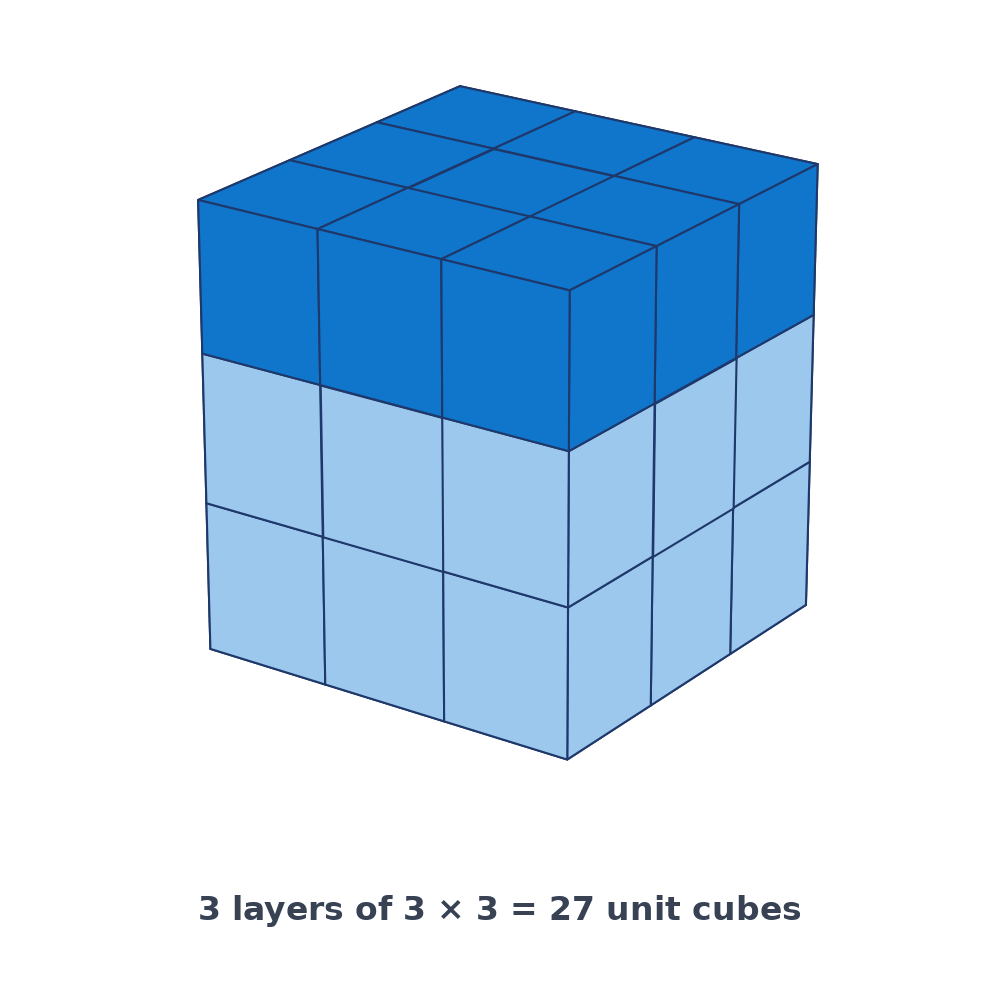
Now step up from flat squares to solid blocks. A cube of edge is built from layers, each with unit cubes, so it holds of them. The perfect cubes are
Unlike squares, cubes can end in any digit. If a number ends in , its cube ends in the last digit of , which gives for to . Each last digit turns up exactly once, so the last digit of a cube tells you straight away the last digit of its root. Keep this in your pocket. Also, a cube ends in zeros, never in exactly two.
There are only two two-digit cubes, and . The three-digit ones are . And the cube of a two-digit number has somewhere between four () and six () digits.
Fractions and negative numbers behave just as you would expect: and . An odd number cubed stays odd.
Cubes from odd numbers
Look at this lovely pattern:
The -th cube is the sum of consecutive odd numbers, each group picking up where the last one stopped. So the eighth group, , has to be . You don't even need to add it up.
The taxicab number
There is a well-loved story here. Hardy went to see Ramanujan in hospital and said the number of his taxi, , seemed rather dull. Ramanujan answered at once that it was the smallest number that can be written as a sum of two cubes in two different ways:
Numbers like this are now called taxicab numbers. The next one is .
Cube roots
Undoing a cube works the same way. If , then . For example, .
With prime factorisation, a perfect cube's factors split into three identical groups, so every prime must appear a multiple of three times.
Now take . That single spoils it. Multiply by and you get .
Guessing from the digits. Try . The last digit tells you the root ends in . Since , the root must be . Check: ✓.
Successive differences
Here is one more pattern worth noticing. The differences between consecutive squares are the odd numbers , and the differences of those are all . For cubes, the first differences are , the second are , and the third are all . So a square settles down after two levels and a cube after three.
A pinch of history
People have needed these numbers for a very long time. Babylonian clay tablets from around 1700 BCE carry tables of squares and cubes, used for surveying and building. In Sanskrit, varga meant both the square shape and the square power, and ghana meant the solid cube and the third power; Āryabhaṭa in 499 CE spells out the link clearly. Our word root comes from mūla, meaning the root of a plant, or origin. So varga-mūla is the square root and ghana-mūla the cube root, a usage that travelled into Arabic as jidhr and into Latin as radix.
Practice
- Find by prime factorisation: , .
- Is a perfect square? If not, find the smallest number to multiply it by to make one, and the resulting root.
- Find the smallest square divisible by , and .
- Find by bracketing and last digits.
- Between which two consecutive whole numbers does lie, and which is it nearer?
- A square field has area m². What is the largest square with whole-number side that fits inside?
- Find and by factorisation.
- By what smallest number must be multiplied to give a perfect cube?
- Guess from the digits: , , .
- Without adding, state the value of .
- True or false, with a reason: (a) a cube ending in has a root ending in ; (b) the cube of a two-digit number can have three digits; (c) is a taxicab number.
- Which is largest: , , ?
Answers
Show answers
- : . : .
- : no. Multiply by : .
- LCM ; multiply by : .
- ; last digit means or ; , so . Check ✓.
- ; nearer .
- : side m.
- : . : .
- : we need two more s, so multiply by to get .
- (ends in , between and ); (ends in , between and ); (ends in , just above ).
- These are nine consecutive odd numbers starting right after the eighth group ends at , so the sum is .
- (a) True: only ends in . (b) False: the smallest is . (c) True: .
- ; ; . The first.