Two more patterns
There are two more kinds of question to add to your kit. In the first, something moves, so the same angle gets measured at two different moments. In the second, the angle is what you have to find, instead of something you're given. Both show up in exams, and both yield to the same two-triangle habit you already have. The moving-object kind usually adds a speed or a time at the end, and that's exactly where students lose track, so go slowly there.
A moving object: distance travelled
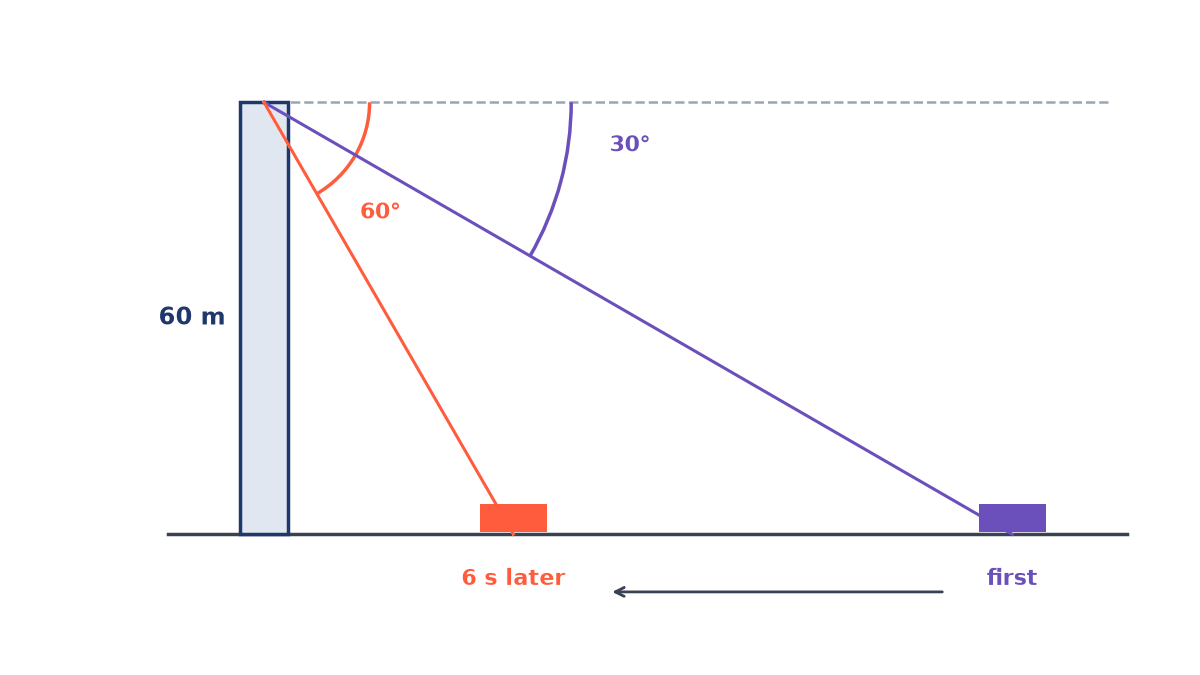
Example 1. A straight road runs to the foot of a tower m high. From the top of the tower, the angle of depression of a car is ; six seconds later it is . How far did the car travel, and how fast was it going?
When the angle is , the car is m away. When it is , the car is m away.
So it travelled m in s, a speed of about m/s.
A moving object: time to arrive
Example 2. Carrying on from above, how much longer will the car take to reach the foot of the tower if it keeps the same speed?
It still has m to go. It covered m in s, so it will cover m in s.
Notice you didn't need a single decimal. The distance left compared with the distance already covered is , so the time left is just half of s.
Finding an angle
When a question asks you for an angle, expect it to be , or . Your job is to recognise the ratio.
Example 3. A tower is m high. Find the angle of elevation of its top from a point m from its base.
, so .
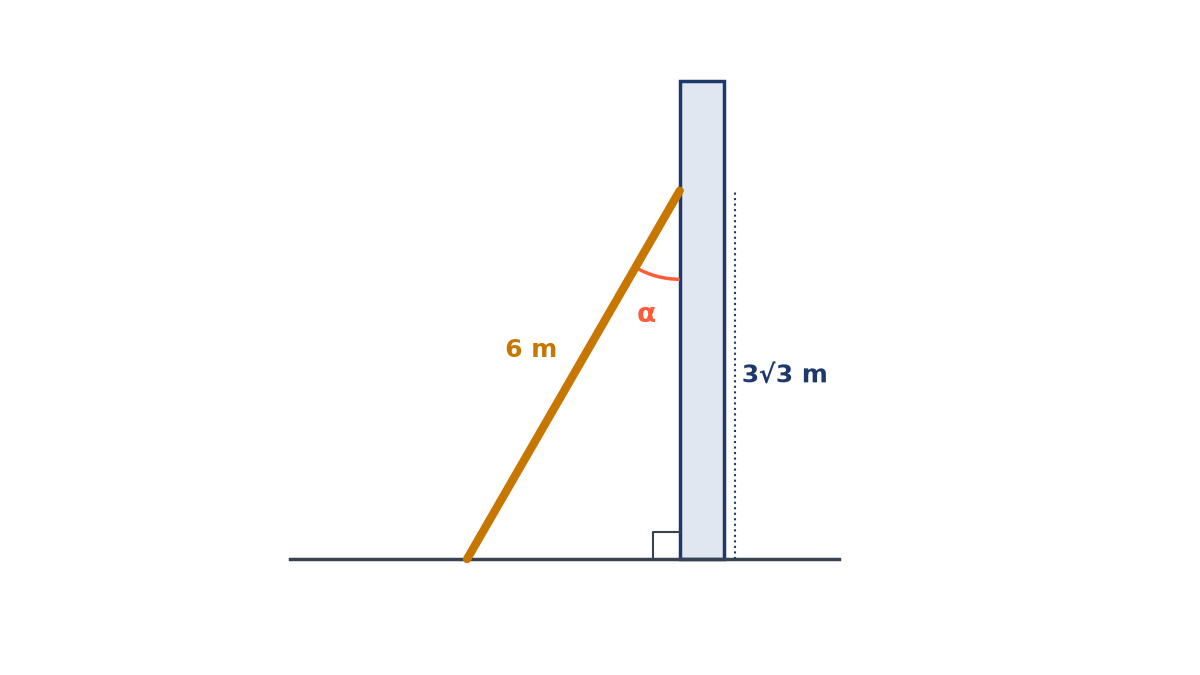
Example 4. A m ladder reaches m up a wall. What angle does it make with the wall?
Call the angle with the wall . Seen from that angle, the height is the adjacent side and the ladder is the hypotenuse. So , and . (With the ground it makes .)
A river's width
Example 5. A bridge across a river makes an angle of with the bank. The bridge is m long. How wide is the river?
The width runs straight across, perpendicular to the bank, and the bridge is the hypotenuse. So the width is m.
Two-angle problems at one point
Example 6. From a window m above the ground, the angle of elevation of the top of a house across the street is , and the angle of depression of its foot is . How tall is the house?
The distance across the street is m. The part of the house above the window is m. So the house is m tall.

Practice
- From the top of a m lighthouse, the angle of depression of an approaching boat changes from to . How far did the boat travel?
- A car drives along a straight road towards a m tower. The angle of depression from the top changes from to in s. Find the car's speed, and how much longer it takes to reach the tower.
- Find the angle of elevation of the sun when a vertical m pole casts a shadow m long.
- A m ladder reaches m up a wall. Find the angle between the ladder and the ground.
- From a point m above a lake, the angle of elevation of a cloud is , and the angle of depression of its reflection in the lake is . How high is the cloud above the lake?
Answers
Show answers
- The distances are and , so it travelled m.
- The distances are and , so it travelled m in s, a speed of m/s. It still has m to go at that speed, which takes s.
- , so .
- , so .
- Say the cloud is m above the lake; then its reflection is m below the surface. Let the horizontal distance be . The cloud is above the observer, so . The reflection is below the observer, so . Dividing one by the other, , so and m.