The balance of payments records all of a country's transactions with the rest of the world. Its three accounts, how the current account is worked out, and what a surplus or deficit means.
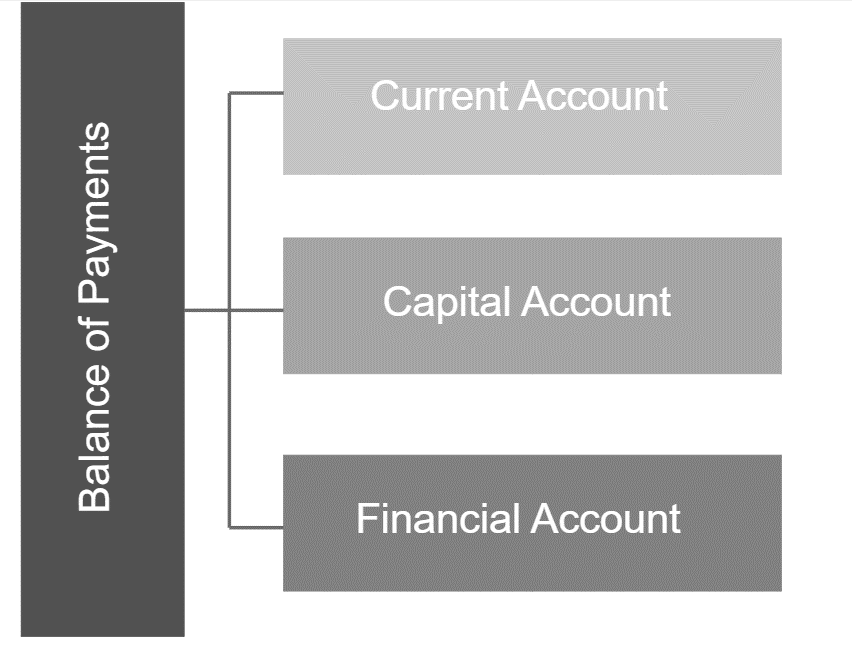
The balance of payments (BOP) is like a country's financial report card, tracking its international transactions over time. It shows how much a nation earns, spends, and invests globally through three main components: current, capital, and financial accounts.
The balance of payments is a comprehensive and systematic record of a country's economic transactions with the rest of the world, encompassing goods, services, and capital flows within a specified time frame. It comprises the current, capital, and financial accounts, each reflecting different types of transactions.
The current account records the country's day-to-day earnings and payments abroad. It is divided into four main components, which record the transactions of a country's capital markets, industries, services, and governments. The four components are:
Balance of trade in goods. Tangible items are recorded here.
Balance of trade in services. Intangible items like tourism are recorded here.
Net income flows (primary income flows). Wages and investment income are examples of what would be included in this section.
Net current account transfers (secondary income flows).
The current account balance is calculated using this formula:
Current account = Balance of trade in goods + Balance of trade in services + Net income flows + Net current transfers
The current account can either be in a surplus or deficit.
The capital account refers to the transfer of funds associated with buying fixed assets, such as land. It also records transfers of immigrants and emigrants taking money abroad or bringing money into a country. The money the government transfers, such as debt forgiveness, is also included here.
The financial account shows the monetary movements into and out of the country.
The financial account is split into three main parts:
Direct investment. This records the net investments from abroad.
Portfolio investment. This records financial flows such as the purchasing of bonds.
Other investments. This records other financial investments such as loans.
The balance of payments and goods and services#
The BOP records all the trades of goods and services conducted both by the public and private sectors, to determine the amount of money flowing into and out of the country.
Trade in goods and services largely decides whether the current account is in surplus or deficit. If a country exports more goods and services than it imports, it has a trade surplus; if it imports more than it exports, it has a trade deficit. Because every transaction is recorded twice, the balance of payments as a whole always balances: a current account deficit is matched by a surplus on the capital and financial accounts.
Trade of goods and services is, therefore, an important part of the balance of payments. Exports are recorded as credits in the balance of payments, and imports as debits.