Sequencing means deciding the order in which waiting jobs, tasks or customers are processed at a work centre. When several jobs compete for the same machine or person, sequencing answers one question: which job goes first, which goes second, and so on. The order is chosen with the help of priority rules, such as first come first served or shortest processing time.
The topic matters because the same set of jobs, on the same machine, can give very different results depending on the order. A good sequence cuts waiting time, work-in-process inventory, idle time and late deliveries; a poor one wastes capacity and upsets customers, even though nothing else has changed.
Objectives of sequencing
The main objective is to arrange jobs so that resources are used efficiently and customer due dates are met. More specifically, a sequence may aim to:
- minimise the average flow time (time a job spends in the system);
- minimise the number of late jobs and average tardiness;
- minimise idle time of machines and workers;
- minimise the makespan, the total time to finish all jobs;
- minimise work-in-process inventory;
- keep the system fair and simple to operate.
No single rule is best for all of these at once, so the manager chooses the rule that fits the objective that matters most.
Sequencing as part of production planning and control
Production planning and control (PPC) moves through planning, routing, scheduling, loading, sequencing, dispatching, follow-up and corrective action. Once jobs are loaded onto a work centre, sequencing fixes their order there, and dispatching releases them to the shop floor in that order.
Sequencing versus routing
Routing decides the path a job follows, that is, which machines or departments it passes through and in what order of operations. Sequencing decides the order in which different jobs are taken up at one machine or work centre. Routing is about the route of one job; sequencing is about the queue of many jobs.
Sequencing versus scheduling
Scheduling fixes the timetable, that is, the start and finish time of each job. Sequencing fixes only the order. In practice the sequence is decided first and the schedule is then built from it.
| Basis | Routing | Sequencing | Scheduling |
|---|---|---|---|
| Question answered | Which path? | Which order? | What time? |
| Focus | Operations of one job | Queue of jobs at a work centre | Start and finish times |
| Output | Route sheet | Priority list | Timetable or Gantt chart |
Sequencing in different production systems
Job production and job shops
In job shops, each order is different, routings vary and many jobs compete for general-purpose machines. Sequencing is most important and most difficult here, because every day brings a new mix of jobs with different processing times and due dates.
Batch production
Batches of different products share the same equipment. Sequencing decides which batch runs next, often considering changeover (set-up) times, since some orders of products need less cleaning or resetting than others.
Mass production
In mass and continuous production the flow is fixed by the line, so day-to-day sequencing is limited. It still matters in mixed-model assembly lines, where the order of different models on the line must be planned.
Factors affecting sequencing decisions
- Processing time of each job
- Due dates promised to customers
- Order of arrival
- Importance of the customer or the order value
- Set-up and changeover times
- Availability of machines, workers and materials
- Number of machines each job must pass through
- Management objectives such as speed, fairness or on-time delivery
Common sequencing (priority) rules
First Come, First Served (FCFS)
Jobs are processed in the order they arrive. A bank queue works this way.
- Advantages: simple, fair and easy for customers to accept.
- Disadvantages: ignores job length and due dates, so a long job can hold up many short urgent ones; usually gives poor average flow time.
Shortest Processing Time (SPT)
The job with the shortest processing time is done first. A photocopy shop that finishes a two-page job before a 300-page job is using SPT.
- Advantages: minimises average flow time, average number of jobs in the system and work-in-process; many jobs are finished quickly.
- Disadvantages: long jobs keep getting pushed back and may become very late; due dates are ignored.
Earliest Due Date (EDD)
The job with the earliest due date is done first. A tailor finishing the wedding outfit due tomorrow before one due next week is using EDD.
- Advantages: focuses on customer deadlines; minimises the maximum lateness on a single machine and often reduces tardiness.
- Disadvantages: ignores processing time, so average flow time may be higher than under SPT; one very long job with an early due date can delay many others.
Longest Processing Time (LPT)
The longest job is done first. It is sometimes used when large jobs are important or need to be started early, but it usually gives the worst average flow time.
Critical Ratio (CR)
The critical ratio compares the time left until the due date with the processing time still required:
The job with the lowest CR is done first, and ratios are recalculated each time a job is completed, which makes CR a dynamic rule.
| CR value | Meaning |
|---|---|
| CR greater than 1 | Ahead of schedule: more time left than work needed |
| CR equal to 1 | Exactly on schedule |
| CR less than 1 | Behind schedule: urgent attention needed |
| CR zero or negative | Due now or already overdue |
CR is useful because it combines both urgency (due date) and workload (processing time) in one number, and because it keeps updating as the situation changes.
Measuring sequence performance
- Flow time of a job = its completion time, measured from when all jobs are available (time zero).
- Average flow time = total flow time divided by the number of jobs.
- Tardiness of a job = completion time minus due date, if positive; otherwise zero.
- Average number of jobs in the system = total flow time divided by total processing time.
Worked example 1: four rules on one machine
Suppose a printing unit has five jobs waiting at the start of day 0, in the order they arrived. Times are in days.
| Job | Processing time | Due date (day) |
|---|---|---|
| A | 6 | 8 |
| B | 2 | 6 |
| C | 8 | 18 |
| D | 3 | 15 |
| E | 9 | 23 |
Total processing time is days.
FCFS: sequence A, B, C, D, E
| Job | Time | Flow time | Due | Tardiness |
|---|---|---|---|---|
| A | 6 | 6 | 8 | 0 |
| B | 2 | 8 | 6 | 2 |
| C | 8 | 16 | 18 | 0 |
| D | 3 | 19 | 15 | 4 |
| E | 9 | 28 | 23 | 5 |
| Total | 28 | 77 | 11 |
Average flow time days; average tardiness days; 3 jobs late; average jobs in system .
SPT: sequence B, D, A, C, E
| Job | Time | Flow time | Due | Tardiness |
|---|---|---|---|---|
| B | 2 | 2 | 6 | 0 |
| D | 3 | 5 | 15 | 0 |
| A | 6 | 11 | 8 | 3 |
| C | 8 | 19 | 18 | 1 |
| E | 9 | 28 | 23 | 5 |
| Total | 28 | 65 | 9 |
Average flow time days; average tardiness days; 3 jobs late; average jobs in system .
EDD: sequence B, A, D, C, E
| Job | Time | Flow time | Due | Tardiness |
|---|---|---|---|---|
| B | 2 | 2 | 6 | 0 |
| A | 6 | 8 | 8 | 0 |
| D | 3 | 11 | 15 | 0 |
| C | 8 | 19 | 18 | 1 |
| E | 9 | 28 | 23 | 5 |
| Total | 28 | 68 | 6 |
Average flow time days; average tardiness days; only 2 jobs late; average jobs in system .
Dynamic critical ratio
At day 0: , , , , . The lowest is A, so A runs first and finishes on day 6.
At day 6: , , , . B is lowest and finishes on day 8.
At day 8: , , . C runs and finishes on day 16.
At day 16: , . D runs and finishes on day 19; E finishes on day 28.
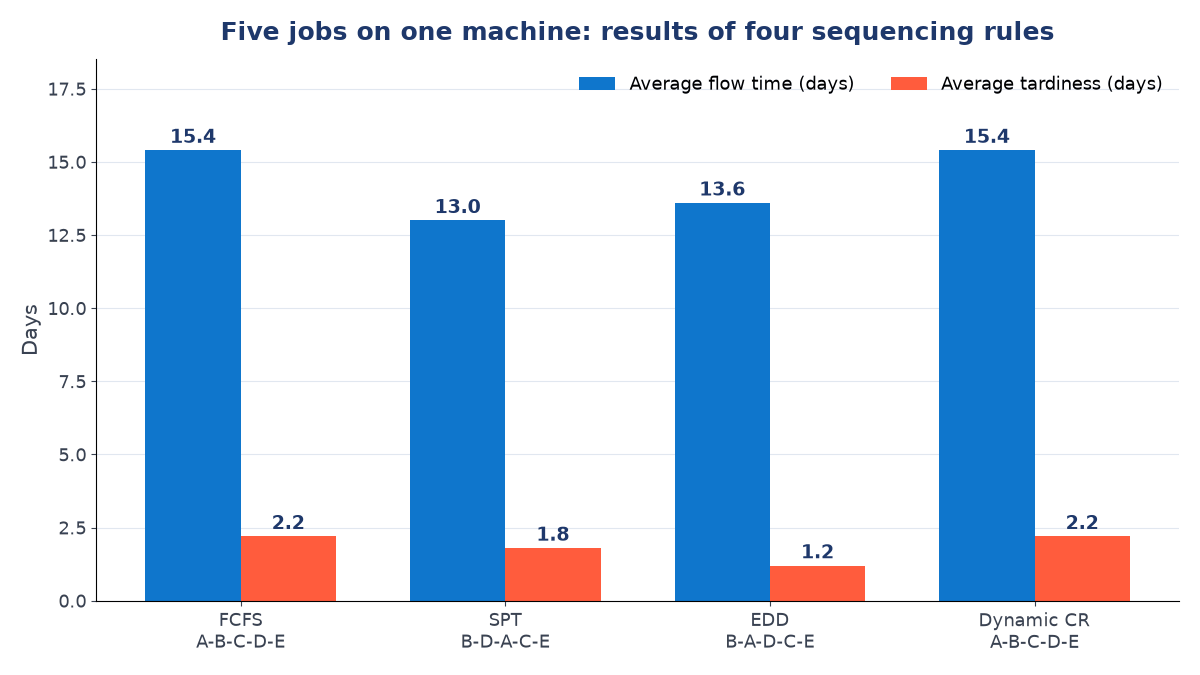
The CR sequence is A, B, C, D, E, which here happens to match the arrival order, so its results equal FCFS: average flow time 15.4 days and average tardiness 2.2 days.
Comparison
| Rule | Sequence | Average flow time (days) | Average tardiness (days) | Late jobs | Average jobs in system |
|---|---|---|---|---|---|
| FCFS | A-B-C-D-E | 15.4 | 2.2 | 3 | 2.75 |
| SPT | B-D-A-C-E | 13.0 | 1.8 | 3 | 2.32 |
| EDD | B-A-D-C-E | 13.6 | 1.2 | 2 | 2.43 |
| Dynamic CR | A-B-C-D-E | 15.4 | 2.2 | 3 | 2.75 |
SPT gives the lowest average flow time, and EDD gives the lowest tardiness and fewest late jobs, which matches the general textbook findings. If on-time delivery is the priority, this printing unit should use EDD.
Sequencing n jobs through two machines: Johnson's rule
When every job must pass through the same two machines in the same order (first M1, then M2), Johnson's rule (S. M. Johnson, 1954) gives the sequence that minimises total completion time (makespan) and hence idle time.
- List the processing time of every job on both machines.
- Find the smallest time in the whole list.
- If it is on Machine 1, place that job as early as possible in the sequence. If it is on Machine 2, place it as late as possible.
- Remove that job from the list.
- Repeat until all jobs are placed. Ties may be broken arbitrarily.
Worked example 2: Johnson's rule
Suppose a workshop must cut (M1) and then polish (M2) five jobs. Times are in hours.
| Job | J1 | J2 | J3 | J4 | J5 |
|---|---|---|---|---|---|
| Machine 1 (cutting) | 5 | 1 | 9 | 3 | 10 |
| Machine 2 (polishing) | 2 | 6 | 7 | 8 | 4 |
Step 1: Smallest time is 1 (J2 on M1), so J2 goes first: J2 _ _ _ _.
Step 2: Next smallest is 2 (J1 on M2), so J1 goes last: J2 _ _ _ J1.
Step 3: Next smallest is 3 (J4 on M1), so J4 goes in the earliest free slot: J2 J4 _ _ J1.
Step 4: Next smallest is 4 (J5 on M2), so J5 goes in the latest free slot: J2 J4 _ J5 J1.
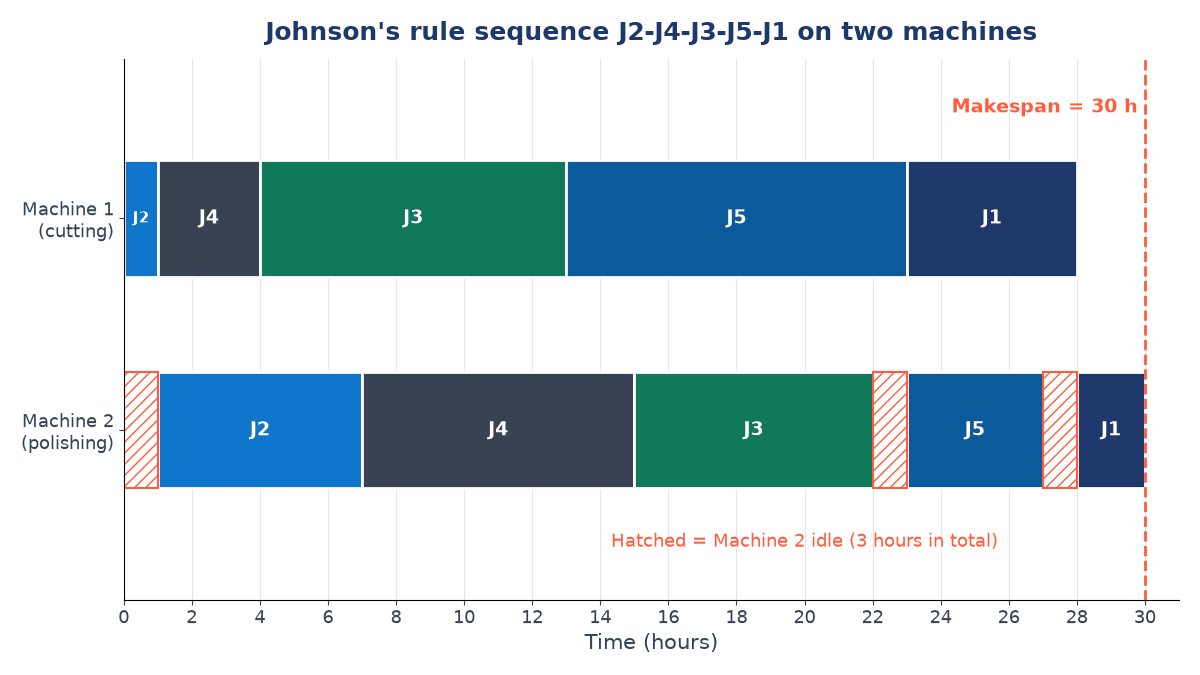
Step 5: J3 fills the remaining slot. Optimal sequence: J2, J4, J3, J5, J1.
Step 6: Build the time table. A job starts on M2 at the later of (its finish on M1) and (the finish of the previous job on M2).
| Job | M1 in | M1 out | M2 in | M2 out | M2 idle before job |
|---|---|---|---|---|---|
| J2 | 0 | 1 | 1 | 7 | 1 |
| J4 | 1 | 4 | 7 | 15 | 0 |
| J3 | 4 | 13 | 15 | 22 | 0 |
| J5 | 13 | 23 | 23 | 27 | 1 |
| J1 | 23 | 28 | 28 | 30 | 1 |
Step 7: Results. Makespan = 30 hours. Machine 2 idle time = hours, which checks with . Machine 1 finishes at 28 hours and is idle for the last 2 hours.
Sequencing, idle time, waiting time and due dates
Idle time
Poor sequencing leaves machines waiting for work that is stuck elsewhere. Johnson's rule shows how the right order can reduce idle time when jobs pass through several machines.
Waiting time
Every job that waits in a queue adds to work-in-process inventory and lead time. SPT reduces average waiting because many short jobs leave the system quickly.
Due dates
EDD and CR focus on meeting promises to customers. Missing due dates can mean penalties, lost goodwill and lost future orders.
Advantages of proper sequencing and problems of poor sequencing
| Proper sequencing | Poor sequencing |
|---|---|
| Better use of machines and labour | Machines idle while jobs wait elsewhere |
| Shorter waiting and flow times | Long queues and high work-in-process |
| More on-time deliveries | Missed due dates and penalties |
| Smoother workflow and less confusion | Frequent rush orders and overtime |
| Higher customer satisfaction | Complaints and lost customers |
Sequencing in services
Services face the same problem with customers instead of jobs. Banks and ticket counters use FCFS. Hospital emergency departments use triage, a priority rule based on how serious each case is. Repair shops often do quick jobs first (SPT). Courier firms sort deliveries by promised time (EDD). Restaurants may give priority to reservations.
Sequencing and managerial judgement
Priority rules are guides, not laws. A manager may override a rule for a key customer, a job with scarce material, a large penalty clause or a job that would otherwise block a bottleneck. Good sequencing combines a clear rule with sensible judgement and keeps customers informed when priorities change.
Key terms
- Sequencing
- Deciding the order in which waiting jobs are processed at a work centre.
- Priority rule
- A rule, such as FCFS, SPT or EDD, used to choose the next job.
- Flow time
- The time a job spends in the system from availability to completion.
- Tardiness
- The amount by which a job's completion is later than its due date; zero if on time.
- Makespan
- The total time needed to complete all jobs in a set.
- Critical ratio
- Time remaining until the due date divided by work time remaining; lowest goes first.
- Johnson's rule
- A method that minimises makespan for jobs passing through two machines in the same order.
- Routing
- Deciding the path and order of operations a job follows.
- Gantt chart
- A bar chart showing jobs against time on each machine.
Common questions
Which sequencing rule minimises average flow time?
Shortest Processing Time (SPT) always minimises average flow time and average number of jobs in the system on a single machine, as the worked example shows (13.0 days against 15.4 for FCFS).
What does a critical ratio of less than 1 mean?
It means the time remaining until the due date is less than the work still needed, so the job is behind schedule and should be given priority.
What is the difference between sequencing and scheduling?
Sequencing fixes the order of jobs; scheduling assigns actual start and finish times to them. The sequence is usually decided first and then converted into a schedule.
When can Johnson's rule be used?
It applies when all jobs pass through the same two machines in the same order, processing times are known and fixed, and jobs cannot overtake each other between the machines.
Why might a manager not use SPT even though it gives the lowest flow time?
SPT ignores due dates and keeps pushing long jobs back, so important long orders can become very late. If on-time delivery matters most, EDD or CR is usually preferred.
References
- Johnson, S. M. (1954) "Optimal two- and three-stage production schedules with setup times included". Naval Research Logistics Quarterly, 1(1), 61–68.
- Stevenson, W. J. Operations Management. McGraw-Hill Education.
- Heizer, J., Render, B. and Munson, C. Operations Management: Sustainability and Supply Chain Management. Pearson.
- Panneerselvam, R. Production and Operations Management. PHI Learning.
- Chary, S. N. Production and Operations Management. McGraw-Hill Education (India).