A make-or-buy decision is the choice an organisation makes between producing a product, part, component or service inside the organisation (make, also called insourcing) and purchasing it from an outside supplier (buy, also called outsourcing). A car maker deciding whether to cast its own engine blocks, or a hospital deciding whether to run its own laundry, faces this decision.
The decision matters because it shapes cost, quality, control, capacity use and even the long-term strategy of the business. A sound choice can lower cost and free management to focus on what the firm does best; a poor choice can create supplier dependence, idle capacity or loss of know-how that is hard to reverse.
Objective and basic idea
The main objective is to choose the option that gives the required quality, quantity and reliability at the lowest relevant total cost, while supporting the firm's long-term strategy.
The basic idea is to compare two things:
- the relevant cost of making the item internally, and
- the total cost of buying it from outside,
and then to adjust the answer for non-cost factors such as quality, capacity, supplier reliability, secrecy and strategy. Cost is usually the starting point, but it is rarely the only point.
When does the decision arise?
- A new product needs parts the firm has never made or bought before.
- An existing supplier raises prices, delivers late or supplies poor quality.
- The firm has spare capacity and looks for work to fill it.
- Demand grows beyond internal capacity.
- Costs of internal production rise, or new technology changes the economics.
- Management reviews which activities are core and which can be outsourced.
Meaning of "make" and "buy"
Make
The organisation uses its own machines, workers, materials and management to produce the item. It controls the process fully but also carries the investment, fixed costs and risks.
Buy
The organisation purchases the finished item or service from a supplier. It pays a price per unit (plus ordering, transport, inspection and similar costs) and relies on the supplier for quality and delivery.
Why companies choose to make
Lower cost of internal production
If the relevant internal cost is below the purchase price, making saves money, especially at high volumes.
Better quality control
The firm can set and check its own standards directly.
Better confidentiality
Designs, formulas and processes stay inside the firm, protecting trade secrets.
Better use of spare capacity
Idle machines and workers can be put to work, spreading fixed costs over more output.
Reliable supply
The firm is less exposed to supplier delays, strikes or shortages.
Other reasons include no suitable supplier existing, the item being a core competence, and the wish to keep skilled workers employed.
Why companies choose to buy
Lower purchase cost
Specialist suppliers often enjoy economies of scale, experience and lower overheads.
Lack of internal capacity
Existing facilities are fully used, and adding capacity would be costly or slow.
Lack of technical skill
The firm may not have the technology, patents or expertise needed.
Time saving
Buying is faster than setting up a new production line.
Focus on core activities
Management can concentrate money and attention on what gives the firm its competitive advantage.
Buying also offers flexibility: order quantities can be changed when demand changes, without the burden of idle plant.
Cost factors in the make-or-buy decision
Internal cost of making
- Direct materials
- Direct labour
- Variable overheads, such as power and consumables
- Additional fixed costs, such as new machines, tooling and supervision
- Opportunity cost of capacity used, if that capacity could earn something else
External cost of buying
- Purchase price per unit
- Freight, packing and insurance
- Ordering, receiving and inspection costs
- Import duties and taxes that cannot be recovered
- Cost of holding extra safety stock against supplier delays
Role of fixed and variable cost
Variable cost changes with the number of units made, for example material and piece-rate labour. Fixed cost stays the same over a range of output, for example machine depreciation, rent and salaried supervision. Making usually involves a fixed cost plus a lower variable cost per unit; buying usually involves only a per-unit price. So:
- making becomes economical at high volumes, because the fixed cost is spread over many units;
- buying is economical at low volumes, because the firm avoids a fixed cost it cannot spread.
A key rule is to consider only relevant costs, that is, future costs that differ between the two options. Fixed overheads that will be incurred anyway, whether the item is made or bought, are not relevant and should be ignored.
Break-even point in make or buy
The break-even (indifference) quantity is the volume at which the total cost of making equals the total cost of buying. Let = fixed cost of making, = variable cost of making per unit, = purchase price per unit and = quantity.
If expected demand is above , making is cheaper. If it is below , buying is cheaper. The formula works only when the purchase price is higher than the variable cost of making (); otherwise buying is always cheaper on cost alone.
Worked example 1: break-even quantity
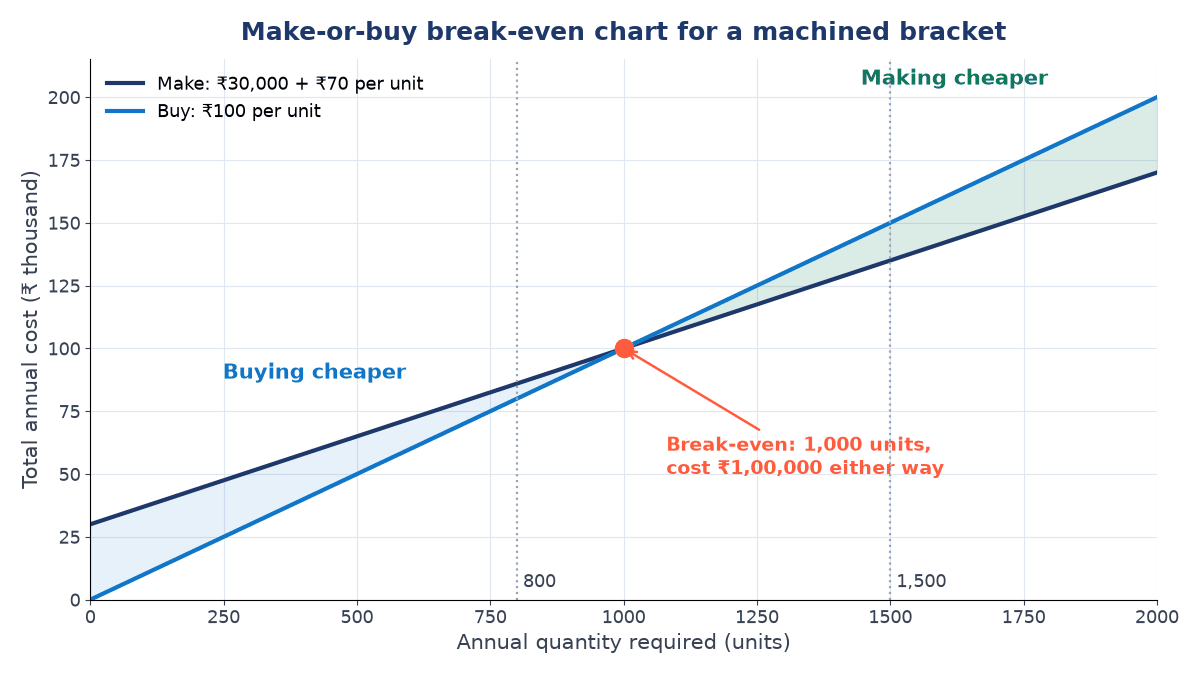
Suppose a pump manufacturer needs a machined bracket. A supplier quotes ₹100 per unit. To make it, the firm would spend ₹30,000 a year on tooling and set-up (fixed) and ₹70 per unit on material, labour and power (variable).
Step 1: Write the data. , , .
Step 2: Break-even quantity.
At 1,000 units both options cost rupees, and rupees.
Step 3: Test at 1,500 units.
Making saves ₹15,000, so the firm should make.
Step 4: Test at 800 units.
Buying saves ₹6,000, so the firm should buy.
Interpretation: above 1,000 units a year making is more economical; below 1,000 units buying is more economical.
Worked example 2: relevant costs and opportunity cost
Suppose a firm currently makes 5,000 units a year of a component. Its cost sheet shows:
| Cost per unit | Amount (₹) |
|---|---|
| Direct materials | 40 |
| Direct labour | 25 |
| Variable overheads | 15 |
| Share of general fixed overheads | 20 |
| Total cost per unit | 100 |
A supplier offers the component at ₹90 per unit. At first sight buying saves ₹10 per unit.
Step 1: Identify relevant cost. The general fixed overheads (factory rent, manager's salary) will continue even if the firm buys, so they are not relevant. Relevant cost of making is
Step 2: Compare with no alternative use of capacity.
Making is cheaper by ₹50,000, so the firm should continue to make, even though the full cost of ₹100 looked higher than the price.
Step 3: Add an opportunity cost. Now suppose that if the firm buys, the freed space and machines can be rented out for ₹70,000 a year. That lost rent is a cost of making.
Now buying is cheaper by ₹20,000, so the firm should buy and rent out the capacity. The lesson is that spare capacity favours making, while capacity with a profitable alternative use favours buying.
Non-cost factors
Quality
If the firm can achieve better or more consistent quality internally, making may be preferred even at a higher cost. If a specialist supplier has superior technology and certified quality systems, buying may give better quality.
Capacity
If spare capacity exists, making uses resources that would otherwise be idle, and only variable costs are relevant. If no spare capacity exists, making would need new investment or would displace other profitable work, so buying often becomes attractive.
Supplier reliability
A cheap supplier who delivers late or inconsistently can stop production. The firm should examine the supplier's delivery record, financial strength, capacity, location and the number of alternative suppliers available.
Strategic factors
Items that form the firm's core competence or give it a competitive edge are usually kept in-house. Outsourcing them can create future competitors and loss of skills. Non-core, standard items are good candidates for buying.
Other factors
- Confidentiality of designs and processes
- Flexibility to change volumes or designs
- Labour relations, since outsourcing may lead to job losses
- Control over lead time and delivery schedules
- Risk from currency changes, transport disruption or supplier failure
Advantages and disadvantages
| Option | Advantages | Disadvantages |
|---|---|---|
| Make | Direct control of quality and schedule; protection of secrets; use of spare capacity; keeps profit margin in-house; independence from suppliers; builds skills | Needs investment and fixed costs; may lack scale and expertise; risk of idle capacity if demand falls; diverts management attention from core work; less flexibility |
| Buy | No investment needed; access to supplier expertise and scale; flexibility in volume; faster start; focus on core activities; supplier bears technology risk | Less control over quality and delivery; dependence on suppliers; risk of leaking designs; transport and coordination costs; supplier may raise prices later |
Make or buy versus ordinary purchasing
| Make-or-buy decision | Ordinary purchasing |
|---|---|
| Strategic, long-term choice | Routine, operational activity |
| Asks whether to produce or procure | Assumes the item will be bought and asks from whom, how much and when |
| Involves production, finance, engineering and top management | Handled mainly by the purchase department |
| Considers capacity, strategy and relevant cost | Considers price, supplier, quantity and delivery |
Make or buy in manufacturing and services
Manufacturing: automobile firms buy tyres, batteries and electronics while making engines; electronics companies outsource assembly to contract manufacturers; garment exporters buy fabric and make garments.
Services: companies outsource payroll, security, cleaning, canteen, IT support and call-centre work; hospitals outsource laboratory tests or laundry; colleges outsource transport. The same cost and non-cost logic applies.
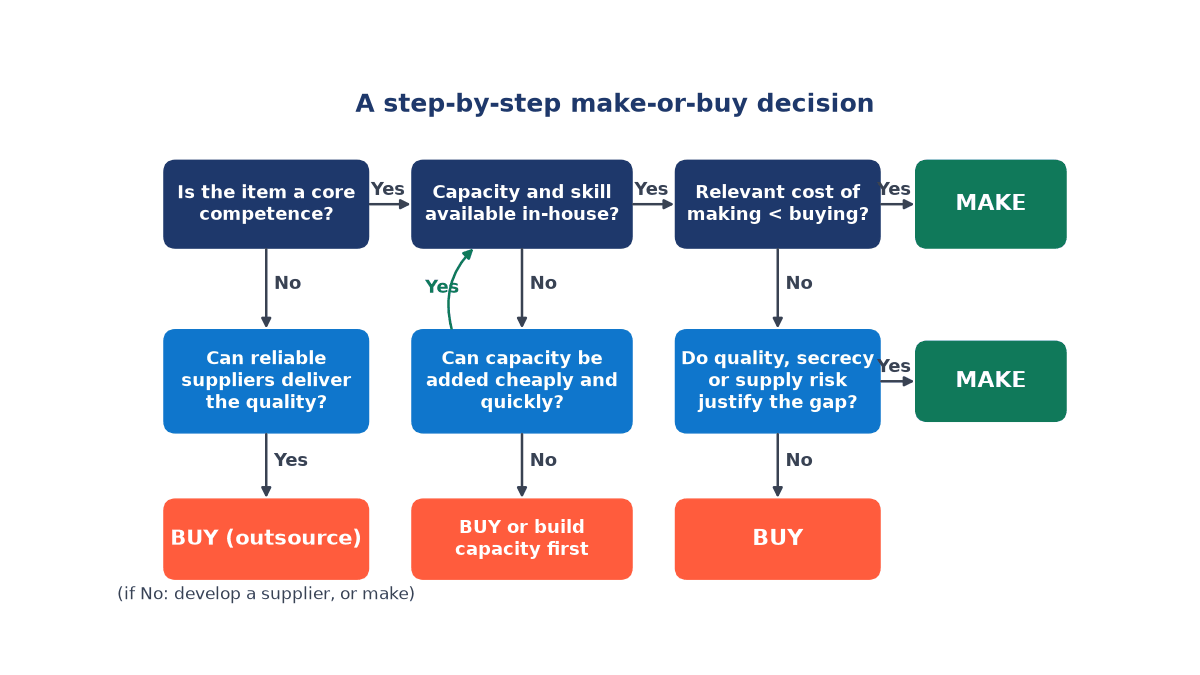
Steps in making the decision
- Define the item, required quality and expected volume.
- Estimate the relevant cost of making, including new fixed costs and opportunity cost.
- Obtain quotations and estimate the total cost of buying.
- Compute the break-even quantity and compare with expected demand.
- Assess non-cost factors: quality, capacity, supplier reliability, strategy, risk.
- Decide, implement, and review the decision periodically as conditions change.
Key terms
- Make-or-buy decision
- The choice between producing an item internally and purchasing it from outside.
- Insourcing
- Performing an activity or making an item within the organisation.
- Outsourcing
- Obtaining an item or service from an external supplier.
- Relevant cost
- A future cost that differs between the alternatives being compared.
- Opportunity cost
- The benefit given up by using a resource for one purpose rather than its best alternative.
- Break-even quantity
- The volume at which the total cost of making equals the total cost of buying.
- Fixed cost
- A cost that does not change with output over a relevant range.
- Variable cost
- A cost that changes in direct proportion to output.
- Core competence
- A capability that gives the firm its competitive advantage and is hard to copy.
Common questions
What is the formula for break-even quantity in a make-or-buy decision?
Break-even quantity equals the fixed cost of making divided by the difference between the purchase price per unit and the variable cost of making per unit. With ₹30,000 fixed cost, ₹100 price and ₹70 variable cost, it is 1,000 units.
Should allocated fixed overheads be included in the cost of making?
Only if they would be saved by buying. Fixed overheads that continue whatever the decision are not relevant and should be excluded, as worked example 2 shows.
How does spare capacity affect the decision?
With spare capacity, only variable costs of making are relevant, which usually favours making. Without spare capacity, the firm must add investment or give up other profitable work, which usually favours buying.
Why might a firm make an item even when buying is cheaper?
To protect trade secrets, control quality, secure supply, keep a core competence in-house or avoid dependence on a single supplier.
Is make or buy a one-time decision?
No. Volumes, prices, technology and supplier performance change, so firms review make-or-buy choices periodically.
References
- Heizer, J., Render, B. and Munson, C. Operations Management: Sustainability and Supply Chain Management. Pearson.
- Stevenson, W. J. Operations Management. McGraw-Hill Education.
- Chopra, S. and Meindl, P. Supply Chain Management: Strategy, Planning, and Operation. Pearson.
- Krajewski, L. J., Malhotra, M. K. and Ritzman, L. P. Operations Management: Processes and Supply Chains. Pearson.
- Chary, S. N. Production and Operations Management. McGraw-Hill Education (India).