This is a profile of Bloomingdale International School (BIS) in Vijayawada, Andhra Pradesh, written for parents who have heard the name and want one clear page that brings together its programmes, its approach, the outcomes it reports and the steps to contact it.
BIS has become one of the most sought-after international school options for families in South India. It was established in 2006 as a play school and reborn in 2016 as an IB World School. Its stated vision is to "empower everyone to become a thriving lifelong learner and responsible global citizen". The school combines globally recognised curricula, personalised mentorship and a strong emphasis on student well-being.
Several figures below, such as results, scholarships and ratios, are reported by the school itself. They are presented as the school's claims, and the guidance sections later explain how to ask about them during a visit.
Why parents choose Bloomingdale International School
International curriculum from preschool to high school
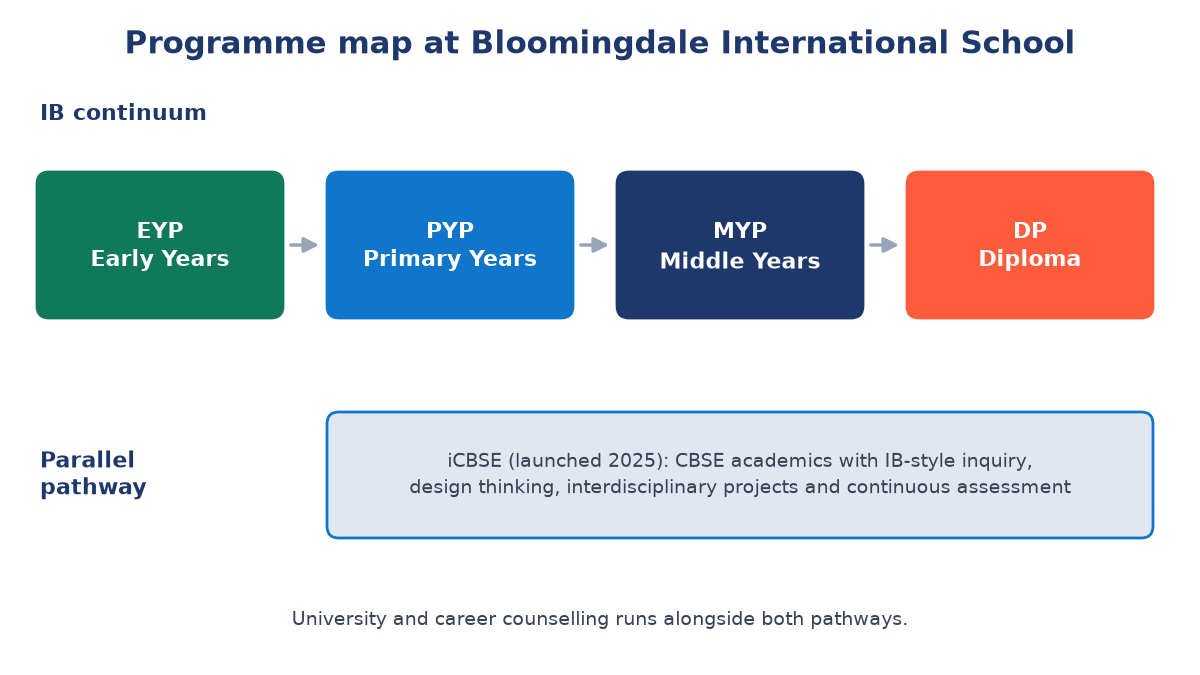
BIS is the only school in Vijayawada offering the International Baccalaureate (IB) continuum (PYP, MYP and DP), and it supplements this with a distinctive iCBSE programme introduced in 2025. The iCBSE pathway blends CBSE academics with IB-style inquiry, critical thinking and real-world projects.
Reported academic outcomes
The school reports that its students consistently outperform global benchmarks: its Middle Years Programme (MYP) averages above 40 points against a world average of 39 (42/56 in May 2025), and Diploma Programme (DP) learners score 1260+ on the SAT. BIS learners are also reported to have secured over USD 440,000 in international scholarships, and the school holds a University and Colleges Admissions Service (UCAS) affiliation, which enables direct applications to UK universities.
What independent sources say about the IB in India
The Indian Express[1] notes that more than 51% of Indian IB graduates choose to stay in India for higher education, and the Association of Indian Universities (AIU) has recognised the IB Diploma as equivalent to the Indian Grade 12 since 1983. On that basis, the article states that BIS's IB credentials keep students eligible for national entrance exams (JEE, NEET, CLAT) and leading Indian universities.
Design thinking and project-based learning
BIS's vision framework emphasises design thinking, project-based learning and interdisciplinary projects. Lessons are inquiry-driven and connect subjects such as art, science and technology through hands-on projects, so that children learn by doing rather than memorising.
Experienced educators and staff ratio
The school's "About Us" page highlights a staff–student ratio of 1:9 and notes that most teachers have at least five years of experience. BIS explicitly aims to help students become confident, creative and caring adults.
Awards and reputation
Bloomingdale has been awarded 5th in India for creating design-thinking leaders and named the Best International School in Andhra Pradesh.
Academic programmes
IB continuum
BIS offers the full IB continuum:
- Early Years Programme (EYP)
- Primary Years Programme (PYP)
- Middle Years Programme (MYP)
- Diploma Programme (DP)
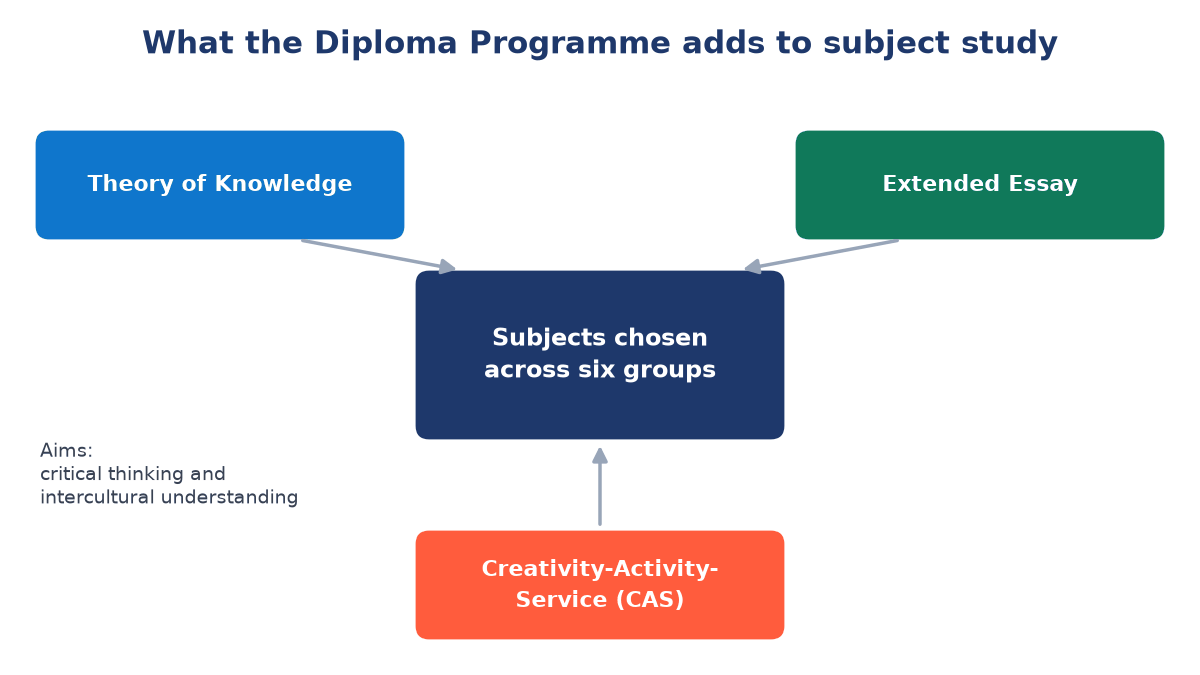
The school notes that the DP is a rigorous two-year pre-university curriculum that includes Theory of Knowledge, the Extended Essay and Creativity–Activity–Service (CAS), fostering critical thinking and intercultural understanding. Students choose subjects across six groups, from languages and humanities to sciences and mathematics.
iCBSE programme
Launched in 2025, iCBSE combines the academic structure of CBSE with the inquiry-based methods of the IB. It is aimed at families who want strong preparation for Indian colleges without giving up global skills. Its features include:
- Experiential learning and design thinking: students learn through real-world projects and design-thinking exercises.
- Interdisciplinary projects: each term ends with projects that combine art, science and technology, or humanities and service.
- Continuous assessment: assessment goes beyond exams to include quizzes, projects, participation, effort and collaboration; progress reports track academic performance, skill development and growth.
- Learner model (V Pillars): BIS aims to nurture self-directed learners, effective communicators, collaborative leaders, strong thinkers and community builders.
- Bridge programme and personalised mentorship: teachers begin each year with a bridge programme to understand every child's strengths and adapt instruction; small mentoring groups provide guidance and emotional support.
University and career guidance
BIS provides a dedicated university counselling programme. Students and parents meet counsellors to explore career pathways, scholarships and university options. The guidance runs from early self-discovery projects to subject selection and application support.
Sports and the arts
BIS treats sports and the arts as part of a holistic education. The school's sports policy emphasises physical fitness, emotional resilience, teamwork and leadership. Highlights include:
- Structured progression across eight core sports: Athletics, Yoga, Football, Basketball, Tennis, Throwball, Swimming and Cricket, with sport specialisation possible from PYP 4 onwards.
- After-school sports coaching programme: students train five days a week under qualified coaches; talent identification tests invite high performers to join school teams.
- Health and sports reports covering fitness, skill development, achievements and medical status.
The iCBSE vision framework also lists arts options: choir and instrumental music, classical and western dance, and visual arts.
Well-being and character development
BIS describes a child's emotional and mental health as the foundation for learning. Its admissions material says that care comes first: bridge programmes, buddy systems and morning circle discussions help students feel safe and valued. Well-being classes cover feelings, friendships, respect and safety, and the school maintains a no-comparison culture. Mentorship programmes offer counselling support, mindfulness practices and academic guidance.
Achievements and outcomes, as reported
- IB results: MYP average scores reported above the world average, and DP learners reported to score 1260+ on the SAT.
- University pathways: BIS is described as the only school in Andhra Pradesh with UCAS affiliation. Graduates are reported to have secured places at Indian institutions such as Delhi University, IITs (via JEE), NITs and AIIMS.
- Scholarships and awards: over USD 440,000 in international scholarships, recognition among India's top design-thinking schools, and the title of best international school in Andhra Pradesh.
How to evaluate a school's reported results
Any school profile that quotes scores, scholarships and awards deserves a careful reading. These steps apply to every school, not just this one.
- Ask for the basis. For any average score, ask which year, which programme and how many students it covers.
- Check the scale. Programme scores can be reported on different scales; ask the school to explain the one it uses.
- Ask who awarded it. For awards and titles, ask for the name of the organisation and the year.
- Look at the full picture. Ask how the school supports students who find the programme difficult, not only its top performers.
- Match outcomes to your plans. If your child is aiming for Indian entrance exams, ask how preparation fits alongside the IB or iCBSE timetable.
Questions to ask before you enrol
- Should my child join the IB continuum or iCBSE, and can a student switch later?
- How does the bridge programme work for a child joining mid-way?
- How is sport specialisation from PYP 4 organised, and how much time does it take?
- How does university counselling begin, and at what stage?
- How are continuous assessment results shared with parents?
Common mistakes
- Choosing between IB and iCBSE on reputation alone rather than on the child's learning style and future plans.
- Reading reported averages without asking what they are based on.
- Assuming the after-school sports programme suits every child's schedule without asking about the weekly commitment.
- Waiting until the senior years to think about entrance exams or overseas applications.
- Skipping the campus visit and relying on the website alone.
Admissions and contact
Families interested in an international school education at Bloomingdale can learn more or schedule a campus visit through the official website (Bloomingdale.edu.in). The admissions team can be contacted on +91 952 552 5525, and enquiries can also be made through the online enquiry form.
Key terms
- IB continuum
- The sequence of IB programmes a school offers, allowing a child to progress from early years to pre-university in one framework.
- Theory of Knowledge
- A Diploma Programme course that asks students to reflect on how we know what we claim to know.
- Extended Essay
- An independent research paper written by Diploma Programme students.
- CAS
- Creativity, Activity, Service: the Diploma Programme component covering creative, physical and community work.
- CBSE
- The Central Board of Secondary Education, a national school board in India.
- UCAS
- The UK's central service through which students apply to universities.
- Continuous assessment
- Judging progress throughout the year through projects, quizzes and participation, not only final exams.
Common questions
When was Bloomingdale International School founded?
It was established in 2006 as a play school and reborn in 2016 as an IB World School.
What is iCBSE at Bloomingdale?
A programme introduced in 2025 that combines CBSE academics with IB-style inquiry, design thinking, interdisciplinary projects and continuous assessment.
Can IB students in India take national entrance exams?
The article notes that the AIU has recognised the IB Diploma as equivalent to the Indian Grade 12 since 1983, and states that this keeps students eligible for exams such as JEE, NEET and CLAT. Always confirm current eligibility rules with the exam body.
Which sports are offered?
Eight core sports: Athletics, Yoga, Football, Basketball, Tennis, Throwball, Swimming and Cricket.
How do I contact admissions?
Call +91 952 552 5525, use the online enquiry form, or visit the Bloomingdale International School website for programmes, admissions and virtual tours.
References
- International Baccalaureate Organization. IB programmes: Primary Years, Middle Years and Diploma Programme. IBO, Geneva.
- Central Board of Secondary Education. Curriculum for Secondary and Senior Secondary Classes. CBSE, New Delhi.
- National Testing Agency. Joint Entrance Examination (Main) information bulletin. NTA, New Delhi.
External source cited in the original profile: