No products in the cart.
In this guide, we break down the essential components of basics Algebra with variables, constants, and terms and revisit the fundamental sets of numbers that form the backbone of mathematics.
Table of Contents
Algebra is essentially the arithmetic of symbols. To understand it, we must define the three core elements that make up every algebraic expression.
What is a variable in algebra?
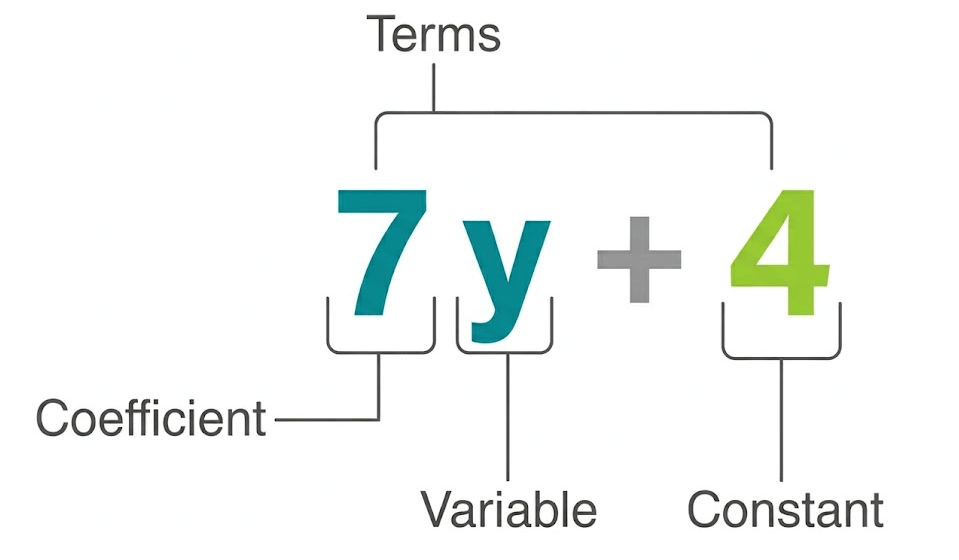
A variable is a symbol that can take on various numerical values in simple words A variable is a letter representing some unknown, a variable always represents a number, but it carries varying values when written in an expression.
In most problems, we use letters like $x, y, z, a, b,$ or $c$ to represent these changing values. Because they represent “letters,” they are also frequently referred to as literals.
Example of variable in an algebraic term:
1.1 $5x$ Here, x is the variable
1.2 $76Z$ Here, Z is the variable
1.3 $525xy$ Here, xy is the variable
What is a Constant in algebra means?
Unlike variables, a constant is a symbol that has a fixed, unchanging value. Standard numbers are the most common constants. in simple words A constant is a value or number that never changes in expression; it’s constantly the same.
Examples:
- $5x$ Here 5 is the Constant
- $-36Z$, Here -36 is the Constant
Do you know what is a Term in Algebra?
A term is formed when constants and variables stand alone or are combined using multiplication or division.
- Examples of terms: $7y$, $4$.
Factors and Coefficients
When we look at a term like $5xy$, there is more going on than meets the eye. We can break these down into “factors” and “coefficients.”
What are Factors?
In a product, every individual literal or numerical value is called a factor of that product.
- Example: In the term $5xy$, the values $5, x,$ and $y$ are all individual factors.
Understanding Coefficients
A coefficient is a specific type of factor. In a product of two or more factors, any single factor is called the coefficient of the remaining factors.
- In 5x: $5$ is the coefficient of $x$.
- In -6xy: $-6$ is the coefficient of $xy$.
Like vs. Unlike Terms
To add or subtract algebraic expressions, you must be able to distinguish between Like and Unlike terms.
Like Terms (Similar Terms):
These are terms that contain the exact same literal (variable) factors.
Example: $a$ and $2a$ are like terms.
Example: $2a$ and $3a$ are like terms.
Unlike Terms:
These are terms that do not have the same literal factors.
Example: $2a$ and $3b$ are unlike terms because the variables ($a$ and $b$) are different.
Example: $2$ and $a$ are unlike terms because one is a constant and the other is a variable.
Translating Phrases into Symbols
One of the most important skills in Algebra is converting word problems into symbolic form. Here is a quick reference for common translations:
| Verbal Statement | Symbolic Form |
| The sum of $a$ and $b$ | $a + b$ |
| The subtraction of $b$ from $a$ | $a – b$ |
| $5$ decreased by $x$ | $5 – x$ |
| $5$ times $x$ | $5x$ |
| $40$ divided by $x$ | $40 / x$ |
| $6$ more than $x$ | $x + 6$ |
| $4$ less than half of $x$ | $(x / 2) – 4$ |
Back to Basics: The Number Systems
Before mastering variables, it is helpful to remember the number sets that variables can represent.
- Natural Numbers ($N$): These are your basic counting numbers: $\{1, 2, 3, 4, \dots\}$.
- Whole Numbers ($W$): These include all natural numbers plus zero: $\{0, 1, 2, 3, \dots\}$.
- Integers ($Z$): This set includes zero, positive counting numbers, and their negative counterparts: $\{\dots, -3, -2, -1, 0, 1, 2, 3, \dots\}$.
Visualizing Fractions
Fractions represent a “shaded part” of a whole. They are often categorized by how much of the “whole” they represent:
- Half: $1/2$
- One-third: $1/3$
- One-fourth (Quarter): $1/4$
- Three-fourths: $3/4$
Basic Algebra Operations
Algebraic expressions are formed by combining variables and constants using arithmetic operations. Mastering these operations is essential for solving complex mathematical problems. The primary methods for handling these expressions include horizontal and vertical arrangements.
Adding Algebraic Expressions
Adding expressions requires identifying and combining like terms. Like terms are those that have the same variables raised to the same powers.
- Horizontal Method: This involves writing the expressions in a single line and grouping like terms together. For example, adding $2a + 3b$ and $5a + 4b$ is done by grouping $(2a + 5a) + (3b + 4b)$, resulting in $7a + 7b$.
- Vertical Method: Expressions are written one below the other, with like terms aligned in columns for easier addition.
Subtraction Techniques
Subtraction follows similar logic to addition but requires careful attention to the signs of the terms being subtracted.
- Horizontal Subtraction: To subtract $2a$ from $7a$, you simply perform $7a – 2a = 5a$. When subtracting polynomials, it is helpful to use the property $a(b + c) = ab + ac$ to distribute negative signs across terms.
- Vertical Subtraction: Aligning like terms vertically allows you to subtract one column at a time. For example, subtracting $3x + 4y$ from a given expression involves changing the signs of the subtracted terms and then adding.
Multiplication of Expressions
Multiplication in algebra varies depending on the number of terms in the expressions involved.
Monomial by Monomial: Multiply the coefficients and then the variables. For example, multiplying $3x$ and $5y$ gives $15xy$. Similarly, multiplying three monomials like $2x, 5y,$ and $7z$ results in $70xyz$.
Monomial by Polynomial: Distribute the monomial across every term inside the polynomial.
Polynomial by Polynomial: Multiply each term of the first polynomial by every term of the second polynomial.
Practical Simplification Examples
Simplification often involves a combination of operations to reach the most concise form of an expression.
- Combining Terms: An expression like $a – 4b + 3a + 3c$ simplifies to $4a – 4b + 3c$ by combining the ‘a’ terms.
- Complex Products: Multiplying complex terms like $4ab$ may involve identifying common factors or distributing variables across multiple sets of parentheses.
Deepen your understanding of mathematical foundations with the Introduction to Algebra course at Expresswala Academy. This beginner-level course offers a detailed exploration of the essential principles covered in this guide, including a deep dive into variables and constants, as well as the critical distinction between like and unlike terms.
Designed for students in classes 2 to 6, this three-week curriculum provides structured lessons and expert instruction to help you transition from basic arithmetic to advanced algebraic thinking. Enroll today for free to access comprehensive learning modules that turn complex equations into manageable skills.