No products in the cart.
In any Managerial Economics course, two concepts form the foundation of market analysis: the Law of Demand and Elasticity of Demand. For MBA students, these aren’t just definitions to memorize for semester exams; they are critical tools for understanding consumer behavior and setting competitive pricing strategies.
In this guide, we will break down the Law of Demand and Elasticity of Demand, explain the formulas you need to know, and apply them to real-world Indian business scenarios.
Table of Contents
1. What is the Law of Demand?
The Law of Demand is a foundational principle in economics that articulates the inverse relationship between the price of a good or service and the quantity demanded by consumers, ceteris paribus (or all other factors being equal).
It encapsulates the basic behavioral pattern observed in markets:
- As Price Rises: Consumers tend to demand less of the product.
- As Price Falls: Consumers demand more.
The MBA Perspective: Why does this happen?
This law is grounded in the concept of consumer choice and rational decision-making. When faced with higher prices, consumers typically seek substitutes or forgo purchases altogether. They represent a “rational actor” seeking to maximize their utility (satisfaction) given their limited budget.
Indian Market Example: When the price of premium smartphones increases significantly, Indian consumers often switch to “value flagship” brands like OnePlus or Xiaomi. This substitution effect is the Law of Demand in action.
2. Defining Elasticity of Demand
While the Law of Demand explains the direction of consumer behavior, it doesn’t explain the magnitude. To measure how much demand changes, we look at the second part of our topic: Elasticity of Demand.
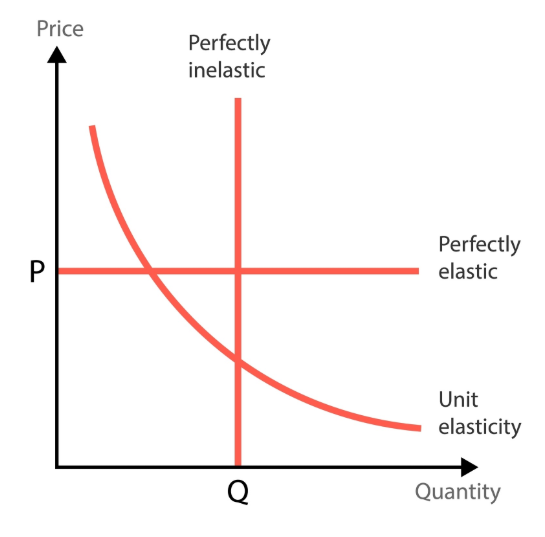
Elasticity of demand measures the responsiveness or sensitivity of the quantity demanded of a good or service to changes in its price. It quantifies the extent to which changes in price lead to changes in quantity demanded.
The Formula
For your MBA numericals, remember that Price Elasticity is expressed as the percentage change in quantity demanded divided by the percentage change in price. Mathematically, it can be represented as:
$$E_d = \frac{\% \text{ Change in Quantity Demanded}}{\% \text{ Change in Price}}$$
3. Interpreting Elasticity: Elastic vs. Inelastic
When studying the Law of Demand and Elasticity of Demand, the value of $E_d$ is crucial for decision-making. Elasticity values can vary widely, influencing market dynamics.
Elastic Demand ($E_d > 1$)
If demand is elastic, it means that a small change in price leads to a proportionally larger change in quantity demanded.
- Business Context: Products with elastic demand tend to have close substitutes available in the market. Consumers are highly responsive to price changes.
- Example: Soft drinks or branded apparel. If Coke raises its price, consumers can easily switch to Pepsi.
Inelastic Demand ($E_d < 1$)
Inelastic demand indicates that changes in price have a relatively smaller impact on quantity demanded.
- Business Context: Products with inelastic demand often lack close substitutes. Consumers may be less sensitive to price fluctuations, particularly for essential goods.
- Example: Petrol or Salt. Even if petrol prices in Delhi rise by ₹5, the demand drops very little because commuters still need to get to work.
4. Strategic Importance for MBA Students
Why do we combine the Law of Demand and Elasticity of Demand in one study unit? Because together, they dictate strategy.
Understanding elasticity of demand is essential for businesses in:
- Setting Prices: If demand is inelastic, a firm can raise prices to increase revenue. If elastic, a price cut might boost total revenue through volume.
- Forecasting Sales: It allows firms to gauge the potential impact of price changes on future revenue.
- Strategic Decisions: It helps managers optimize profit margins while meeting consumer demand.
Additionally, policymakers use elasticity of demand to design effective taxation policies (like “Sin Tax” on cigarettes) and regulate markets. Thus, these concepts play a pivotal role in both microeconomic decision-making and macroeconomic analysis.
Conclusion
Mastering the Law of Demand and Elasticity of Demand is vital for any MBA student aiming for a career in marketing, consulting, or finance. These concepts provide the analytical framework to predict how markets behave when prices fluctuate.
Ready to dive deeper into Managerial Economics?
Visit Expresswala Academy for comprehensive MBA notes, video lectures, and exam tips designed specifically for Indian B-School students.