
No products in the cart.
Accounting is the backbone of every business—small shop or giant corporation—because it helps us understand money flow, performance, and financial health. In this first session, let’s learn the fundamentals of accounting with proper explanations, simple real-life examples, and quick recap points.
Chapters
What Is Accounting?
Accounting is the systematic process of identifying, measuring, recording, and communicating financial information related to economic activities. Think of it like maintaining a diary for your business, where every financial action—earning, spending, buying, selling—is recorded correctly so that at the end of the month or year, you can see whether your business is profitable or struggling. For example, imagine you run a small stationery shop. Every time you purchase pens, sell notebooks, pay the electricity bill, or collect cash from customers, all these are recorded. These records later help prepare financial statements like the Income Statement and Balance Sheet, which give a complete picture of your business’s performance.
Quick Summary
Accounting = business money management system
Helps in tracking income, expenses, assets, and liabilities
Final goal: prepare financial statements for decision-making
Basic Accounting Terms (Explained in Full Detail)
1. Business Transaction
A business transaction is any activity involving money or measurable value between two parties. It may involve buying goods, paying salaries, receiving payments, or even offering services. For instance, when a mobile phone store purchases 20 handsets from a wholesaler for ₹2,00,000, it is a business transaction because money is exchanged for goods. Even paying your shop’s electricity bill counts as a transaction. For a transaction to be recorded in accounting, it must be measurable in money.
Quick Summary:
A measurable financial event involving two parties.
2. Capital
Capital refers to the amount invested by the owner to start or run the business. It can be money, machinery, furniture, or anything of value contributed by the owner. Imagine opening a bakery and investing ₹5,00,000 to buy ovens, ingredients, and rent a shop. That investment is your capital. Capital increases when the owner invests more and decreases when the owner withdraws funds.
Quick Summary:
Owner’s investment in the business; helps the business operate and grow.
3. Drawings
Drawings represent the amount withdrawn by the owner from the business for personal use. For example, if the bakery owner takes home ₹10,000 from the business cash to pay rent at home, it is considered a drawing. It reduces the owner’s capital because the money is taken out from business funds.
Quick Summary:
Withdrawals by the owner for personal use; reduces capital.
4. Liabilities (Current & Non-Current)
Liabilities are obligations the business must repay. Current liabilities are short-term dues payable within 12 months—for example, unpaid electricity bill, outstanding salaries, or payments to suppliers. Non-current liabilities are long-term obligations such as bank loans payable over 5–10 years. For example, taking a 5-year loan of ₹10 lakhs from a bank to expand your shop is a non-current liability.
Quick Summary:
Amount the business owes—short-term (current) or long-term (non-current).
5. Assets (Current & Non-Current)
Assets are resources the business owns and uses to generate income. Current assets include cash, stock, and receivables—items convertible into cash within one year. For example, fruits stocked in a supermarket are current assets. Non-current assets are long-term, such as buildings, machines, or vehicles used for years. A delivery van owned by a courier service is a non-current asset.
Quick Summary:
Things the business owns—quickly convertible (current) or long-term (non-current).
6. Fixed Assets (Tangible & Intangible)
Fixed assets are long-term investments used for business operations. Tangible fixed assets have physical form—like land, machinery, computers. Intangible fixed assets do not have physical existence—for example, patents, brand value, copyrights, or software licenses. When a tech startup buys a software license worth ₹2,00,000, it becomes an intangible fixed asset.
Quick Summary:
Long-term assets—physical (tangible) or non-physical (intangible).
7. Expenditure (Capital & Revenue)
Capital expenditure refers to money spent to acquire long-term assets such as machinery, buildings, or vehicles. For example, purchasing a refrigerator for a restaurant is capital expenditure. Revenue expenditure includes day-to-day operational expenses like paying wages, buying ingredients, or repairing machinery. These expenses help keep the business running but do not create long-term assets.
Quick Summary:
- Capital → long-term investment
- Revenue → daily running expenses
8. Expense
Expenses are costs incurred to run the business and generate revenue. For example, a bakery buying flour, sugar, and butter incurs expenses because these contribute to making the final product. Electricity bills, rent, advertising costs—everything falls under expenses.
Quick Summary:
Costs needed to run the business and generate revenue.
9. Income
Income is the money earned by selling goods or providing services. When a beauty salon charges ₹500 for a haircut, that amount is income. Without income, a business cannot survive.
Quick Summary:
Money earned from business activities.
10. Profit
Profit is the excess of income over expenses. For example, if your café earns ₹1,00,000 in a month and spends ₹70,000, the profit is ₹30,000. Profit helps businesses grow, reinvest, and reward owners.
Quick Summary:
Income – Expenses = Profit.
11. Gain
A gain is an additional benefit not related to core business operations. Suppose a shop bought a machine for ₹50,000 and sold it later for ₹60,000. The extra ₹10,000 is a gain.
Quick Summary:
Extra income from non-normal business activities.
12. Loss
Loss occurs when expenses exceed income. For example, if a restaurant earns ₹80,000 but spends ₹1,00,000, it incurs a loss of ₹20,000. Continuous losses may force the business to shut down.
Quick Summary:
When expenses > income.
13. Purchase
Purchasing refers to buying goods for resale or production. A grocery store buying rice bags from a wholesaler is a purchase.
Quick Summary:
Buying goods for business use or resale.
14. Sales
Sales are the income-generating activity of selling goods or services. A clothing store selling shirts worth ₹1,000 is making a sale.
Quick Summary:
Selling goods/services to earn income.
15. Goods
Goods are items bought or manufactured for selling. For a footwear shop, shoes are goods; for a furniture maker, chairs are goods.
Quick Summary: Items that a business trades in.
16. Stock
Stock refers to unsold goods available at the end of a period. If a shop has 40 unsold T-shirts at month end, that is stock.
Quick Summary: Unsold goods.
17. Debtor
A debtor is someone who owes money to the business. For example, if a stationery shop sells items worth ₹5,000 on credit to a school, the school becomes a debtor.
Quick Summary:
Person who owes money to the business.
18. Creditor
A creditor is someone to whom the business owes money. If you purchase goods on credit from a supplier, that supplier becomes a creditor.
Quick Summary:
Person to whom the business owes money.
19. Voucher
A voucher is supporting proof for an accounting entry—like a bill, invoice, or receipt. For example, if you buy stationery for ₹500, the bill becomes a voucher.
Quick Summary:
Documentary proof of a transaction.
20. Discount (Trade & Cash Discount)
Trade discount is given to encourage more buying—e.g., wholesalers offering 20% off to retailers. It is NOT recorded in books.
Cash discount is given for quick payment—e.g., “Pay within 10 days and get ₹100 off.” This IS recorded in books.
Quick Summary:
- Trade discount → increase sales
- Cash discount → ensure quick payment
Meaning of Accounting Principles
Accounting principles are the standard rules and guidelines businesses follow when recording transactions. Just like traffic rules help maintain order on the road, accounting principles ensure accuracy, comparability, and reliability in financial reporting. These principles—often referred to as GAAP (Generally Accepted Accounting Principles)—make financial statements universally understandable regardless of business size or country.
Quick Summary:
Standard rules that guide how financial transactions must be recorded.
Basic Accounting Principles (Detailed Explanation)
1. Historical Cost Principle
This principle says assets must be recorded at their original purchase price. For example, if you purchase land for ₹10 lakhs and its market value increases to ₹15 lakhs, you still show it in books as ₹10 lakhs. This avoids subjective valuation and ensures reliability.
Quick Summary:
Record assets at purchase cost, not market value.
2. Revenue Recognition Principle
Revenue must be recorded when it is earned—not when the cash is received. For instance, a tuition teacher who completes a month of classes in January but receives payment in February must record the income in January.
Quick Summary:
Income is recorded when earned, not when received.
3. Matching Principle
This principle ensures that expenses are recorded in the same period as the revenues they helped generate. For example, if a business spends ₹20,000 on advertising in December that helps generate sales in January, that expense must be recorded in January.
Quick Summary:
Match expenses with related revenue.
4. Disclosure Principle
All important financial information must be disclosed in notes to the financial statements. For example, if a business faces a legal case that may cost money later, it must be disclosed.
Quick Summary:
Reveal all important information to users.
5. Cost-Benefit Principle
Financial information should be recorded only if the benefit outweighs the cost. For example, tracking a ₹5 pen individually is unnecessary because its cost exceeds the benefit.
Quick Summary:
Record information only if beneficial.
6. Conservatism Principle
When uncertain, choose the option that results in lower profits or lower asset valuation. For example, if stock value could be ₹10,000 or ₹8,000, choose ₹8,000 to avoid overstating profits.
Quick Summary:
Recognize losses early; record profits only when assured.
7. Objectivity Principle
Financial reporting must be free from bias. Everything should be supported by verifiable evidence like invoices or receipts.
Quick Summary:
Use proof—avoid personal judgement.
8. Consistency Principle
Businesses should use the same accounting methods year after year. For example, using the same depreciation method ensures easier comparison.
Quick Summary:
Use same method every year for comparability.
Meaning of Accounting Concepts
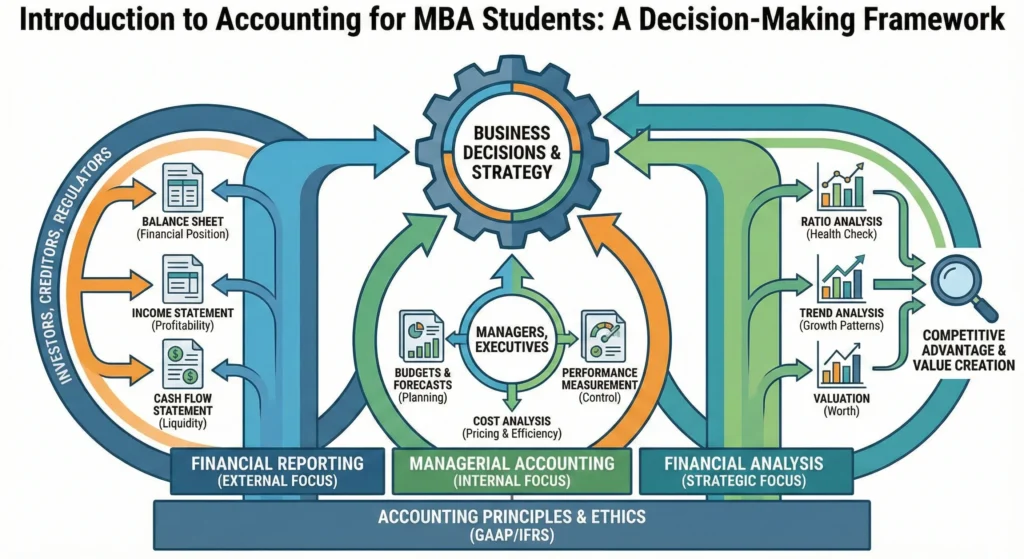
Accounting concepts are fundamental assumptions that guide the recording and reporting of transactions. They act as the foundation upon which principles and methods are built.
Quick Summary:
Basic assumptions that form the foundation of accounting.
Basic Accounting Concepts (Detailed)
1. Business Entity Concept
Business and owner are treated separately. If the owner deposits ₹1 lakh into the business, it is business capital—not the owner’s personal money.
Quick Summary:
Business ≠ Owner.
2. Money Measurement Concept
Only transactions measurable in money are recorded. For example, employee skills or customer satisfaction are important but not recorded in accounts.
Quick Summary:
Record only money-measurable events.
3. Dual Aspect Concept
Every transaction has two effects—one debit and one credit. If you buy furniture for ₹5,000 cash, Furniture increases and Cash decreases. This forms the foundation of the double-entry system.
Quick Summary:
Every transaction has two sides.
4. Going Concern Concept
Assumes the business will continue long-term. This is why assets are recorded at cost and not liquidation value.
Quick Summary:
Business will continue operations.
5. Cost Concept
Assets are recorded at their purchase cost, not market value. Depreciation is charged every year based on this cost.
Quick Summary:
Record assets at cost.
6. Accounting Year Concept
Each business prepares accounts for a specific period—monthly, quarterly, or yearly. This helps measure performance systematically.
Quick Summary:
Accounts prepared for a fixed period.
7. Matching Concept
Revenue of a period must be matched with expenses of the same period. For example, if rent for March is paid in April, it is still recorded in March.
Quick Summary:
Match revenue with expenses.
8. Realization Concept
Revenue is recognized only when goods/services are delivered. If a customer orders a product today but delivery happens next month, revenue is recognized next month.
Quick Summary:
Record revenue when service is delivered.
Meaning of Accounting Conventions
Accounting conventions are practices followed over time to improve the usefulness of financial statements. They fill gaps where principles don’t give strict rules.
Quick Summary:
Common practices used to improve reporting quality.
Basic Accounting Conventions
1. Conservatism
Choose the least optimistic value while recording transactions. For example, if a business expects a loss on a legal case, it must record it even if not yet confirmed.
Quick Summary:
Avoid overstating profits.
2. Consistency
Use the same accounting method across periods. This allows fair comparison of one year’s performance with another.
Quick Summary:
Same method every period.
3. Materiality
Record only information that is significant. For example, losing a pen worth ₹10 need not be recorded individually.
Quick Summary:
Record only important information.
4. Disclosure
Reveal all relevant information—good or bad—to shareholders, creditors, and other users.
Quick Summary:
Be transparent; disclose everything important.