





Exponents can feel a bit like that one friend who over-exaggerates everything. You start with a small number, toss a little superscript on it, and suddenly you’re dealing with values larger than the number of atoms in the observable universe.
But behind the intimidatingly large numbers lies a set of elegant, predictable rules. Once you master these formulas, you aren’t just doing math; you’re shorthand-coding the language of growth.
What Exactly is an Exponent?
Before we dive into the “how,” let’s recap the “what.” An exponent tells you how many times to multiply a number (the base) by itself.
In the expression  :
:
 is the base.
 is the exponent (or power).
So,  isn’t
isn’t  . It’s
  , which equals 81.
The Core Exponent Formulas
Think of these as the “Laws of Physics” for exponents. They allow you to simplify complex expressions without needing a supercomputer.
1. The Product Rule
When you are multiplying two powers with the same base, you simply add the exponents.
Formula:
![\[a^m \cdot a^n = a^{m+n}\]](https://expresswala.in/wp-content/ql-cache/quicklatex.com-c0177b0f4355c91607aa57795c46bbfb_l3.png "Rendered by QuickLaTeX.com")
- Example:

- Why it works:
 is just seven 2s multiplied together.
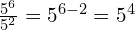
2. The Quotient Rule
When you are dividing two powers with the same base, you subtract the exponent in the denominator from the exponent in the numerator.
Formula:
![\[\frac{a^m}{a^n} = a^{m-n}\]](https://expresswala.in/wp-content/ql-cache/quicklatex.com-6cc00f5bbfa8857d3e5d147baf725829_l3.png "Rendered by QuickLaTeX.com")
- Example:
3. Power of a Power Rule
If you have an exponential expression raised to another power, you multiply the exponents.
Formula:
![\[(a^m)^n = a^{mn}\]](https://expresswala.in/wp-content/ql-cache/quicklatex.com-d7420b247f2ee43c1116531831d2339c_l3.png "Rendered by QuickLaTeX.com")
- Example:

Handling Different Bases and Brackets
Sometimes the base isn’t just a single number. Here is how to distribute the “power.”
4. Power of a Product Rule
If a product is raised to a power, the exponent applies to every factor inside the parentheses.
Formula:
![\[(ab)^n = a^n \cdot b^n\]](https://expresswala.in/wp-content/ql-cache/quicklatex.com-bb3453e8d57e9ba5fac335ec91256c68_l3.png "Rendered by QuickLaTeX.com")
- Example:

5. Power of a Quotient Rule
Similar to the product rule, the exponent applies to both the numerator and the denominator.
Formula:
![\[\left(\frac{a}{b}\right)^n = \frac{a^n}{b^n}\]](https://expresswala.in/wp-content/ql-cache/quicklatex.com-f26853bfcb354a3134321bce048a5014_l3.png "Rendered by QuickLaTeX.com")
The “Special” Cases (Zero and Negatives)
These are the ones that usually trip people up during exams, but they are actually the most consistent.
6. The Zero Exponent Rule
Any non-zero base raised to the power of zero is always 1.
Formula:
![\[a^0 = 1 \text{ (where } a \neq 0)\]](https://expresswala.in/wp-content/ql-cache/quicklatex.com-9112e8d43def51f64fd294556ed59b65_l3.png "Rendered by QuickLaTeX.com")
- Wait, why? Think of the Quotient Rule:
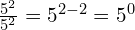 . Since any number divided by itself is 1,
  must be 1.
7. The Negative Exponent Rule
A negative exponent is just a fancy way of saying “I belong on the other side of the fraction line.” It represents the reciprocal.
Formula:
![\[a^{-n} = \frac{1}{a^n}\]](https://expresswala.in/wp-content/ql-cache/quicklatex.com-3e7f14b482c84e08159d32cab63350e4_l3.png "Rendered by QuickLaTeX.com")
Example: 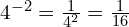
Fractional (Rational) Exponents
When exponents become fractions, they turn into roots. The denominator of the fraction tells you the “index” of the root.
Formula:
![\[a^{\frac{m}{n}} = \sqrt[n]{a^m}\]](https://expresswala.in/wp-content/ql-cache/quicklatex.com-af6b2cbe3d4388f106f5983e9f81389b_l3.png "Rendered by QuickLaTeX.com")
Example: 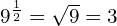
Example: ![8^{\frac{2}{3}} = (\sqrt[3]{8})^2 = 2^2 = 4](https://expresswala.in/wp-content/ql-cache/quicklatex.com-fd354073e919a66d14fff4b6165c5227_l3.png "Rendered by QuickLaTeX.com")
Summary Table for Quick Reference
| Rule Name | Formula | Example |
| Product |  |  |
| Quotient |  |  |
| Power of Power |  |  |
| Zero Power |  |  |
| Negative Power | 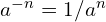 |  |
| Fractional | ![a^{1/n} = \sqrt[n]{a}](https://expresswala.in/wp-content/ql-cache/quicklatex.com-ee37de5a5adee8112c36e6257eb1eb4f_l3.png "Rendered by QuickLaTeX.com") |  |
Pro-Tip: Avoid the “Common Trap”
The biggest mistake students make is trying to use these rules when the bases are different.
Incorrect:
❌
Correct: You just have to calculate them separately (
).
