Operations management (OM) is the planning, organising and controlling of the activities that turn inputs such as people, materials, machines, money and information into the goods and services customers want. Put simply, it is the part of management that answers the practical questions of any organisation: what to produce, how to produce it, how much, when, and at what quality and cost.
The topic matters because operations is where most of an organisation's people, assets and money are used. A company with a good product can still fail if deliveries are late, quality is uneven or costs run out of control. Good operations management turns a business idea into a reliable, efficient system, and it applies equally to a car plant, a hospital, a bank branch, a school or a restaurant.
Meaning and definition
Most textbooks define operations management along these lines: operations management is the design, operation and improvement of the systems that create and deliver an organisation's products and services. A shorter exam definition is that operations management is the process of planning, organising and controlling the activities that transform inputs into goods and services efficiently and effectively.
Three words in these definitions deserve attention:
- Design covers long-term choices such as what product to offer, which process to use, where to locate and how much capacity to build.
- Operation covers day-to-day running: scheduling, inventory, quality checks and maintenance.
- Improvement covers continuous effort to raise productivity, cut waste and serve customers better.
The older term production management was used when the focus was only on factories. "Operations management" is the wider modern term because it includes services as well as manufacturing.
Operations management typically deals with questions such as:
- What should be produced?
- How should it be produced?
- How much should be produced?
- When should it be produced?
- How can quality and cost be controlled?
The input - transformation - output model
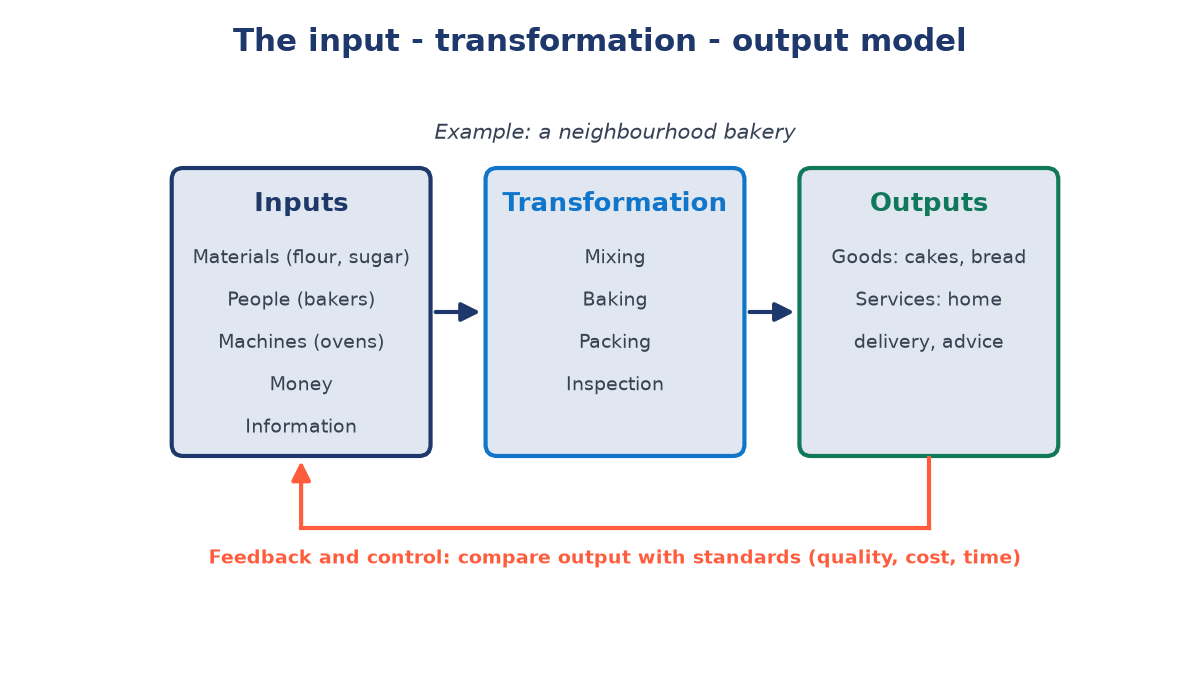
The simplest way to picture operations is as a transformation process. Inputs enter, something is done to them, and outputs leave. Information about the outputs is then fed back so that managers can correct the process.
Inputs
Inputs are the resources an operation uses. They are usually grouped as:
- Transformed resources: materials, information and customers that are changed by the process (flour becomes bread; a patient becomes healthier).
- Transforming resources: people, machines, buildings and money that do the changing but are not themselves the output.
Transformation process
The transformation can be physical (making furniture), locational (a courier moving a parcel), storage (a warehouse), informational (an accountant preparing a tax return) or physiological (a hospital treating a patient). In a bakery, mixing, baking, packing and inspection make up the process.
Outputs
Outputs are goods, services or, most often, a mix of both. The bakery produces cakes and bread (goods) and may also offer home delivery and advice on custom orders (services).
Feedback and control
Actual output is measured against standards for quality, cost and time. If loaves come out under-weight, or orders are late, managers adjust inputs or the process. This loop is what turns a one-off activity into a managed system.
Why operations management is important
Operations management helps an organisation to:
- reduce cost by cutting waste, idle time and excess stock;
- improve quality so that products and services meet specifications every time;
- save time and deliver faster;
- use resources properly, including labour, machines, space and capital;
- satisfy customers through reliable, flexible service;
- increase profit and build a competitive advantage that rivals find hard to copy.
Because operations usually accounts for the largest share of an organisation's costs and staff, even a small percentage improvement in productivity can have a large effect on profit.
Objectives of operations management
The overall aim is often summarised as providing the right product or service, in the right quantity, at the right time, with the right quality, at the right cost. Slack and colleagues express this as five performance objectives:
| Objective | Meaning | Bakery example |
|---|---|---|
| Quality | Doing things right, meeting specifications | Every cake has the correct weight and taste |
| Speed | Doing things fast, short lead time | Custom cake ready within 24 hours |
| Dependability | Doing things on time, keeping promises | Orders delivered at the promised hour |
| Flexibility | Being able to change what or how much is made | Switching to eggless cakes on request |
| Cost | Doing things cheaply, low cost per unit | Less wasted batter and electricity |
These objectives often conflict. Very high flexibility, for instance, can raise cost. Part of an operations manager's job is to decide which objectives matter most to the target customers and to trade the others off sensibly.
Main functions (decision areas) of operations management
The work of operations managers can be grouped into ten decision areas. The first few are mainly strategic and long term; the later ones are mainly tactical and short term.
1. Product and service design
Deciding what product or service to offer and what its features will be. Example: a college designs a new MBA specialisation, deciding its courses, duration and intake.
2. Process design
Deciding how the work will be done, including the choice of technology and the type of production system. Example: a hospital decides the sequence of steps for admitting a patient.
3. Capacity planning
Deciding how much output the operation should be able to produce in a period. Example: a factory checks how many units it can make in one day and whether to add a shift.
4. Location and layout
Location is where the facility operates; layout is how machines, departments and people are arranged inside it. Example: a supermarket places billing counters near the exit so that customers flow in one direction.
5. Forecasting
Estimating future demand so that the other decisions rest on a sound basis. Example: a clothing store estimates sales for the festival season.
6. Inventory management
Managing raw materials, work-in-progress and finished goods so that there is enough stock without tying up too much money. Example: a restaurant keeps enough vegetables in stock without letting them spoil.
7. Scheduling
Fixing the timing of jobs, workers and machines. Example: a tuition centre schedules batches at different times so that rooms and teachers are not double-booked.
8. Quality management
Making sure the product or service meets standards, through inspection, statistical quality control and continuous improvement. Example: a school monitors teaching quality and gives timely feedback.
9. Maintenance
Keeping equipment and systems in working condition through preventive and breakdown maintenance. Example: a factory services its machines on a fixed schedule.
10. Supply chain management
Managing the flow of materials, information and money from suppliers to final customers. Example: a bookstore obtains books from publishers and delivers them to buyers.
Types of production systems
How an operation is organised depends mainly on its volume and variety. The four classic types, which are frequently asked in exams, are:
| Type | What it means | Volume and variety | Examples |
|---|---|---|---|
| Job production | One product at a time, made to the customer's order | Very low volume, very high variety | Wedding dress, custom furniture |
| Batch production | Products made in groups or lots | Medium volume, medium variety | Bakery items, medicines |
| Mass production | Large-scale standardised products on a line | High volume, low variety | Cars, bottled water |
| Continuous production | Output flows without interruption | Very high volume, very low variety | Oil refinery, cement plant |
Each type is covered in detail in the related article on production systems.
Goods versus services
Operations management applies to both goods and services, but they differ in important ways.
| Basis | Goods | Services |
|---|---|---|
| Nature | Tangible | Intangible |
| Storage | Can be stored as inventory | Cannot usually be stored |
| Timing | Produced before consumption | Produced and consumed together |
| Customer contact | Low; customer rarely enters the factory | High; customer often takes part |
| Quality measurement | Easier, against physical specifications | Harder, depends on perception |
| Examples | Mobile phone, notebook | Teaching, haircut, banking |
In practice most outputs are a bundle. A restaurant meal combines food (a good) with cooking, serving and ambience (services). That is why operations management is not only for factories: it also applies to hospitals, banks, schools, colleges, hotels and transport services.
Productivity, efficiency and effectiveness
Productivity
Productivity is the ratio of output to input. If output rises while input stays the same, productivity improves.
When only one input is used in the denominator (labour-hours, machine-hours) it is called single-factor or partial productivity. When several inputs are combined in money terms it is called multifactor productivity.
Efficiency
Efficiency means doing the work with minimum waste of time, effort and material, often measured as actual output compared with standard or expected output.
Effectiveness
Effectiveness means doing the right work and achieving the intended goals. An operation can be efficient at making a product nobody wants, which is not effective. Good operations management aims for both.
Worked example: measuring productivity
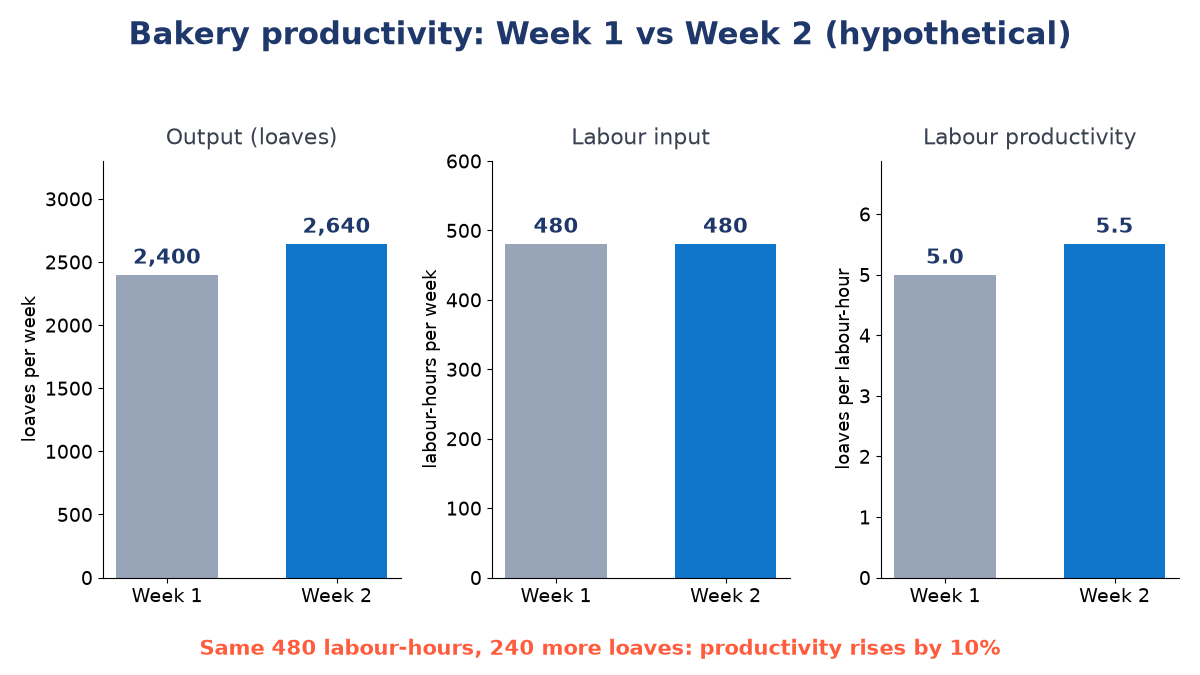
Suppose a small bakery employs 12 bakers, each working 40 hours a week. In Week 1 it bakes 2,400 loaves. In Week 2, after rearranging the work area so that bakers walk less, it bakes 2,640 loaves with the same staff and hours.
Step 1: find the labour input.
Step 2: find labour productivity in each week.
Step 3: find the percentage change.
Step 4: a multifactor measure for Week 2. Suppose Week 2 inputs cost ₹72,000 for labour (480 hours at ₹150 an hour), ₹48,000 for materials and ₹12,000 for energy, a total of ₹1,32,000.
That is 2 loaves for every ₹100 of input. Comparing this figure over time shows whether the bakery is using all its resources better, not just labour.
Operations management in a service: a restaurant
Operations management in a restaurant includes:
- forecasting customer demand for each day and meal;
- buying ingredients in the right quantity;
- scheduling chefs and waiters for busy and quiet hours;
- maintaining food quality and hygiene;
- reducing customer waiting time;
- controlling cost and food waste.
Every one of the ten decision areas appears here in some form, which shows how broad the subject is.
Brief history
Modern operations management grew out of several developments. Adam Smith described the gains from division of labour. Frederick W. Taylor's scientific management (1911) studied work methods and set standard times. Frank Gilbreth developed motion study. Henry Ford's moving assembly line made mass production practical. Walter Shewhart introduced statistical quality control, later extended by W. Edwards Deming. From the 1950s onwards, Toyota's production system gave rise to lean and just-in-time thinking. Today the field also covers supply chains, sustainability and digital technologies.
How to study and write about it
A sensible study order is:
- Meaning and definition
- Objectives
- Input - process - output model
- Functions of operations management
- Types of production
- Goods versus services
- Productivity and efficiency
For a 5-mark answer to "Explain operations management", write the definition, the input - process - output concept, the objectives, the key functions and a short example. For a 2-mark answer, write: operations management is the process of planning, organising and controlling the activities that transform inputs into goods and services efficiently.
Key terms
- Operations management
- The planning, organising and controlling of the processes that convert inputs into goods and services.
- Transformation process
- The set of activities that changes inputs into outputs of higher value.
- Transformed resources
- Materials, information or customers that are changed by the operation.
- Transforming resources
- People, equipment and facilities that carry out the change.
- Productivity
- The ratio of output to input over a period.
- Efficiency
- Achieving output with the least waste of resources.
- Effectiveness
- Achieving the intended goals or doing the right things.
- Performance objectives
- Quality, speed, dependability, flexibility and cost.
Common questions
What is the difference between production management and operations management?
Production management traditionally referred only to manufacturing goods in factories. Operations management is broader: it covers both manufacturing and services such as banking, health care and education, and it includes supply chain and improvement activities.
Is operations management only for factories?
No. Any organisation that converts inputs into outputs has operations. Hospitals, banks, colleges, hotels, airlines and restaurants all make capacity, scheduling, quality and inventory decisions.
What are the five performance objectives?
Quality, speed, dependability, flexibility and cost. They describe what customers value in an operation and what managers try to improve.
How is productivity different from efficiency?
Productivity compares output with input, for example loaves per labour-hour. Efficiency compares actual performance with a standard or expected level. A firm can improve productivity by investing in better machines even if workers' efficiency against standard is unchanged.
Why is feedback part of the transformation model?
Without feedback, managers would not know whether outputs meet standards. Measuring outputs and correcting inputs or processes is what allows control and continuous improvement.
References
- Slack, N., Brandon-Jones, A. and Burgess, N. Operations Management. Pearson.
- Heizer, J., Render, B. and Munson, C. Operations Management: Sustainability and Supply Chain Management. Pearson.
- Stevenson, W. J. Operations Management. McGraw-Hill Education.
- Chary, S. N. Production and Operations Management. McGraw-Hill Education (India).
- Taylor, F. W. (1911) The Principles of Scientific Management. Harper & Brothers.