Material Requirements Planning (MRP) is a planning system that works out what materials and components a factory needs, how much of each it needs and when each must be ordered or made, so that production of finished goods can go ahead on schedule. It starts from the plan for finished products and works backwards to the parts that go into them.
MRP matters because production stops the moment a single part is missing, yet holding large stocks of every part "just in case" ties up money and space. MRP tries to give the shop floor the right material at the right time while keeping inventory as low as the plan allows. The approach was set out in detail by Joseph Orlicky and is now built into almost every ERP package used by manufacturers.
Meaning and objectives of MRP
In simple words, MRP is a planning system for materials. Suppose a factory wants to make 100 tables. It needs wood, screws, glue, polish and packing material, and it must know how much of each is required, how much is already in the store, how much must be bought and when the orders must go out. The system that answers these questions systematically is MRP.
The three questions MRP answers
- What is needed? The list of items, taken from the bill of materials.
- How much is needed? The net quantity after allowing for stock already held or on order.
- When is it needed? The date each order must be released, found by offsetting lead time.
Main objective
The main objective of MRP is to ensure that materials are available for production when needed, while avoiding unnecessary excess inventory. It balances two risks: shortage on one side and excess stock on the other. Supporting objectives are:
- timely availability of materials and components;
- lower inventory levels and carrying cost;
- smoother workflow with fewer delays and fewer emergency purchases;
- clear purchase and work order plans;
- better coordination between production, purchase and stores.
Why MRP is needed
When material planning is poor, production may stop, machines stand idle, workers wait, customer orders are delayed, emergency purchasing raises cost and, paradoxically, too much of the wrong inventory piles up. Consider a bakery preparing 1,000 cake boxes for a festival week. It needs flour, sugar, eggs, butter and boxes. If it does not calculate total requirements, subtract what is in stock and time the deliveries, ingredients may run out mid-production while other items spoil on the shelf. MRP is the discipline that prevents this.
Independent and dependent demand
The basic idea behind MRP is dependent demand thinking: start with the finished product requirement and calculate the requirement for everything that goes into it.
Independent demand
Independent demand is demand for the final product, which comes from customers and must be forecast. Example: customers want 500 bicycles next month.
Dependent demand
Dependent demand is demand for parts and materials that is derived from the plan for the final product. If one bicycle needs 2 wheels, 1 frame and 1 handle, then 500 bicycles need 1,000 wheels, 500 frames and 500 handles. Nobody needs to forecast wheels; they can be calculated. MRP deals mainly with dependent demand, whereas techniques such as EOQ and reorder point were designed for independent demand items.
| Basis | Independent demand | Dependent demand |
|---|---|---|
| Source | Customers and the market | Plan for the parent product |
| How it is found | Forecasting | Calculation from the BOM |
| Pattern | Fairly continuous | Lumpy, in batches |
| Typical technique | EOQ, reorder point | MRP |
| Example | Finished bicycles | Wheels, frames, spokes |
Inputs of MRP
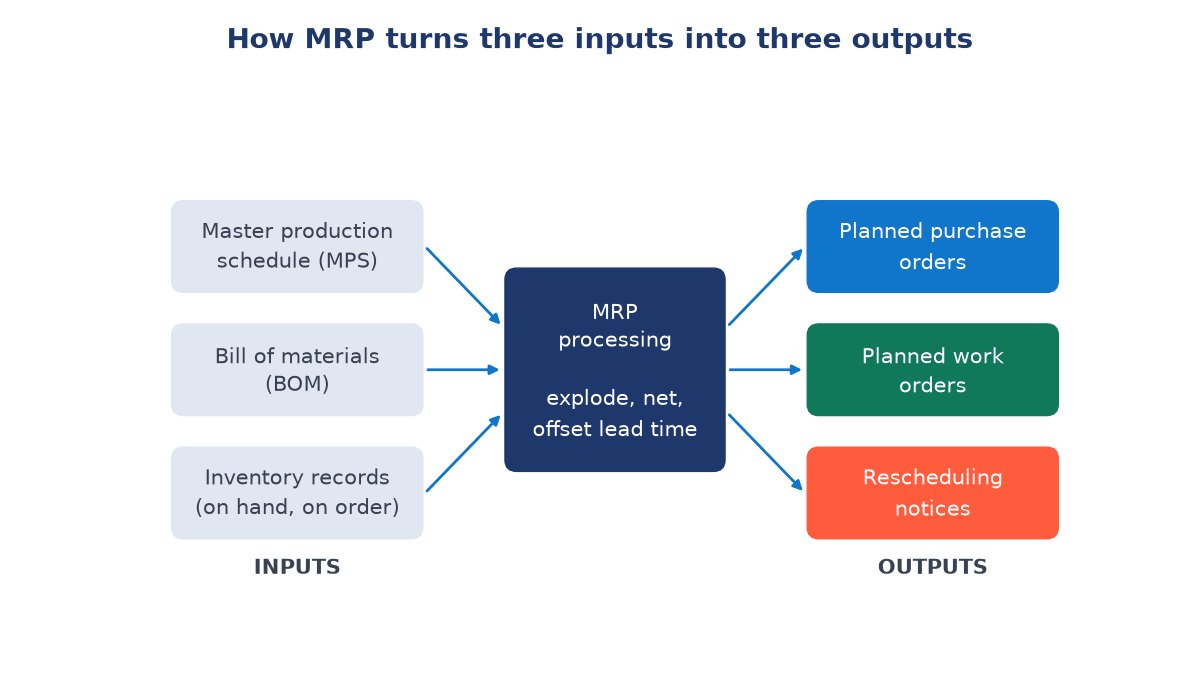
MRP works on three core inputs: the Master Production Schedule, the Bill of Materials and Inventory Records. A frequent objective-type question lists "product packaging plan" as an option; it is not an input of MRP.
Master Production Schedule (MPS)
The MPS states which finished products will be made, how many and in which time period (usually weeks). For example: week 1, 200 chairs; week 2, 300 chairs; week 3, 250 chairs. The MPS is the starting point of MRP; it tells the system what finished goods the company plans to make. It is itself derived from customer orders, forecasts and the aggregate production plan.
Bill of Materials (BOM)
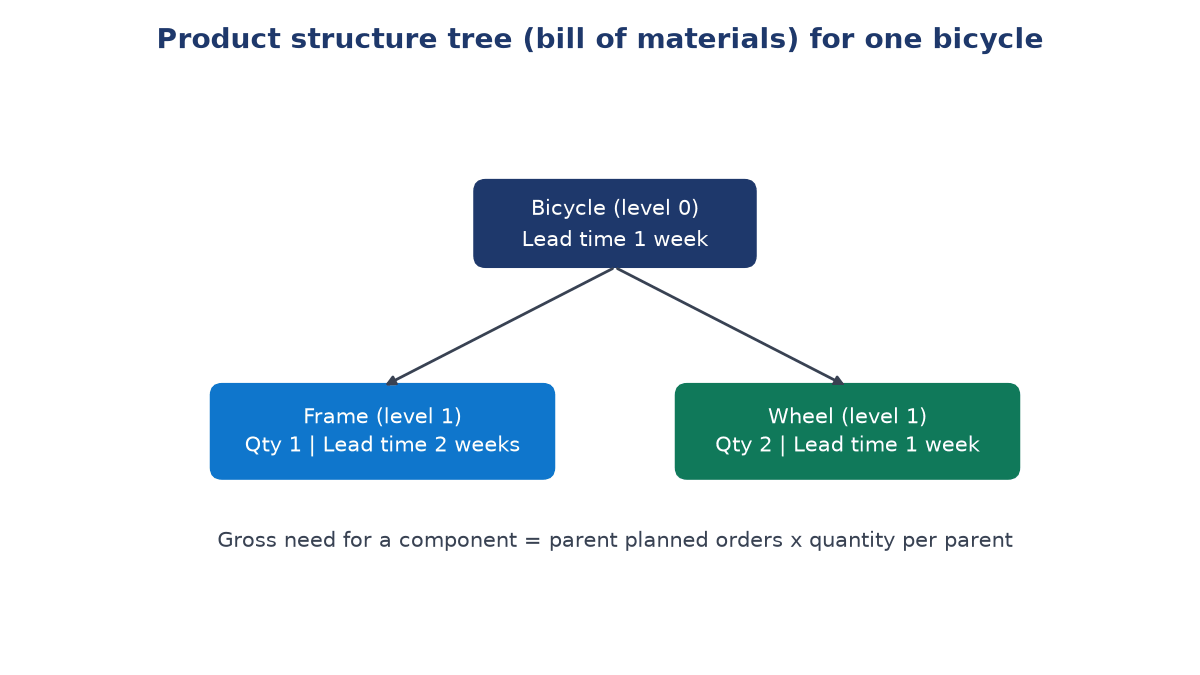
The BOM is a complete list of all parts, sub-assemblies and raw materials needed to make one unit of the finished product, with the quantity of each. For one study table the BOM may list 10 kg of wood, 20 screws, 1 bottle of glue and 1 polish pack; for 100 tables MRP multiplies these to get 1,000 kg of wood, 2,000 screws, 100 bottles of glue and 100 polish packs. When drawn as a diagram, the BOM becomes a product structure tree with the finished product at level 0 and its components at levels 1, 2 and so on.
Inventory records
Inventory records (the inventory status file) show for every item how much is on hand, how much is already on order (scheduled receipts), how much is reserved or allocated to other jobs, and therefore how much is actually free to use. They also hold the lead time, lot-size rule and safety stock of each item. If the company needs 500 handles and 200 are free in stock, it only needs to arrange 300 more.
How MRP works: step by step
- Start with the MPS. Take the quantity and due week of each finished product.
- Explode the BOM. Multiply parent quantities by the quantity per parent to get the gross requirements of each component, level by level.
- Net against inventory. Subtract stock on hand and scheduled receipts to get net requirements.
- Apply a lot-sizing rule. Decide the order quantity, for example lot-for-lot (order exactly the net requirement), fixed order quantity or EOQ.
- Offset for lead time. Move each planned order receipt back by the item's lead time to find the week in which the order must be released.
- Pass requirements down. The planned order releases of a parent become the gross requirements of its children, and the cycle repeats.
The basic netting relationship is:
A negative result simply means no new order is needed in that period. So MRP is not about total need; it is about the actual additional need.
Lead time in MRP
Lead time is the gap between releasing an order (purchase or production) and receiving or completing it. Because materials must arrive before production needs them, MRP uses lead time to fix the release date. If lead time is ignored, orders arrive late, production stops and the schedule fails.
Worked example: MRP netting for a bicycle
Suppose a small bicycle assembler has the product structure shown above. The MPS requires 100 bicycles in week 6 and 150 bicycles in week 8. Lot-for-lot ordering is used and there is no safety stock. Inventory data are:
| Item | Quantity per bicycle | Lead time | On hand | Scheduled receipts |
|---|---|---|---|---|
| Bicycle | — | 1 week | 20 | none |
| Frame | 1 | 2 weeks | 30 | none |
| Wheel | 2 | 1 week | 40 | 50 in week 3 |
Step 1: bicycle (level 0)
Gross requirements are 100 in week 6 and 150 in week 8. The 20 bicycles on hand cover part of week 6:
With a one-week lead time, assembly orders must be released in week 5 (80 units) and week 7 (150 units).
Step 2: frames (level 1)
Each bicycle order release creates a frame requirement in the same week: gross requirements are in week 5 and in week 7.
With a two-week lead time, frame purchase orders are released in week 3 (50) and week 5 (150).
Step 3: wheels (level 1)
Gross requirements are in week 5 and in week 7. Available stock by week 5 is the 40 on hand plus the 50 arriving in week 3, that is 90.
With a one-week lead time, wheel orders are released in week 4 (70) and week 6 (300).
Summary MRP record for wheels
| Week | 1 | 2 | 3 | 4 | 5 | 6 | 7 |
|---|---|---|---|---|---|---|---|
| Gross requirements | 0 | 0 | 0 | 0 | 160 | 0 | 300 |
| Scheduled receipts | 0 | 0 | 50 | 0 | 0 | 0 | 0 |
| Projected on hand (40 at start) | 40 | 40 | 90 | 90 | 0 | 0 | 0 |
| Net requirements | 0 | 0 | 0 | 0 | 70 | 0 | 300 |
| Planned order receipts | 0 | 0 | 0 | 0 | 70 | 0 | 300 |
| Planned order releases | 0 | 0 | 0 | 70 | 0 | 300 | 0 |
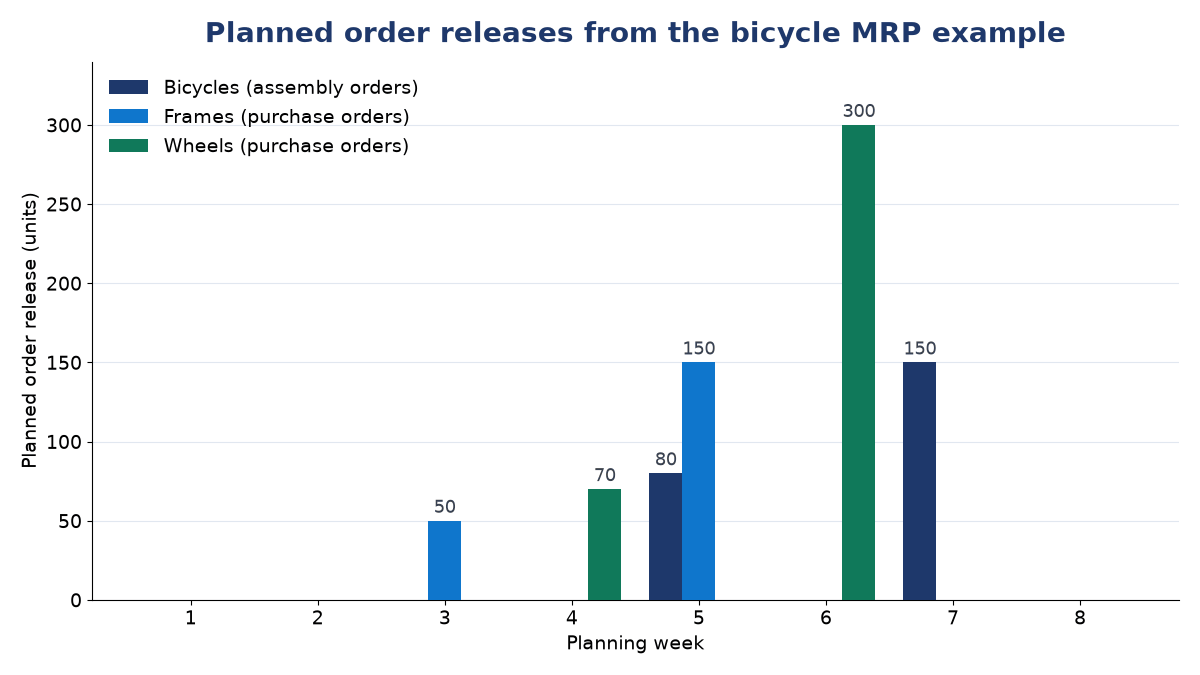
This is the essence of MRP: the purchase department now knows exactly what to buy (frames and wheels), how many (50 and 150 frames; 70 and 300 wheels) and when to place each order.
Outputs of MRP
The primary outputs are planned purchase orders and planned work orders; these two are the output components usually named in exam questions. MRP also generates rescheduling notices.
Purchase orders
Instructions to buy materials from suppliers, for example "buy 1,000 screws, due by next Monday".
Work orders
Instructions to make components internally, for example "produce 500 metal brackets in the machine shop in week 4".
Rescheduling notices
Messages suggesting that an existing order be advanced, delayed, cancelled or changed in quantity because demand or supply has changed.
Secondary outputs
Many systems also produce exception reports (late orders, items below safety stock), planning reports for future inventory needs and performance reports that compare planned with actual lead times and costs.
MRP I and MRP II
MRP I (material requirements planning) focuses only on materials: what, how much and when. MRP II (manufacturing resource planning), developed and popularised by Oliver Wight, widens the scope. It links the material plan with capacity requirements planning, shop-floor control, purchasing, and the financial and marketing plans so that the whole business works from one set of numbers. It also adds "what if" simulation. ERP later extended the same integration to all business functions.
| Basis | MRP I | MRP II |
|---|---|---|
| Full form | Material Requirements Planning | Manufacturing Resource Planning |
| Scope | Materials only | Materials, machines, labour, money |
| Capacity check | No (assumes infinite capacity) | Yes, through capacity requirements planning |
| Users | Production and purchase | Production, finance, marketing, top management |
| Loop | Largely open | Closed loop with feedback |
MRP and other functions
MRP and purchasing
MRP tells purchasing what to buy, how much and when, so buying is based on planned signals rather than guesswork. This improves supplier coordination, order timing and stock control. Ordinary purchasing is often reactive, buying only when a shortage is noticed; MRP is planned and proactive.
MRP and inventory control
Because orders follow actual production needs, MRP avoids overstocking, understocking, random buying and unnecessary storage cost.
MRP and production control
MRP ensures materials are ready according to the production plan. Without it, schedules fail, machines stand idle and delivery dates are missed.
Advantages of MRP
- Better material availability: materials are planned in advance, so shortages fall.
- Lower inventory: items arrive close to when they are used, reducing work-in-progress and raw material stocks.
- Better production planning: material timing is coordinated with the schedule.
- Better purchase planning: buyers get clear, time-phased guidance.
- Better coordination: production, purchase, stores and inventory work from one plan.
- Lower cost: reduced carrying cost, emergency purchase cost, idle machine cost and delay cost.
- Responsiveness: the plan can be re-run quickly when the MPS changes.
Limitations of MRP
- Depends on accurate data: a wrong BOM or wrong stock record gives wrong orders ("garbage in, garbage out").
- Depends on a stable schedule: frequent MPS changes make the plan unstable, a problem called system nervousness.
- Lead time assumptions may fail: unexpected supplier delays can upset the plan.
- Needs coordination and discipline: departments must share accurate, timely information.
- Not enough by itself: basic MRP ignores capacity, and success also depends on labour, machines, maintenance and quality.
- Cost of implementation: software, training and data clean-up require investment.
Conditions for successful MRP
- an accurate and realistic master production schedule;
- a correct, up-to-date bill of materials for every product;
- updated inventory records with high record accuracy;
- reliable lead time data;
- disciplined record keeping and a stable planning system;
- coordination between production, purchase, stores and sales;
- top management support and trained users.
Where MRP is most useful
MRP is especially helpful where products have many components, production is planned in advance in batches, inventory must be controlled carefully and demand for parts depends on the final product. Typical users are automobile makers, furniture factories, electronics assemblers and machinery producers. In a furniture factory with an order for 200 desks, each needing 15 kg of wood, 30 screws and 1 polish pack, MRP calculates 3,000 kg of wood, 6,000 screws and 200 polish packs, subtracts stock, checks the due date, allows for supplier lead times and generates the purchase and work orders. For simple, single-level products with steady demand, reorder point systems may be enough.
Key terms
- Master Production Schedule (MPS)
- A time-phased plan of which finished products will be made, in what quantity and when.
- Bill of Materials (BOM)
- A structured list of all components and quantities required to make one unit of a product.
- Inventory records
- The file showing on-hand stock, scheduled receipts, allocations, lead times and lot sizes for each item.
- Gross requirement
- The total quantity of an item needed in a period before considering available stock.
- Net requirement
- The additional quantity needed after subtracting on-hand stock and scheduled receipts.
- Scheduled receipt
- An order already placed that is due to arrive in a given period.
- Lead time offsetting
- Moving a planned receipt back by the lead time to find when the order must be released.
- Lot-for-lot
- A lot-sizing rule that orders exactly the net requirement of each period.
- Work order
- An internal instruction to produce a component or product.
- Purchase order
- An external instruction to buy material from a supplier.
Common questions
What are the three inputs of MRP?
The master production schedule, the bill of materials and the inventory records. A product packaging plan is not an input.
What are the outputs of MRP?
The main outputs are planned purchase orders and planned work orders, supported by rescheduling notices and exception, planning and performance reports.
Why is MRP suited to dependent demand?
Demand for components can be calculated exactly from the finished product schedule and the BOM, so forecasting each part separately is unnecessary and less accurate.
How is net requirement calculated?
Net requirement equals gross requirement minus on-hand stock minus scheduled receipts, plus any safety stock the firm wants to keep. If the answer is zero or negative, no new order is needed.
What is the difference between MRP I and MRP II?
MRP I plans materials only. MRP II plans all manufacturing resources, adds capacity planning and feedback, and links production with finance and marketing.
What happens if the BOM is wrong?
Every requirement calculated from it will be wrong, leading to shortages of some items and surplus of others. BOM accuracy is therefore a precondition for MRP.
References
- Orlicky, J. (1975) Material Requirements Planning. McGraw-Hill.
- Wight, O. W. (1981) MRP II: Unlocking America's Productivity Potential. CBI Publishing.
- Heizer, J., Render, B. and Munson, C. Operations Management: Sustainability and Supply Chain Management. Pearson.
- Stevenson, W. J. Operations Management. McGraw-Hill Education.
- Chary, S. N. Production and Operations Management. McGraw-Hill Education (India).